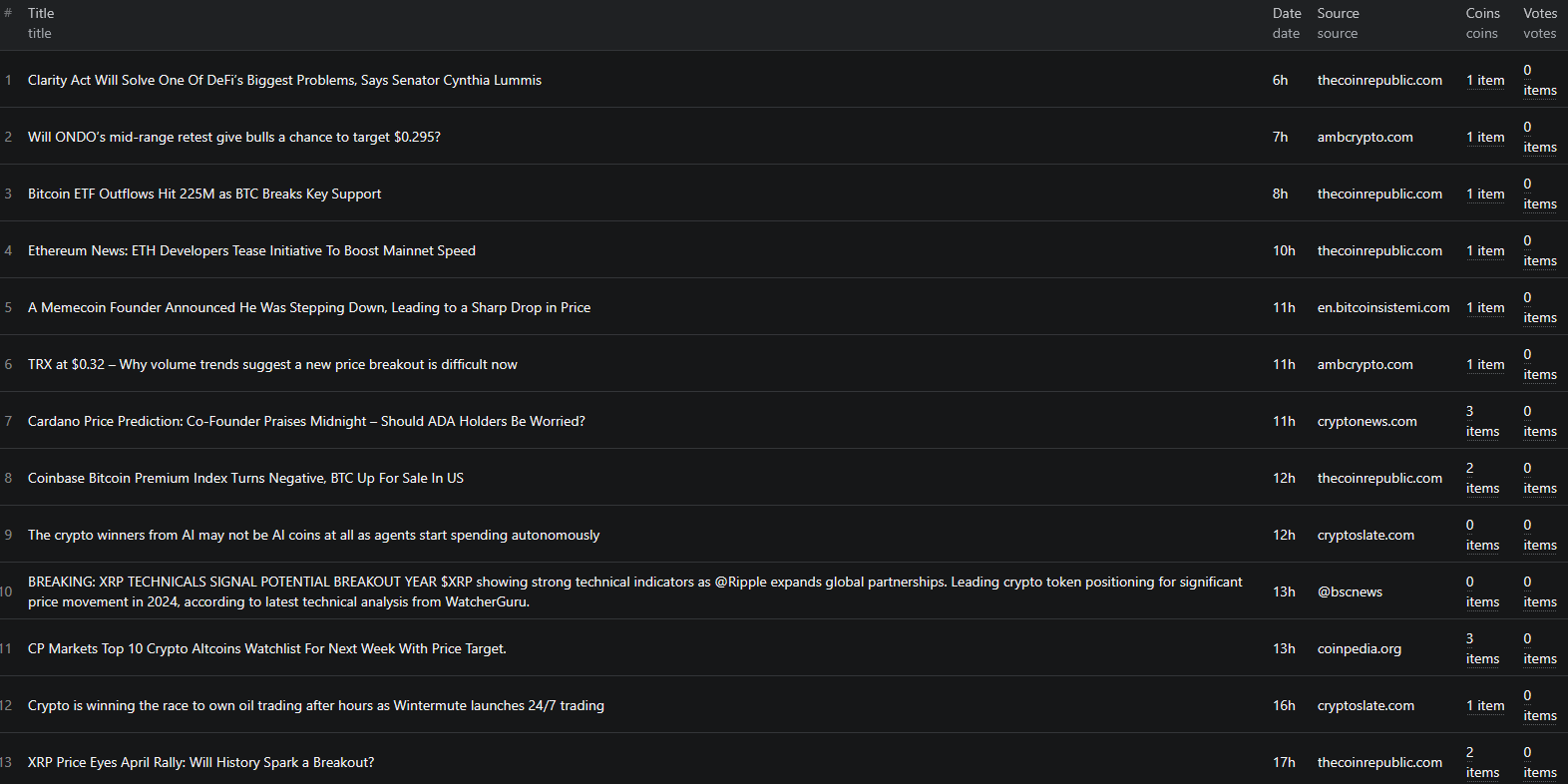
How to Scrape CryptoPanic News for Crypto Sentiment Analysis (Step-by-Step Guide)

If you want to scrape CryptoPanic news for sentiment analysis, market research, or trading signal generation, this guide walks you through the entire process. You will learn what data you can extract, how to automate collection, and how to turn CryptoPanic's community-voted news feed into structured, actionable crypto intelligence.
Why Scrape CryptoPanic News Data?
CryptoPanic is the most widely used crypto news aggregator in the industry. It collects headlines from hundreds of crypto news sources and layers community voting on top — allowing traders, analysts, and researchers to gauge not just what is being said about a coin, but how the community is reacting to it.
The combination of news headlines, coin mentions, and sentiment votes makes CryptoPanic data uniquely valuable:
- Sentiment signals — community votes (positive, negative, important, lol, like, dislike) are a real-time proxy for market sentiment on specific cryptocurrencies
- Event detection — track when a coin starts receiving a surge in news coverage, which often precedes significant price movement
- Trading research — build quantitative models that correlate CryptoPanic sentiment signals with price action across assets
- Market monitoring — track news flow for a specific coin or the broader market to stay ahead of narratives
- Competitive intelligence — monitor which projects are generating the most buzz and how the community is responding
- Academic research — study the relationship between crypto news sentiment and market dynamics, volatility, and adoption
Manually browsing CryptoPanic and recording votes and coin mentions is impractical at any useful frequency. News moves fast in crypto. Automation is the only realistic approach for building a continuous sentiment data feed.
What Data You Can Extract from CryptoPanic
The CryptoPanic News Scraper extracts structured data from the CryptoPanic news feed. Here are the key fields you can collect:
| Field | Description | Example |
|---|---|---|
| Title | The news headline | Bitcoin retreats below $100,000, causing $850 million in crypto liquidations |
| Date | Relative publication time | 4w, 3mon, 2d |
| Coins | Cryptocurrency tickers mentioned in the article | BTC, ETH, LINK |
| Positive votes | Number of positive community votes | 5 positive votes |
| Negative votes | Number of negative community votes | 3 negative votes |
| Important votes | Number of votes marking the article as important | 2 important votes |
| Like votes | Number of like reactions | 4 like votes |
| Dislike votes | Number of dislike reactions | 3 dislike votes |
| Lol votes | Number of lol reactions | 5 lol votes |
| Comments votes | Number of comment interactions | 1 comments votes |
| Source | Domain of the original news article | theblock.co, coindesk.com |
This structured data — especially the vote breakdowns and coin tags — is what makes CryptoPanic uniquely valuable compared to generic news scrapers. Each article comes pre-labeled with which assets it affects and how the community feels about it.
Common Use Cases for CryptoPanic Data
Crypto Sentiment Analysis
CryptoPanic's vote system is a direct expression of community sentiment on crypto news. Positive and negative votes, combined with like/dislike ratios, give you a quantified sentiment score for each article — and by extension, for each coin mentioned.
Aggregate these signals at the coin level to build sentiment indices. Track how sentiment for BTC, ETH, or any altcoin shifts over time, how it responds to market events, and whether it leads or lags price movements. This is one of the most actionable datasets for sentiment-driven trading research.
Trading Signal Generation
Many quantitative trading strategies incorporate news sentiment as an input signal. CryptoPanic data provides a high-frequency, community-validated sentiment stream that can be fed into signal generation pipelines.
Correlate positive vote surges with price action to identify predictive patterns. Detect when a coin transitions from negative to positive sentiment momentum. Use the "important" vote count as a filter for high-signal articles versus noise.
Market Narrative Monitoring
Crypto markets are narrative-driven. The story the community is telling about a coin — DeFi summer, the Bitcoin ETF, Layer 2 adoption — shapes buying and selling behavior. CryptoPanic data lets you track which narratives are gaining traction in real time.
Monitor which coin tickers appear most frequently in headlines. Track how the ratio of positive to negative coverage shifts over time. Identify which news sources are driving the most engagement on specific topics.
Event Detection and Alerting
Sudden spikes in CryptoPanic coverage for a specific coin are often an early indicator that something significant is happening — a hack, a partnership announcement, a regulatory development, or a whale movement. Automated scraping lets you detect these spikes as they happen rather than hours later.
Build alerting systems that trigger when a coin's news volume or vote count crosses a threshold. This is valuable for both traders who need to react quickly and risk managers who need to stay aware of developing situations.
Research and Backtesting
Academic researchers and quantitative analysts use CryptoPanic data to study the relationship between news sentiment and market behavior. Historical CryptoPanic data is a valuable input for backtesting sentiment-based trading strategies, building NLP models trained on crypto-specific language, and studying information diffusion in crypto markets.
Source Quality Assessment
The source domain field lets you analyze which news publishers drive the most community engagement on CryptoPanic. Identify which sources consistently generate high vote counts, which skew positive versus negative, and which cover specific assets most heavily. This helps filter signal from noise in downstream analysis.
Challenges of Collecting CryptoPanic Data Manually
Before jumping into the tutorial, it is worth understanding why automating CryptoPanic data collection matters:
- Velocity — crypto news moves fast. Dozens of articles can appear within an hour during active market periods. Manual checking captures only a snapshot
- Vote decay — community votes accumulate quickly after publication and then slow down. To capture vote signals at meaningful resolution, you need frequent collection, not just daily snapshots
- Volume — CryptoPanic aggregates hundreds of sources. Tracking all of them manually across multiple filter combinations is infeasible
- Coin tagging — the coin ticker associations on each article are particularly valuable and not available from raw news feeds. Extracting them consistently requires structured parsing
- Historical depth — building a useful sentiment dataset requires collecting consistently over weeks and months. Manual collection at that cadence is not sustainable
Step-by-Step: How to Scrape CryptoPanic News
Here is how to scrape CryptoPanic news data using the CryptoPanic News Scraper on Apify.
Step 1 — Choose Your Categories and Filters
CryptoPanic organizes its news feed by category and provides filters to narrow down the news type. Decide what slice of the CryptoPanic feed you want to target:
- Categories — news, media, and other content types available on CryptoPanic
- Filters — hot, rising, bullish, bearish, important, saved, lol — these mirror CryptoPanic's built-in feed filters and let you target specific sentiment segments
For sentiment analysis, collecting across multiple filter combinations gives you a broader signal. For focused monitoring, narrow filters help reduce noise.
Step 2 — Configure the Scraper Input
Head to the CryptoPanic News Scraper on Apify and configure your run:
- Select the news categories you want to collect
- Apply any filters to narrow the feed (hot, bullish, bearish, important, etc.)
- Click Start to begin the extraction
The scraper queries CryptoPanic and returns all matching articles with their full vote breakdowns and coin tag data.
Step 3 — Run the Scraper
Once started, the scraper will:
- Query CryptoPanic with your selected categories and filters
- Extract structured news data including headlines, dates, vote breakdowns, and coin mentions
- Return results in a clean, structured dataset
Runs are fast — CryptoPanic's news feed is paginated and the scraper collects results efficiently.
Step 4 — Export Structured Results
Once the scraper finishes, export your results in your preferred format:
- JSON — ideal for developers building sentiment pipelines, trading signal systems, or data integrations
- CSV — perfect for analysis in Excel or Google Sheets, or importing into a database
- API — access results programmatically via the Apify API for automated workflows
Each record includes the full structured fields: headline, date, coin tickers, vote breakdown by type, and source domain.
Ready to try it? Run the CryptoPanic News Scraper on Apify and get your first dataset in minutes.
Example Output (Real Data Preview)

Here is what the actual output looks like from the CryptoPanic News Scraper. Each article returns a structured JSON object:
[
{
"title": "Bitcoin retreats below $100,000, causing $850 million in crypto liquidations over past day",
"date": "4w",
"coins": ["BTC"],
"votes": [
"5 positive votes",
"2 important votes",
"1 comments votes",
"2 like votes",
"1 lol votes"
],
"source": "theblock.co"
},
{
"title": "Trump-Backed World Liberty Financial Acquires $12M in ETH, LINK, AAVE",
"date": "3mon",
"coins": ["ETH", "USDC", "LINK"],
"votes": [
"4 positive votes",
"3 negative votes",
"2 important votes",
"5 lol votes",
"4 like votes",
"3 dislike votes"
],
"source": "daily.shib.io"
}
]
Key things to notice:
- Coin tickers — the
coinsarray gives you pre-labeled asset associations for every article. No NLP required to know which coins a story affects - Granular vote breakdown — votes are split into six reaction types (positive, negative, important, lol, like, dislike), not just a single sentiment score. This allows nuanced sentiment modeling
- Multi-coin articles — the second example tags ETH, USDC, and LINK simultaneously, reflecting real-world stories that affect multiple assets at once
- Source domain — the
sourcefield lets you filter by publisher or analyze which outlets drive the most community engagement for specific coins - Relative dates — dates are returned as relative timestamps (4w, 3mon) matching CryptoPanic's display format
This structured output is ready to feed directly into sentiment analysis pipelines, trading signal systems, or time-series databases.
Try the CryptoPanic News Scraper now — no coding required.
Automating CryptoPanic Data Collection
For ongoing sentiment monitoring or signal generation, you need continuous data collection, not one-off runs. The Apify platform supports full automation:
Scheduled Runs
Set up recurring scrapes on any schedule — hourly, daily, or weekly. The scraper runs automatically and appends results to a persistent dataset you can access at any time. For trading signal use cases, frequent runs (hourly or every few hours) ensure you capture vote accumulation and news velocity patterns. For broader research, daily runs provide a solid baseline.
API Integration
Use the Apify API to trigger scraper runs programmatically and retrieve results. This lets you integrate CryptoPanic data into your existing workflows:
- Feed fresh sentiment data into your trading strategy or signal engine automatically
- Trigger alerts when specific coins appear in a surge of news articles
- Build dashboards showing real-time sentiment trends across the crypto market
- Connect to tools like Zapier, Make, or custom data pipelines
Sentiment Monitoring Pipelines
Combine scheduled CryptoPanic scraping with coin-level aggregation to build continuous sentiment dashboards. Track rolling sentiment scores for BTC, ETH, and altcoins. Alert on sentiment reversals — when a coin transitions from predominantly negative to positive coverage, or when "important" vote counts spike.
Node.js Example
For a complete working example showing how to call this scraper from Node.js, see the GitHub repository.
Webhooks
Configure webhooks to get notified when a scraper run completes. This enables event-driven architectures where fresh CryptoPanic data triggers downstream processing — sentiment scoring, alert evaluation, or database updates — immediately rather than on a polling schedule.
Using CryptoPanic Data for Sentiment Modeling
CryptoPanic's vote structure is well-suited for building quantitative sentiment features.
Building Sentiment Scores
A simple but effective sentiment score for each article can be derived from the vote breakdown:
- Bullish signal = positive votes + like votes
- Bearish signal = negative votes + dislike votes
- Importance weight = important votes (use to weight high-signal articles)
- Noise indicator = lol votes (use to discount low-credibility articles)
Normalize by total vote count to get a sentiment ratio per article, then aggregate at the coin level across a time window.
Coin-Level Sentiment Aggregation
Group articles by coin ticker and aggregate sentiment scores over rolling time windows — 1 hour, 4 hours, 24 hours. Track how sentiment evolves for individual assets. A rising positive ratio combined with increasing article volume is a notable signal worth monitoring in your models.
Cross-Source Analysis
Use the source field to filter by publication quality. High-credibility outlets like CoinDesk, The Block, and Decrypt may carry different signal value than smaller blogs. Building source-weighted sentiment scores can improve the signal-to-noise ratio of your models.
NLP Enhancement
The headline text combined with coin tags provides a labeled dataset for crypto-specific NLP. Train classifiers to predict vote outcomes from headline language alone, or build models that identify sentiment patterns specific to crypto market events.
Does CryptoPanic Offer an API?
CryptoPanic has a free API, but it comes with meaningful limitations:
Rate Limits and Access Restrictions
The free CryptoPanic API has strict rate limits that constrain how frequently you can pull data. For high-cadence sentiment monitoring — which is where CryptoPanic data is most valuable — these limits become a bottleneck quickly.
Limited Filter and Vote Access
Some filtering options and vote breakdown granularity available on the website are not fully accessible through the free API tier. Accessing the full range of community reaction data requires either a paid API plan or a scraper.
The Practical Alternative
For teams that need flexible, high-volume access to CryptoPanic data, the CryptoPanic News Scraper provides full access to the public news feed with complete vote breakdowns and category filtering — without API rate limit concerns.
Why Use a Pre-Built CryptoPanic Scraper
Building your own CryptoPanic scraper has more hidden complexity than it might seem:
- Vote data parsing — vote counts are displayed in a non-trivial format that requires careful extraction to get all six vote types accurately
- Coin tag extraction — coin ticker associations are rendered dynamically and require structured parsing to collect reliably
- Rate limit management — scraping at high frequency without triggering blocks requires thoughtful request pacing and session management
- Filter handling — replicating CryptoPanic's filter combinations in a scraper requires understanding the URL and request structure for each filter type
- Maintenance — CryptoPanic updates its frontend periodically, breaking custom scrapers that rely on specific selectors or request formats
- Opportunity cost — time spent building scraper infrastructure is time not spent building the sentiment models and signals that actually generate value
A maintained, pre-built solution lets you skip straight to the analysis.
Try the CryptoPanic News Scraper
The CryptoPanic News Scraper extracts structured data from CryptoPanic's news feed — headlines, publication dates, community vote breakdowns, coin mentions, and source domains.
What you get:
- Structured JSON or CSV output ready for analysis
- Full vote breakdown across all six reaction types
- Coin ticker associations pre-labeled on every article
- Category and filter selection matching CryptoPanic's feed options
- Scheduled runs for continuous sentiment monitoring
- API access for integration into trading and analytics workflows
- No coding or scraper maintenance required
Start scraping CryptoPanic now — your first run takes less than 5 minutes to set up.
If you are building a comprehensive crypto intelligence pipeline, combine CryptoPanic sentiment data with on-chain data sources and price feeds to build multi-signal models that go beyond pure news sentiment.
Legal and Ethical Considerations
Web scraping occupies a well-established legal space, but responsible practice matters:
- Public data only — the CryptoPanic News Scraper extracts publicly visible news data that anyone can see by visiting CryptoPanic. No login or authentication is required
- Responsible use — use the data for legitimate purposes such as market research, sentiment analysis, and trading research
- Respect rate limits — the scraper is designed to make requests at a reasonable pace to avoid overloading CryptoPanic's servers
- No financial advice — sentiment data from CryptoPanic is one input signal among many. It should not be the sole basis for financial decisions
Frequently Asked Questions
Is scraping CryptoPanic legal?
Scraping publicly available news data from CryptoPanic is generally legal. The headlines, votes, and coin mentions are visible to anyone who visits the site without logging in. However, you should always use the data responsibly and avoid overloading CryptoPanic's servers with excessive requests.
Does CryptoPanic offer an API?
CryptoPanic offers a limited free API, but it has rate limits and restricted access to vote data and filtering options. For high-volume extraction or full access to all filters and vote breakdowns, a scraper provides more flexibility and coverage.
What data can be extracted from CryptoPanic?
You can extract news headlines, publication dates, vote breakdowns (positive, negative, important, lol, like, dislike, comments), affected cryptocurrencies (coin tickers), and source domain for each article.
Can I filter CryptoPanic news by category or cryptocurrency?
Yes. The CryptoPanic News Scraper supports filtering by news category and other available CryptoPanic filters, allowing you to target specific segments of the crypto news feed.
Can I use CryptoPanic data for sentiment analysis?
Yes. The vote breakdown data — positive, negative, important, lol, like, and dislike counts — is a direct community sentiment signal. Combined with headline text and coin mentions, CryptoPanic data is well-suited for building crypto sentiment models and trading signal pipelines.
Can I export CryptoPanic news to CSV?
Yes. The CryptoPanic News Scraper supports exporting results as JSON, CSV, or via API. CSV exports can be opened directly in Excel or Google Sheets for analysis.
About the Author
This guide was written by Piotr, a software engineer with hands-on experience building and maintaining web scrapers at scale. He develops and maintains a suite of data extraction tools on the Apify platform, helping businesses automate their data collection workflows.
Need help with your scraping project?
Book a free discovery call and let's scope your project together.
Book a Call