Piotr VassevPiotr Vassev

How to Scrape Coupang Product Listings (Step-by-Step Guide)

How to Scrape Coupang Product Listings

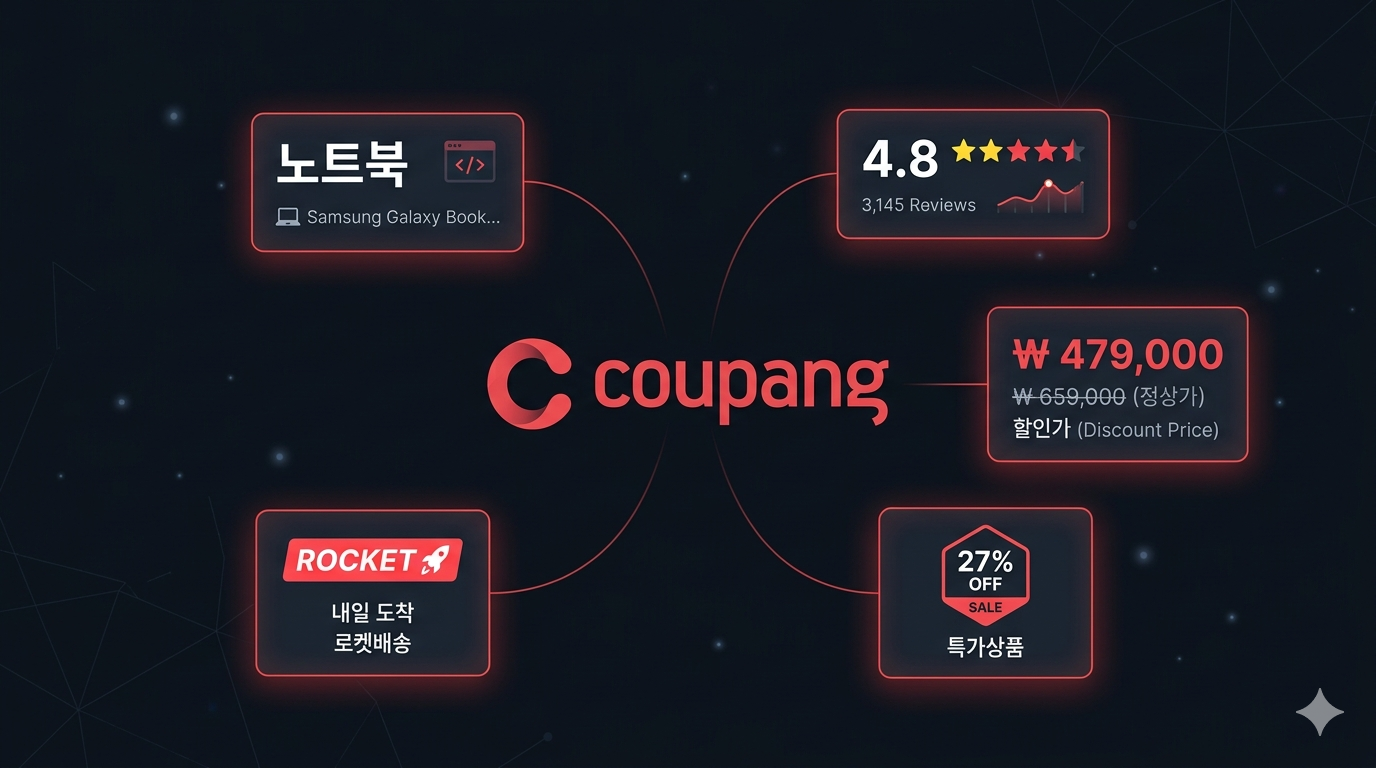
If you want to scrape Coupang product listings for price monitoring, market research, or competitor analysis in the Korean market, this guide walks you through the entire process. You will learn what data you can extract from Coupang search and category pages, how to handle Korean geo-gating and bot protection, and how to turn raw listings into actionable Korean e-commerce intelligence — including Rocket Delivery badges, cashback, and discount rates.

Why Scrape Coupang Data?

Coupang is South Korea's largest e-commerce platform and the dominant force in Korean online retail. Often described as "the Amazon of Korea," Coupang has built an aggressive vertical-stack moat around its Rocket Delivery (로켓배송) same-day and next-day fulfillment network, owning warehouses, last-mile logistics, and an enormous own-brand catalog. For anyone selling into Korea, sourcing from Korea, or studying Korean consumer behavior, Coupang is the single highest-signal public dataset available.

What makes Coupang particularly valuable as a data source is the depth of structured information surfaced on every search and category page: sale price and original price in KRW, a clean discount percentage, cashback amount, star rating, review count, the product's organic rank on the page, and the full set of Rocket badges that signal how the product is fulfilled. Combined, these fields tell you not just what a product costs — but how it competes within Coupang's unique logistics-driven retail model.

Businesses and researchers scrape Coupang data for a range of purposes:

  • Korean price intelligence — track KRW sale prices, original prices, and discount rates across an entire category in real time
  • Cashback-adjusted pricing — compute the effective price (salesPrice - cashback) that Korean shoppers actually compare against
  • Rocket vs. third-party share analysis — understand how much of a category is owned by Coupang's own Rocket-fulfilled inventory vs. marketplace sellers
  • Rank tracking — monitor how your product or a competitor's product ranks on key Korean search terms over time
  • Catalog & assortment research — map the full assortment for a category by brand, price band, and rating
  • Cross-marketplace comparison — pair Coupang data with Rakuten Japan or other Asian marketplaces to spot regional pricing gaps

Manually browsing Coupang and copy-pasting product details is impractical at any meaningful scale — a single category like 노트북 (laptops) spans thousands of SKUs across dozens of pages, and prices change continuously during Coupang's near-daily promotional cycles. Automation is the only realistic approach.

What Data You Can Extract from Coupang

The Coupang Listings Scraper extracts structured product data from any Coupang search query, category URL, or direct product URL. Here are the key fields available:

FieldDescriptionExample
Product IDCoupang's unique product identifier8036829511
Item IDItem-level identifier within the product22489515360
Vendor item IDVendor-specific listing identifier89564765549
TitleFull Korean product title[삼성전자 공식파트너] 갤럭시북Go NT345XPA-K14AS
Sales priceCurrent selling price in KRW479000
Original priceList price before discount in KRW659000
Discount rateDiscount off original price (%)27
CashbackCoupang cashback amount in KRW23950
RatingAverage star rating (0–5)5
Rating countTotal number of reviews1377
Rocket flagsRocket, Rocket Fresh, Rocket Merchant, OverseasisRocket: true
Sold outWhether the product is currently out of stockfalse
Ad flagWhether the listing is a sponsored placementfalse
RankOrganic position within the result set1
BadgesStructured badge array (ROCKET, TOMORROW, etc.)["ROCKET", "TOMORROW"]
Image URLProduct image via Coupang's CDNthumbnail.coupangcdn.com/...
SourceWhere the record came from (search, url, pdp)search
Product URLDirect link to the product detail pagecoupang.com/vp/products/...

Every record also carries the originating searchTerm (when applicable) and pageNumber, so you can deduplicate and audit your dataset cleanly.

Common Use Cases for Coupang Data

Korean Price Monitoring

Coupang's pricing is unusually transparent — every listing carries both the original price and the sale price, a clean discount percentage, and a cashback amount. Scraping these fields on a schedule lets you build a real-time view of how aggressively competitors are discounting and how prices move during Coupang's frequent promotion events.

Cashback-Adjusted Pricing

Korean shoppers do not just look at the sticker price — they look at the effective price after Coupang Cash and cashback rewards. A ₩50,000 product with ₩5,000 cashback is meaningfully cheaper than a ₩47,000 product with zero cashback for a regular Coupang user. Extracting cashback as structured data lets you model the real price Korean buyers compare against.

Rocket Share Analysis

The isRocket, isRocketFresh, and isRocketMerchant flags break down Coupang's logistics tiers. Aggregating these over a category tells you how much of that category is owned by Coupang's own fulfillment vs. third-party marketplace sellers — one of the most important strategic signals in the Korean e-commerce market.

Rank & Sponsored Tracking

The rank field captures the organic position of every product on the page, and the isAd flag distinguishes sponsored placements from organic ones. Together they let you monitor how your product (or a competitor's) ranks for key Korean search terms over time, and how much of the page is sold to sponsored inventory.

Catalog & Assortment Analysis

A single Coupang category URL (e.g. /np/categories/186764) covers thousands of SKUs across every major brand. Scraping the category lets you map the full assortment by brand, price band, and rating — and identify gaps in your own catalog relative to what sells on Korea's largest marketplace.

Cross-Border Comparison

Pair Coupang data with Rakuten Japan or 1688.com on the same SKUs to spot regional pricing gaps and identify cross-border arbitrage. The Korean market often prices imported electronics very differently from Japan or China, and surfacing those differences is straightforward once the data is structured.

Challenges of Scraping Coupang Manually

Before jumping into the tutorial, it is worth understanding why building your own Coupang scraper is harder than it looks:

  • Korean geo-gating — many Coupang endpoints are partially or fully restricted to Korean IPs. Requests from outside Korea routinely receive challenge pages or empty results
  • Aggressive bot protection — Coupang applies sophisticated anti-bot defenses including TLS fingerprinting, request rate limits, and behavioral challenges
  • Sponsored vs. organic placements — Coupang injects sponsored cards throughout search results that can duplicate organic listings. Naïve scrapers either double-count or lose rank-tracking accuracy
  • Korean character handling — search terms, titles, and category names are in Hangul. Naïve scrapers often mangle Korean text or fail to URL-encode queries correctly
  • Multiple input shapes — Coupang catalog data lives across keyword search, category pages, and individual PDPs, each with different URL patterns and response structures
  • Rocket badge semantics — there are multiple Rocket variants (Rocket, Rocket Fresh, Rocket Merchant, Rocket Overseas) and they overlap in non-obvious ways. Extracting them correctly requires careful badge parsing
  • Frontend churn — Coupang updates its layout regularly, breaking custom scrapers that are not actively maintained

For most use cases, a pre-built and maintained scraper is dramatically more practical than building one in-house.

Step-by-Step: How to Scrape Coupang Product Listings

Here is how to scrape Coupang product data using the Coupang Listings Scraper on Apify.

Step 1 — Choose Your Input Mode

The scraper supports three input modes that you can mix and match in a single run:

  • Search terms — plain-text keywords like 노트북 or macbook. Each becomes a Coupang search URL behind the scenes
  • Start URLs — any Coupang search or category URL (e.g. https://www.coupang.com/np/categories/186764). Product detail page URLs are auto-detected and routed to the PDP handler
  • Product URLs / IDs — direct PDP URLs or bare numeric product IDs (e.g. 8036829511) to extract a specific product without crawling any listings

Korean keywords return dramatically richer results than English ones. For example, 노트북 returns the full Korean laptop catalog while laptop returns a much narrower slice. Always prefer the native Korean term when one exists.

Step 2 — Configure the Scraper Input

Head to the Coupang Listings Scraper on Apify and configure your run:

  1. Add your searchTerms, startUrls, or productUrls (at least one is required)
  2. Set maxResults to cap the total number of items returned across the whole run (default 50, max 10000)
  3. Leave proxy configuration on its default — the scraper handles Korean geo-gating and bot protection automatically

Example input:

{
    "searchTerms": ["노트북", "맥북"],
    "startUrls": [
        { "url": "https://www.coupang.com/np/categories/186764" }
    ],
    "productUrls": ["8036829511"],
    "maxResults": 100
}

Step 3 — Run the Scraper

Once started, the scraper will:

  • Build search URLs from your Korean and English query terms
  • Walk pagination on search and category pages until maxResults is reached
  • Auto-detect PDP URLs inside startUrls and route them to the product handler
  • Resolve Coupang's CDN image URLs to ready-to-use thumbnails
  • Extract structured Rocket flags, badges, discount rates, and cashback for every product
  • Track each listing's organic rank and sponsored status
  • Stream results to the dataset as they are scraped

Processing time depends on the volume of data requested. Most runs of a few hundred products complete in a couple of minutes.

Step 4 — Export Your Results

When the scraper finishes, export your data in the format you need:

  • JSON — ideal for developers building integrations or price-monitoring pipelines
  • CSV — perfect for spreadsheet analysis or importing into BI tools
  • Excel / HTML — for sharing with non-technical stakeholders
  • API — access results programmatically via the Apify API for automated workflows

Ready to try it? Run the Coupang Listings Scraper on Apify and get your first dataset in minutes.

Example Output (Real Data Preview)

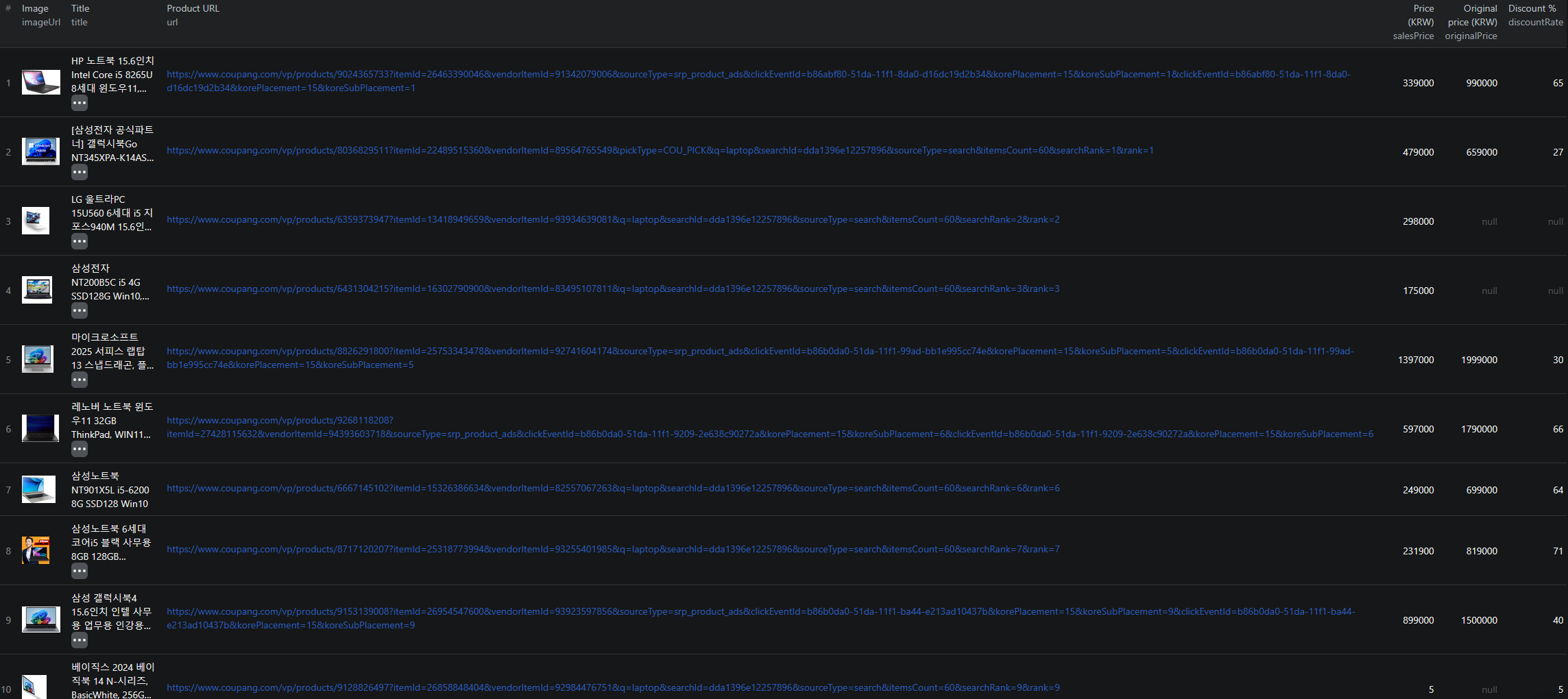
Coupang scraper results

Here is what the actual output looks like. Each product is returned as a structured JSON object:

{
    "productId": "8036829511",
    "itemId": "22489515360",
    "vendorItemId": "89564765549",
    "title": "[삼성전자 공식파트너] 갤럭시북Go NT345XPA-K14AS 윈도우11 14인치 휴대용 가성비 학생용 문서작성 5G LTE",
    "url": "https://www.coupang.com/vp/products/8036829511?itemId=22489515360&vendorItemId=89564765549&rank=1",
    "imageUrl": "https://thumbnail.coupangcdn.com/thumbnails/.../b186976ff535f67b6898.jpg",
    "salesPrice": 479000,
    "originalPrice": 659000,
    "discountRate": 27,
    "cashback": 23950,
    "rating": 5,
    "ratingCount": 1377,
    "isRocket": true,
    "isRocketFresh": false,
    "isRocketMerchant": false,
    "isOverseas": false,
    "isSoldOut": false,
    "isAd": false,
    "rank": 1,
    "badges": ["ROCKET", "TOMORROW"],
    "source": "search",
    "searchTerm": "노트북",
    "pageNumber": 1
}

Key things to notice:

  • Sales price + original price + discount as separate fieldssalesPrice, originalPrice, and discountRate are extracted as numeric fields, ready for analysis
  • Cashback as a first-class field — compute the effective price (salesPrice - cashback) for accurate Korean shopper comparisons
  • Structured Rocket flagsisRocket, isRocketFresh, isRocketMerchant, and isOverseas are typed booleans, not free-text badges
  • Rank tracking — every record carries its organic rank on the page, perfect for SERP-position monitoring
  • Sponsored detection — the isAd flag distinguishes paid placements from organic listings
  • Provenance fieldssource, searchTerm, and pageNumber make it easy to deduplicate and audit your dataset

The same record shape is returned whether the product came from a search query, a category URL, or a direct PDP request — so downstream consumers can treat the dataset uniformly.

Try the Coupang Listings Scraper now — no coding required.

Automating Coupang Data Collection

For ongoing Korean e-commerce intelligence, you do not want to run the scraper manually every time you need fresh data. The Apify platform supports full automation:

Scheduled Runs

Set up recurring scrapes on any schedule — hourly, daily, or weekly. The scraper runs automatically and stores results in a dataset you can access anytime. Hourly runs work well during Coupang's frequent promotion events when prices and Rocket inventory move quickly; daily runs are sufficient for general catalog tracking.

API Integration

Use the Apify API to trigger scraper runs programmatically and retrieve results. This lets you integrate Coupang data into your existing analytics workflows:

  • Feed new listings into your Korean price-monitoring pipeline
  • Trigger alerts when a tracked SKU drops below a target KRW price
  • Sync Coupang catalog data into your BI warehouse
  • Connect to tools like Zapier, Make, or custom data pipelines

Cross-Platform Comparison Pipelines

Pair Coupang data with Rakuten Japan on the same SKUs to compare Korean retail prices against Japanese marketplace prices, or with 1688.com for upstream factory-direct sourcing. Together they give you a full view of the East Asian product economy.

Node.js Example

For a complete working example showing how to call this scraper from Node.js, see the GitHub repository.

Webhooks

Configure webhooks to get notified when a scraper run completes. This is useful for event-driven architectures where you want to process new product data as soon as it is available.

Using Coupang Data for Korean Market Intelligence

The structured data from Coupang unlocks a range of analytical use cases.

Effective-Price Analytics

Use the salesPrice - cashback formula to model what Korean shoppers actually compare. A product with aggressive cashback can outcompete a nominally cheaper rival because the effective price is lower — and Coupang shoppers are highly sensitive to this.

Rocket Mix Analysis

Aggregate isRocket, isRocketFresh, and isRocketMerchant across a category to understand the share of Coupang-fulfilled inventory vs. marketplace inventory. A category with high Rocket share is hard to enter as a third-party seller; a category with low Rocket share is still open for marketplace competition.

Rank & Sponsored Intelligence

Combine rank, isAd, and pageNumber over time to build a Korean SERP-tracking pipeline. You can see exactly where your product ranks for each target keyword, how much of page 1 is sold to sponsored placements, and how competitors are buying their way into top positions.

Discount Cadence Tracking

Coupang runs promotions almost continuously. By scraping discountRate daily, you can quantify how often each SKU hits its peak discount, how long that discount lasts, and which competitors lead vs. lag the category in promotional intensity.

Brand & Price Band Mapping

Scrape every result in a Coupang category and group by brand, price band, and Rocket tier. The result is a clean map of which brands own which price points in the Korean market — useful for competitive positioning, channel strategy, and brand-equity tracking.

Does Coupang Provide an API?

Coupang does not offer a public catalog API. The closest official channel is the Coupang Partners affiliate program, which has serious limitations for data collection:

What's Available

  • The Partners API is restricted to approved affiliate partners
  • It is designed for affiliate marketing rather than catalog research
  • Coverage is limited — only featured categories and a subset of products are exposed
  • The structured Rocket flags, cashback amounts, and ranking data central to competitive analysis are not available

What the API Misses

The official affiliate channel omits exactly the fields that make Coupang data useful: discount-rate decomposition, cashback amounts, the full Rocket badge taxonomy, organic rank, sponsored-vs-organic separation, and marketplace seller data. For real Korean e-commerce intelligence, a public-page scraper is the practical alternative.

The Coupang Listings Scraper gives you structured catalog data from any search query, category URL, or direct product URL — without partner approval or rate-limit gating.

Why Use a Coupang Scraper Instead of Building One

Building a custom Coupang scraper sounds straightforward until you actually start:

  • Korean geo-gating — Coupang restricts many endpoints to Korean IPs. Without proper proxy management, requests from outside Korea silently return empty or challenge pages
  • Bot protection — Coupang applies TLS fingerprinting, rate limits, and behavioral challenges that take real engineering to bypass cleanly
  • Sponsored deduplication — sponsored cards mirror organic listings and have to be deduplicated without losing rank accuracy
  • Rocket badge parsing — the multiple Rocket tiers overlap in non-obvious ways. Mapping them to typed boolean flags requires careful badge analysis
  • Hangul handling — Korean queries have to be URL-encoded correctly, and Korean titles have to survive transport without character corruption
  • Frontend churn — Coupang redesigns parts of its site frequently, and every update breaks unmaintained scrapers
  • Opportunity cost — every hour spent fixing your scraper is an hour not spent on the analysis the scraper exists to support

Unless you have very specific requirements that no existing tool can meet, a maintained scraper lets you focus on insights instead of plumbing.

Try the Coupang Listings Scraper

The Coupang Listings Scraper extracts structured data from Coupang product listings — product IDs, Korean titles, KRW sale and original prices, discount rates, cashback, ratings, review counts, Rocket Delivery badges, organic rank, sponsored flags, and product images.

What you get:

  • Structured JSON, CSV, Excel, or HTML output ready for any downstream tool
  • Three input modes — Korean/English search terms, Coupang search/category URLs, and direct product URLs/IDs — mix and match in a single run
  • Automatic handling of Korean geo-gating and bot protection so listings load reliably from anywhere
  • Structured Rocket Delivery flags (isRocket, isRocketFresh, isRocketMerchant, isOverseas) and badge arrays
  • Per-listing organic rank and isAd flags for SERP-tracking and sponsored-share analysis
  • Up to 10,000 items per run with a hard maxResults cap to control spend
  • Scheduled runs and API access for ongoing Korean market intelligence
  • No coding, no proxy management, no scraper maintenance

Start scraping Coupang now — your first run takes less than 5 minutes to set up.

If you are building an East Asia data pipeline, combine Coupang data with other regional sources like Rakuten Japan for Japanese retail, 1688.com for upstream factory sourcing, or Xianyu for Chinese secondhand resale.

Legal and Ethical Considerations

Web scraping occupies a well-established legal space, but responsible practice matters:

  • Public data only — the Coupang scraper extracts publicly visible product information that anyone can see by visiting coupang.com. No login or authentication is required
  • Respect rate limits — the scraper is designed to make requests at a reasonable pace and handle Coupang's bot protection cleanly without aggressive hammering
  • No misuse — use collected data for legitimate business purposes like price monitoring, catalog research, and competitive analysis. Do not use the data to create counterfeit listings or mislead Korean buyers
  • Compliance — if you handle data from Korean users, ensure your processing complies with South Korea's Personal Information Protection Act (PIPA). The scraper extracts product and listing data, not personal data, but downstream use is your responsibility

Coupang product listings are public marketplace data — they are designed to be found by buyers. Scraping this data for catalog research and price intelligence is aligned with the platform's intended purpose.

Frequently Asked Questions

What is Coupang?

Coupang is South Korea's largest e-commerce platform — often called "the Amazon of Korea." It is dominant in Korean online retail thanks to its Rocket Delivery (로켓배송) same-day and next-day logistics network, aggressive pricing, and a deep catalog spanning groceries, electronics, fashion, and household goods. For anyone tracking the Korean consumer market, Coupang is the single highest-signal public dataset available.

Is scraping Coupang legal?

Scraping publicly available product data from Coupang is generally legal. The product listings are visible to anyone who visits coupang.com without logging in. You should always use the data responsibly, comply with South Korea's Personal Information Protection Act (PIPA), and avoid overloading Coupang's servers with excessive requests.

Does Coupang provide a public API?

No. Coupang does not offer a general-purpose public catalog API. The Coupang Partners affiliate program exposes a limited API for approved partners, but it covers a narrow subset of products and omits the structured Rocket badges, cashback fields, and ranking data that make Coupang data valuable. A web scraper is the practical alternative for catalog research and price monitoring.

Do I need a Korean proxy to scrape Coupang?

Yes — Coupang geo-gates many of its pages and bot-protects requests from outside Korea. The Coupang Listings Scraper handles Korean geo-gating and bot protection automatically so listings load reliably from anywhere. You do not need to configure your own Korean proxy.

Should I search in Korean or English?

Korean. Coupang is built for Korean shoppers and Korean queries return dramatically richer results than their English equivalents. For example, 노트북 returns the full Korean laptop catalog while laptop returns a much narrower slice. Always prefer the native Korean term when one exists — the scraper accepts both.

What are Rocket Delivery (로켓배송) badges and why do they matter?

Rocket Delivery is Coupang's fulfillment-by-Coupang program — products fulfilled from Coupang's own warehouses ship same-day or next-day. The isRocket, isRocketFresh, and isRocketMerchant flags identify which logistics tier a product falls into. Korean shoppers strongly prefer Rocket products, so these flags are a first-class signal in competitive analysis and price comparison.

About the Author

This guide was written by Piotr, a software engineer with hands-on experience building and maintaining web scrapers at scale. He develops and maintains a suite of data extraction tools on the Apify platform, helping businesses automate their data collection workflows.

Need help with your scraping project?

Book a free discovery call and let's scope your project together.

Book a Call
Piotr Vassev

Piotr Vassev

Founder of FalconScrape. Building production-grade web scraping systems and data automation pipelines for businesses worldwide.

Connect on LinkedIn