Piotr VassevPiotr Vassev

How to Scrape Depop Listings and Product Data (Step-by-Step Guide)

How to Scrape Depop Listings and Product Data

If you want to scrape Depop listings and product data for resale market research, price monitoring, or inventory analysis, this guide walks you through the entire process. You will learn what data you can extract from one of the world's fastest-growing secondhand fashion marketplaces, how to automate the collection, and how to turn raw Depop listings into actionable resale intelligence.

Why Scrape Depop Data?

Depop is one of the most popular peer-to-peer resale marketplaces for fashion and apparel, with a particularly strong following among Gen Z buyers and sellers. It spans categories from streetwear and vintage to designer pieces and everyday clothing — making it a rich data source for tracking resale trends, brand valuations, and secondhand market demand.

What sets Depop apart is its focus on style-driven, community-led resale. The platform is a leading indicator for what fashion trends are emerging in the secondhand market before they reach mainstream retail. That makes Depop data uniquely valuable for brands, resellers, and market researchers alike.

Businesses and resellers scrape Depop data for several reasons:

  • Price monitoring — track how specific brands, styles, and categories are priced in the resale market
  • Product trend analysis — identify which brands and item types are gaining traction among secondhand fashion shoppers
  • Inventory research — understand what products are widely available and at what price points
  • Competitor analysis — analyze how other sellers price and present similar items
  • Brand tracking — monitor how your brand (or a competitor's) appears in the secondhand market
  • Market intelligence — build datasets for resale market reports and fashion analytics

Manually browsing Depop and copying listing details is completely impractical at scale. A single category page or search query can surface hundreds of listings, and inventory changes constantly. Automation is the only viable approach for meaningful data collection.

What Data You Can Extract from Depop

The Depop Listings Scraper extracts structured data from both category pages and search result pages. Here are the key fields available:

FieldDescriptionExample
URLDirect link to the product listingdepop.com/products/956thriftfindz-blue-polo-assn...
SlugURL-friendly listing identifier956thriftfindz-blue-polo-assn-polo-shirt
PriceCurrent listing price12.30
Original priceOriginal or retail price before markdown25.00
CurrencyCurrency code for the listed priceUSD
SizeProduct sizeM
BrandThe product brandU.S. Polo Assn.
ImagesArray of product image URLsmedia-photos.depop.com/b1/45041112/...
CategoryCategory path for the listingmens/tops/tshirts

This data gives you everything you need to analyze pricing patterns, track brand availability, compare markdowns, and understand what is selling across different fashion categories.

Common Use Cases for Depop Data

Resale Price Monitoring

Knowing current resale prices is fundamental to any buy-and-sell operation. Scrape Depop regularly to build a pricing database for specific brands, item types, and sizes. Compare current prices against original retail values to understand typical resale margins across different categories.

This is especially valuable for resellers sourcing inventory from thrift stores or wholesale — knowing what a specific brand and size commands on Depop before you buy determines whether the deal is profitable.

Fashion Trend Analysis

Depop is a leading indicator of what styles are gaining momentum in the secondhand market. What brands are being listed in high volumes? Which item types are commanding premium prices relative to their category? Which vintage or retro styles are seeing increased demand?

By scraping Depop at scale and tracking changes over time, you can identify emerging trends before they reach mainstream fashion media — giving you an edge in sourcing and inventory decisions.

Competitor Research

If you sell on Depop or another resale platform, understanding how other sellers price and position similar items is critical. Scrape listings by category or search query to see what competitors are doing — how they title listings, what price points they use, and how often they offer markdown pricing.

Recurring scrapes reveal patterns: when sellers reduce prices, which brands generate the most competition, and what listing strategies appear most effective.

Brand Intelligence

Brands use secondhand marketplace data to understand how their products perform after the initial sale. How quickly do your products appear on resale platforms? What do they sell for relative to retail? Which product lines hold their value best?

Depop data offers a direct window into the secondhand lifecycle of branded products — useful for product strategy, pricing decisions, and understanding brand perception among resale-focused consumers.

Market Research and Reporting

Analytics platforms and research firms use Depop data to build resale market reports, trend dashboards, and pricing tools. The structured JSON output maps directly into any analytics pipeline, making it straightforward to aggregate Depop data with other marketplace sources.

Challenges of Extracting Depop Data Manually

Before jumping into the tutorial, it is worth understanding why scraping Depop is harder than it looks:

  • Large listing volume — popular categories and search queries return hundreds of pages of results, making manual collection completely impractical
  • Dynamic content loading — Depop renders listings using JavaScript, so simple HTTP requests will not return usable data
  • Automatic pagination — results load across multiple pages that require automated navigation to collect comprehensively
  • Rate limiting — sending too many requests from a single IP can trigger throttling or blocks
  • Maintenance overhead — Depop updates its frontend regularly, which means custom scrapers break and need constant attention to stay functional

Building and maintaining your own Depop scraper is a significant engineering commitment. For most use cases, a pre-built, maintained solution is the more practical approach.

Step-by-Step: How to Scrape Depop Listings

Here is how to scrape Depop data using the Depop Listings Scraper on Apify.

Step 1 — Choose Your Input: Category URL or Search Query

The Depop Listings Scraper supports two input methods, which you can use together in a single run:

Category URLs — browse Depop and navigate to any category page. Copy the URL and paste it as input. For example:

  • Men's T-shirtshttps://www.depop.com/category/mens/tops/tshirts/
  • Women's dresseshttps://www.depop.com/category/womens/dresses/
  • Vintage outerwearhttps://www.depop.com/category/mens/coats-and-jackets/

Search queries — provide free-text search terms to scrape results matching specific keywords. For example:

  • vintage tshirt
  • supreme hoodie
  • levi's jeans

You can combine multiple category URLs and multiple search queries in the same run — the scraper will process all of them and merge the results.

Step 2 — Configure the Scraper Input

Head to the Depop Listings Scraper on Apify and configure your run:

  1. Add your category URLs to the categoryUrls field
  2. Add any search terms to the searchQueries field
  3. Set maxItems to control how many listings to extract (use 0 for unlimited)
  4. At least one category URL or search query is required to start a run
  5. Set the proxy configuration — it is recommended to use Apify Residential Proxies to reduce the chances of getting blocked. Depop is more likely to rate-limit or block requests coming from datacenter IPs, so residential proxies significantly improve reliability at scale
  6. Click Start to begin the extraction

The scraper handles browser rendering, pagination, and data parsing automatically.

Step 3 — Run the Scraper

Once started, the scraper will:

  • Load each category page or search result page and extract listing data
  • Navigate through all available pages automatically
  • Parse structured product data including prices, brands, sizes, and images
  • Store results in a clean, structured dataset

Processing time depends on the number of listings and pages. Most runs complete within a few minutes.

Step 4 — Export Your Results

Once the scraper finishes, you can export the results in multiple formats:

  • JSON — ideal for developers building data pipelines or integrations
  • CSV — perfect for spreadsheet analysis in Excel or Google Sheets
  • API — access results programmatically via the Apify API for automated workflows

Each record includes the full set of structured fields: product URL, slug, pricing, currency, brand, size, images, and category path.

Ready to try it? Run the Depop Listings Scraper on Apify and get your first dataset in minutes.

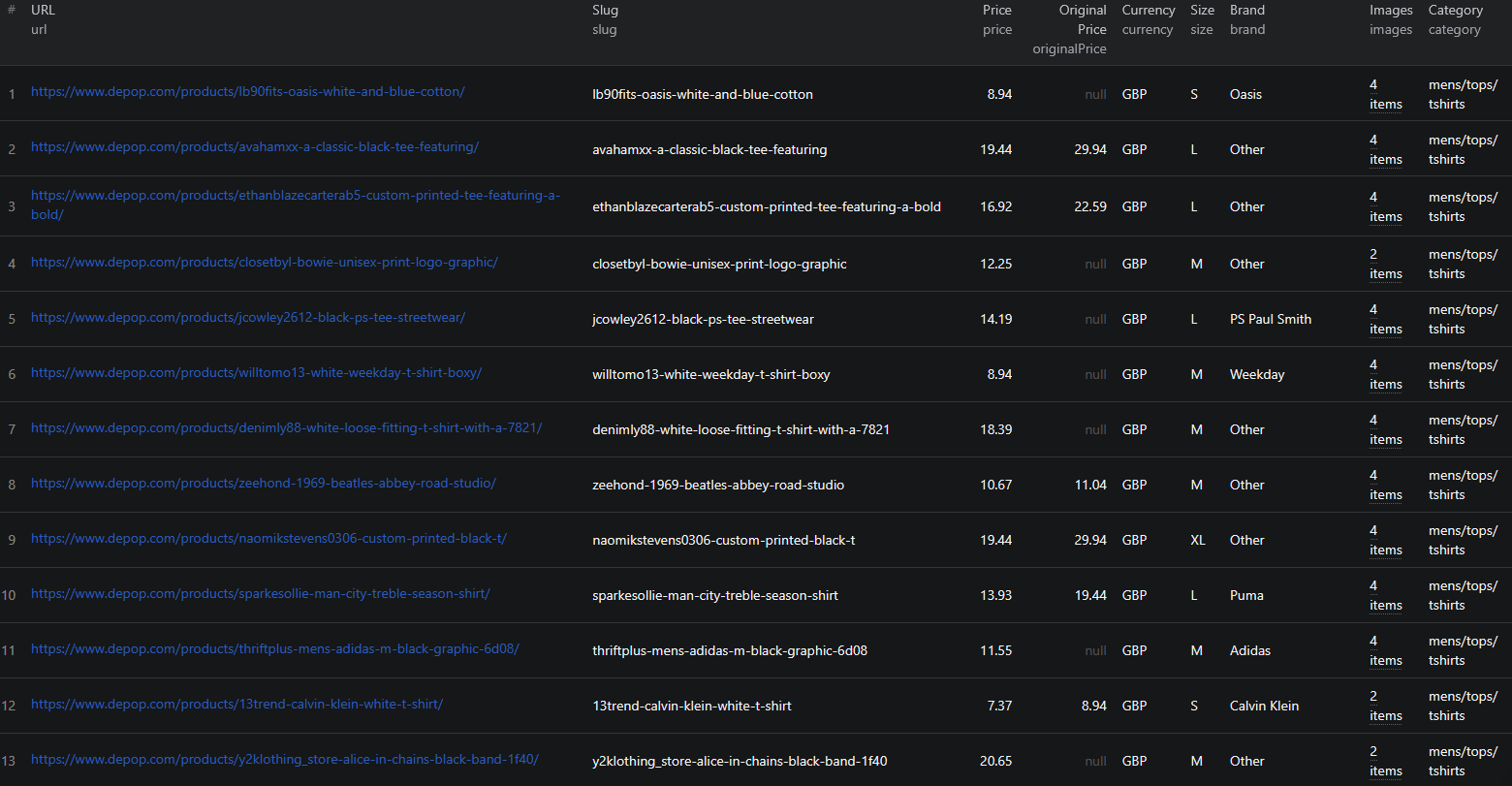
Example Output (Real Data Preview)

Depop scraper results

Here is what the actual output looks like from the Depop Listings Scraper. Each listing returns a structured JSON object:

{
  "url": "https://www.depop.com/products/956thriftfindz-blue-polo-assn-polo-shirt/",
  "slug": "956thriftfindz-blue-polo-assn-polo-shirt",
  "price": 12.3,
  "originalPrice": null,
  "currency": "USD",
  "size": "M",
  "brand": "U.S. Polo Assn.",
  "images": [
    "https://media-photos.depop.com/b1/45041112/2964841841_7ee708d18f7c4d8984d34267f1c9ad96/P10.jpg",
    "https://media-photos.depop.com/b1/45041112/2964841833_91e722aee9514045955322e91c3ce3a0/P10.jpg"
  ],
  "category": "mens/tops/tshirts"
}

Key things to notice:

  • Pricing data — both current price and original price are returned, so you can instantly calculate markdowns and resale margins
  • Brand and size — key product attributes for filtering, segmenting, and analyzing listings at scale
  • Multiple images — the scraper returns all listing images as an array, giving you complete visual data without visiting the listing
  • Category path — the full category path (e.g. mens/tops/tshirts) lets you segment data by product type without any additional parsing
  • Slug — the URL slug serves as a stable unique identifier for each listing, useful for deduplication across runs

This structured format imports cleanly into any spreadsheet, database, or analytics platform.

Try the Depop Listings Scraper now — no coding required.

Automating Depop Market Monitoring

For ongoing price tracking or trend research, you do not want to run the scraper manually every time. The Apify platform supports full automation:

Scheduled Runs

Set up recurring scrapes on any schedule — daily, weekly, or monthly. The scraper runs automatically and stores results in a dataset you can access anytime. Daily runs work well for price monitoring and competitive tracking. Weekly runs are sufficient for broader trend research and market analysis.

API Integration

Use the Apify API to trigger scraper runs programmatically and retrieve results. This lets you integrate Depop data into your existing workflows:

  • Feed listing data into pricing dashboards or analytics tools automatically
  • Trigger alerts when specific brands or items drop below a target price threshold
  • Build trend reports that update on a schedule with fresh Depop data
  • Connect to tools like Zapier, Make, or custom data pipelines

Price Tracking Pipelines

Combine scheduled scraping with historical data storage to build price tracking systems. Monitor how resale prices shift over time for specific brands, sizes, and categories. Identify seasonal pricing patterns and optimal times to source or sell specific item types.

Node.js Example

For a complete working example showing how to call this scraper from Node.js, see the GitHub repository.

Webhooks

Configure webhooks to get notified when a scraper run completes. This is useful for event-driven workflows where you want to process new listing data as soon as it is available.

Using Depop Data for Resale Intelligence

Depop data powers a range of intelligent resale and fashion analytics applications.

Resale Margin Analysis

Combine current prices with original prices to calculate typical resale margins across brands and categories. Build pricing models that tell you what to expect when reselling a specific brand's items at a given size — and where the best margin opportunities lie.

Brand Value Retention

Not all brands hold their value equally in the secondhand market. Scraping Depop over time lets you quantify how well different brands retain their resale value. Which labels command near-retail prices secondhand? Which depreciate quickly? This data informs sourcing decisions and brand-level investment strategies.

Trend Forecasting

Track which brands, styles, and item types are increasing in listing volume and price over time. Rising search activity and tightening supply on Depop often precede mainstream fashion trend coverage — making marketplace data a leading signal for what's next.

Inventory Planning

For resellers, understanding what is widely available at what price points helps with inventory planning. If a specific brand is flooding the market and driving down prices, that changes your sourcing strategy. Depop data lets you make these decisions based on current market reality rather than intuition.

Does Depop Provide an API?

No. Depop does not offer a public API for accessing its marketplace data. There is no official endpoint to query product listings, pricing, or brand information programmatically.

Your practical options for bulk data extraction are:

  • Manual browsing — works for a handful of listings but completely unscalable
  • Custom scraper — requires development time, ongoing maintenance, and infrastructure for dynamic content rendering and pagination
  • Pre-built scraper — a maintained solution like the Depop Listings Scraper that handles all technical complexity out of the box

For most teams, the pre-built scraper is the most practical choice. It eliminates the engineering and maintenance burden while delivering reliable, structured output.

Why Use a Depop Scraper Instead of Building One

Building a custom Depop scraper sounds straightforward until you encounter the real challenges:

  • Dynamic content — Depop requires browser-level rendering. Simple HTTP requests will not return listing data, so you need a full browser automation setup
  • Pagination handling — navigating through all result pages requires automated page management that breaks whenever Depop changes its frontend
  • Anti-bot protection — reliable scraping at scale requires proxy rotation, request throttling, and detection avoidance, each of which requires ongoing engineering and operational investment
  • Maintenance burden — Depop updates its frontend regularly. Every update is a potential breakage that requires immediate intervention to keep your data pipeline running
  • Scaling infrastructure — scraping thousands of listings requires distributed infrastructure, queue management, and monitoring that adds operational complexity fast
  • Opportunity cost — every hour spent building and maintaining a scraper is an hour not spent analyzing trends, making pricing decisions, or growing your resale operation

Unless you have highly specific requirements that no existing tool can meet, a pre-built, maintained scraper lets you focus on using the data rather than collecting it.

Try the Depop Listings Scraper

The Depop Listings Scraper extracts structured product data from Depop category pages and search results — pricing, original prices, brands, sizes, images, category paths, and direct listing URLs.

What you get:

  • Structured JSON or CSV output ready for analysis
  • Both category URL and search query support in a single run
  • All key product data fields including price, original price, brand, size, and images
  • Automatic pagination to collect all available listings
  • Scheduled runs for ongoing price monitoring and trend tracking
  • API access for integration into your data workflows
  • No coding or scraper maintenance required

Start scraping Depop now — your first run takes less than 5 minutes to set up.

If you are building a broader resale market intelligence pipeline, combine Depop data with other secondhand marketplace sources like Poshmark for US resale comparison or Mercari for Japanese market insights.

Legal and Ethical Considerations

Web scraping occupies a well-established legal space, but responsible practice matters:

  • Public data only — the Depop scraper extracts publicly visible listing information that anyone can see by visiting Depop without logging in
  • Respect rate limits — the scraper is designed to make requests at a reasonable pace to avoid overloading Depop's servers
  • Responsible use — use collected data for legitimate business purposes like market research, price monitoring, and inventory analysis
  • Privacy compliance — if you operate in the EU or California, ensure your data handling complies with GDPR or CCPA. This applies to how you store and process data, not to the collection of publicly visible listing information

Frequently Asked Questions

Is scraping Depop legal?

Scraping publicly available data from Depop is generally legal. Product listings are visible to anyone who visits the site without logging in. You should always use the data responsibly, comply with applicable privacy regulations, and avoid overloading Depop's servers with excessive requests.

Does Depop have an API?

Depop does not offer a public API for accessing its marketplace data. There is no official way to programmatically query product listings, pricing, or brand information. A web scraper is the practical alternative for extracting structured resale data at scale.

What data can be extracted from Depop?

You can extract product URLs, slugs, current prices, original prices, currency, sizes, brand names, product images, and category paths. Each listing is returned as a structured JSON object ready for analysis or export.

Can I scrape Depop by search term or category?

Yes. The Depop Listings Scraper supports both category page URLs (e.g. depop.com/category/mens/tops/tshirts/) and free-text search queries (e.g. vintage tshirt). You can combine both input types in a single run.

How many Depop listings can I scrape at once?

The scraper supports automatic pagination and will continue extracting listings until it reaches your configured limit or exhausts all available results. Set maxItems to 0 for unlimited extraction.

Can I export Depop data to CSV or JSON?

Yes. The Depop Listings Scraper exports data in both JSON and CSV formats. You can also access results via the Apify API for automated workflows and data pipeline integrations.

About the Author

This guide was written by Piotr, a software engineer with hands-on experience building and maintaining web scrapers at scale. He develops and maintains a suite of data extraction tools on the Apify platform, helping businesses automate their data collection workflows.

Need help with your scraping project?

Book a free discovery call and let's scope your project together.

Book a Call
Piotr Vassev

Piotr Vassev

Founder of FalconScrape. Building production-grade web scraping systems and data automation pipelines for businesses worldwide.

Connect on LinkedIn