Piotr VassevPiotr Vassev

How to Scrape Vinted Listings and Seller Data (Step-by-Step Guide)

How to Scrape Vinted Listings and Seller Data

If you want to scrape Vinted listings and seller data for price monitoring, brand intelligence, or resale market research, this guide walks you through the entire process. You will learn what data you can extract from one of Europe's largest secondhand fashion platforms, how to automate collection across 16 country domains, and how to turn raw Vinted listings into actionable resale intelligence.

Why Scrape Vinted Data?

Vinted is Europe's dominant peer-to-peer fashion resale platform with tens of millions of active members across the UK, France, Germany, and more than a dozen other countries. Unlike many marketplace platforms, Vinted charges zero seller fees — all costs fall on the buyer through a buyer protection fee — which keeps listing volume high and pricing more reflective of true secondhand market rates.

What makes Vinted data particularly valuable is its scale and geographic breadth. The same secondhand item can be priced very differently across the UK, France, Germany, and Poland — making cross-market price comparison a genuinely useful analytical exercise that is impossible without automated data collection.

Businesses, resellers, and researchers scrape Vinted data for several reasons:

  • Price monitoring — track how specific brands, styles, and categories are priced across multiple European markets
  • Cross-market arbitrage — identify pricing gaps between Vinted's country domains for sourcing and resale opportunities
  • Brand tracking — understand how your brand (or a competitor's) appears in the secondhand market at scale
  • Seller intelligence — analyze top sellers' listing strategies, pricing patterns, and item turnover
  • Product trend analysis — identify which brands and item types are gaining traction in the European resale market
  • Market research and reporting — build pricing datasets and trend dashboards for fashion analytics

Manually browsing Vinted across multiple country domains and copying listing details is completely impractical at scale. A single keyword search can surface thousands of listings, and inventory changes constantly. Automation is the only viable approach for meaningful data collection.

What Data You Can Extract from Vinted

The Vinted Listings Scraper extracts structured data from keyword searches, category pages, direct search URLs, and seller profile pages. Here are the key fields available:

FieldDescriptionExample
TitleFull listing titleNike Air Max 90 Essential white UK 9
URLDirect link to the listingvinted.co.uk/items/8483516504-nike-air-max-90
PriceListed price in local currency55.00
Service feeBuyer protection fee added at checkout3.45
Total pricePrice including buyer protection58.45
CurrencyCurrency code for the listed priceGBP
BrandThe product brandNike
SizeProduct sizeUK 9
ConditionItem condition as listed by the sellerVery good
PhotosArray of photo objects with URLs and dimensionsimages1.vinted.net/t/...
Favourite countNumber of times the listing has been favourited12
View countTotal number of listing views134
Seller profileUsername, profile URL, and phototrainers_uk
Seller details (optional)Feedback score, item count, location, response time97% positive, London
DomainThe Vinted country domain scrapedvinted.co.uk

The optional seller details enrichment adds feedback reputation, positive and negative feedback counts, item count, follower count, country, city, bio, and average response time — giving you a full picture of who is selling.

Common Use Cases for Vinted Data

Cross-Market Price Intelligence

Vinted operates across 16 country domains, and the same secondhand item can carry very different prices in different markets. A pair of Nike trainers might sell for £55 in the UK, €45 in Germany, and €35 in Poland. Scraping multiple domains in parallel gives you a cross-market pricing picture that would be impossible to build manually.

This intelligence is valuable for sourcing decisions, pricing strategy on your own listings, and identifying where specific brands are undervalued in one market relative to another.

Resale Price Monitoring

Knowing the going rate for specific brands, sizes, and conditions is fundamental to any resale operation. Scrape Vinted regularly to build a pricing database for the categories you trade in. Compare prices across condition grades (New with tags, Very good, Good, Satisfactory) to understand how condition affects price — and where the best value purchases sit.

Seller Analysis and Benchmarking

Use seller scraping to analyze how top-performing sellers on Vinted structure their listings, price their items, and turn over inventory. Understanding what a high-feedback seller with thousands of items does differently from an average seller reveals patterns in listing strategy, pricing, and presentation.

Brand Intelligence for Retailers

Brands use secondhand marketplace data to understand the secondhand lifecycle of their products. How quickly do your products appear on Vinted after the initial sale? What do they resell for relative to retail? Which product lines hold their value best across different European markets?

Vinted data provides a direct window into brand perception among resale-focused consumers — useful for product strategy, pricing decisions, and understanding how different SKUs perform post-retail.

Market Research and Fashion Trend Analysis

Vinted is a leading indicator for what fashion categories are gaining traction in European secondhand markets. What brands are being listed in high volumes? Which item types are commanding premium prices relative to their condition? By tracking listing volumes and pricing over time, you can identify which trends are gaining momentum before they reach mainstream fashion media.

Demand and Supply Analysis

Combining view counts and favourite counts with pricing data lets you assess demand signals at a listing level. Items with high view and favourite counts but unsold status are in high demand but may be overpriced — a useful signal for pricing your own inventory. Items with low engagement may indicate oversupply or poor presentation rather than lack of demand.

Challenges of Extracting Vinted Data Manually

Before jumping into the tutorial, it is worth understanding why scraping Vinted is harder than it looks:

  • Multi-domain complexity — Vinted's 16 country domains each have separate inventory, making cross-market research a multi-target scraping challenge
  • High listing volume — popular searches return thousands of listings across many pages, making manual collection completely impractical
  • Residential proxy requirement — Vinted blocks datacenter IP addresses, so you need residential proxies for reliable access at scale
  • Anti-bot protection — Vinted employs bot detection that blocks naive scraping attempts without proper proxy rotation and request throttling
  • Dynamic content — listings are rendered using JavaScript, so simple HTTP requests will not return usable data
  • Maintenance overhead — Vinted updates its frontend regularly, which means custom scrapers break and need constant attention

Building and maintaining a reliable Vinted scraper across multiple domains is a significant engineering commitment. For most use cases, a pre-built, maintained solution is the more practical approach.

Step-by-Step: How to Scrape Vinted Listings

Here is how to scrape Vinted data using the Vinted Listings Scraper on Apify.

Step 1 — Choose Your Input Method

The Vinted Listings Scraper supports three input methods, which you can combine in a single run:

Search queries — provide free-text keywords to scrape results matching specific terms. For example:

  • nike air max
  • levi's jeans
  • zara summer dress

Search URLs — navigate to any Vinted search page, apply your filters, and paste the URL directly. Query parameters are extracted automatically, so you get exactly the filtered results you configured in the browser. For example:

  • https://www.vinted.co.uk/catalog?search_text=nike+air+max&order=newest_first

Seller IDs — provide one or more Vinted user IDs to scrape all public listings from specific sellers.

Step 2 — Configure the Scraper Input

Head to the Vinted Listings Scraper on Apify and configure your run:

  1. Add your search queries to the searchQueries field, or paste search URLs into startUrls, or add seller IDs to sellerIds
  2. Set the domain field to the Vinted country domain you want to scrape (e.g. vinted.co.uk, vinted.fr, vinted.de)
  3. Apply optional filters — category IDs, brand IDs, size IDs, condition codes, color IDs, and price range
  4. Set maxItems to control how many listings to extract (use 0 for unlimited)
  5. Toggle includeSellerDetails to true if you want full seller profile data for each listing
  6. Leave the proxy configuration set to Apify Residential Proxies — datacenter IPs are blocked by Vinted, so residential proxies are required for reliable scraping
  7. Click Start to begin the extraction

The scraper handles request management, pagination, and data parsing automatically.

Step 3 — Run the Scraper

Once started, the scraper will:

  • Execute each search query or load each URL against the configured domain
  • Paginate through all available results automatically
  • Parse structured listing data including titles, prices, brands, sizes, conditions, and images
  • Optionally fetch full seller profile details for each unique seller
  • Store results in a clean, structured dataset

Processing time depends on the number of listings requested. Most runs with the default maxItems: 100 complete within seconds.

Step 4 — Export Your Results

Once the scraper finishes, you can export the results in multiple formats:

  • JSON — ideal for developers building data pipelines or integrations
  • CSV — perfect for spreadsheet analysis in Excel or Google Sheets
  • Excel — ready-to-use workbook format for business reporting
  • API — access results programmatically via the Apify API for automated workflows

Each record includes the full set of structured fields: title, URL, price, service fee, total price, currency, brand, size, condition, photos, engagement data, seller profile, and domain.

Ready to try it? Run the Vinted Listings Scraper on Apify and get your first dataset in minutes.

Example Output (Real Data Preview)

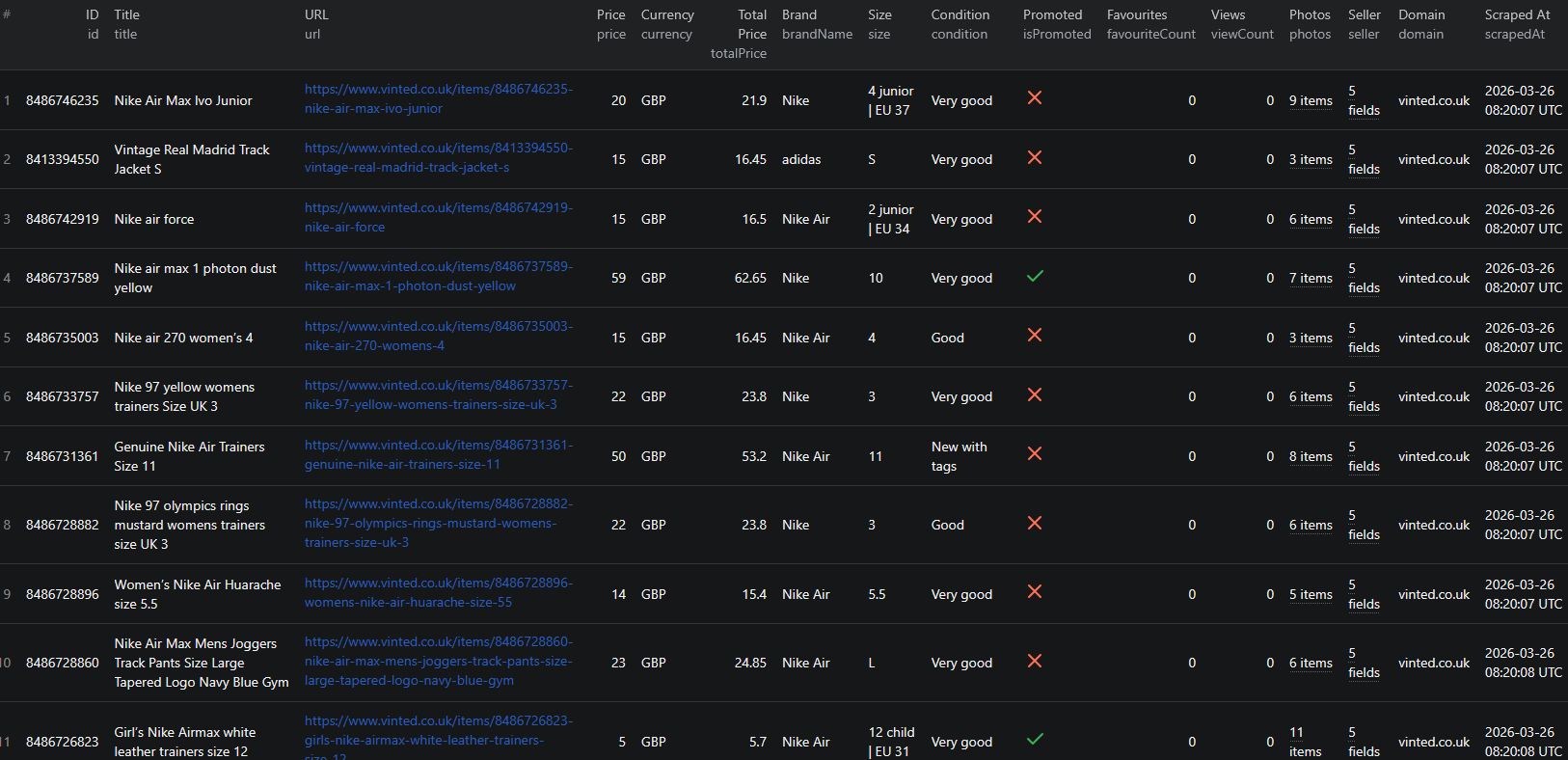
Vinted scraper results

Here is what the actual output looks like from the Vinted Listings Scraper. Each listing returns a structured JSON object:

{
  "id": 8483516504,
  "title": "Nike Air Max 90 Essential white UK 9",
  "url": "https://www.vinted.co.uk/items/8483516504-nike-air-max-90",
  "price": 55.0,
  "currency": "GBP",
  "serviceFee": 3.45,
  "totalPrice": 58.45,
  "brandName": "Nike",
  "size": "UK 9",
  "condition": "Very good",
  "isPromoted": false,
  "favouriteCount": 12,
  "viewCount": 134,
  "photos": [
    {
      "url": "https://images1.vinted.net/t/...f800.jpg",
      "fullSizeUrl": "https://images1.vinted.net/tc/...original.jpg",
      "isMain": true,
      "width": 600,
      "height": 800
    }
  ],
  "seller": {
    "id": 184714746,
    "username": "trainers_uk",
    "profileUrl": "https://www.vinted.co.uk/member/184714746-trainers_uk",
    "photoUrl": "https://images1.vinted.net/...",
    "isBusiness": false
  },
  "sellerDetails": {
    "feedbackReputation": 0.97,
    "positiveFeedbackCount": 63,
    "negativeFeedbackCount": 2,
    "itemCount": 41,
    "followerCount": 8,
    "country": "United Kingdom",
    "city": "London",
    "isOnHoliday": false,
    "bio": "Fast dispatch, well packaged.",
    "avgResponseTime": "< 1 hour"
  },
  "scrapedAt": "2026-03-26T08:00:00.000Z",
  "domain": "vinted.co.uk"
}

Key things to notice:

  • Total price transparency — both the listed price and the buyer protection fee are returned separately, so you can see what buyers actually pay versus what sellers receive
  • Engagement signalsfavouriteCount and viewCount give you demand signals for each listing, useful for distinguishing popular items from overlooked ones
  • Photo arrays — each photo includes both a compressed thumbnail URL and the full-size original, plus dimensions — useful for image analysis and visual similarity matching
  • Seller details — the optional sellerDetails block gives you a complete seller profile including feedback score, transaction history, and location, without a separate lookup
  • Domain tracking — every record carries the domain field, so multi-domain runs stay clearly labeled in mixed datasets

This structured format imports cleanly into any spreadsheet, database, or analytics platform.

Try the Vinted Listings Scraper now — no coding required.

Automating Vinted Market Monitoring

For ongoing price tracking or trend research, you do not want to run the scraper manually every time. The Apify platform supports full automation:

Scheduled Runs

Set up recurring scrapes on any schedule — daily, weekly, or monthly. The scraper runs automatically and stores results in a dataset you can access anytime. Daily runs work well for active price monitoring and competitive tracking. Weekly runs are sufficient for broader trend research and brand-level market analysis.

API Integration

Use the Apify API to trigger scraper runs programmatically and retrieve results. This lets you integrate Vinted data into your existing workflows:

  • Feed listing data into pricing dashboards or analytics tools automatically
  • Trigger alerts when items matching specific criteria drop below a target price
  • Build cross-domain price comparison reports that update on a schedule
  • Connect to tools like Zapier, Make, or custom data pipelines

Multi-Domain Monitoring

Run the scraper against multiple Vinted domains in parallel to build a cross-market dataset. Compare pricing for the same brand across the UK, French, German, and Polish domains simultaneously. This is the foundation of any meaningful cross-market resale intelligence operation.

Node.js Example

For a complete working example showing how to call this scraper from Node.js, see the GitHub repository.

Webhooks

Configure webhooks to get notified when a scraper run completes. This is useful for event-driven workflows where you want to process new listing data as soon as it is available — for example, triggering a repricing check on your own listings when fresh market data arrives.

Pricing

The Vinted Listings Scraper uses Pay Per Event pricing — you only pay for what you use.

| Event | Description | Price | |---|---|---| | product-listing | Each listing scraped and pushed to the dataset | $1.00 / 1,000 results | | item-detail | Each unique seller profile fetched (when includeSellerDetails: true) | $4.00 / 1,000 profiles |

Example costs:

  • 1,000 listings (no seller details): $1.00
  • 1,000 listings + seller details (assuming all unique sellers): $5.00
  • 10,000 listings (no seller details): $10.00

The default maxItems: 100 limits a test run to $0.10 or less.

Does Vinted Provide an API?

No. Vinted does not offer a public API for accessing its marketplace data. There is no official endpoint to query product listings, pricing, or seller information programmatically.

Your practical options for bulk data extraction are:

  • Manual browsing — works for a handful of listings but completely unscalable across 16 country domains
  • Custom scraper — requires development time, ongoing proxy management, and maintenance to keep up with Vinted's anti-bot measures and frontend changes
  • Pre-built scraper — a maintained solution like the Vinted Listings Scraper that handles all technical complexity out of the box

For most teams, the pre-built scraper is the most practical choice. It eliminates the engineering and maintenance burden while delivering reliable, structured output across all 16 supported domains.

Why Use a Vinted Scraper Instead of Building One

Building a custom Vinted scraper sounds straightforward until you encounter the real challenges:

  • Residential proxy requirement — Vinted actively blocks datacenter IP ranges, which means any scraper that doesn't route through residential proxies will fail at scale. Sourcing and managing residential proxies adds cost and operational complexity
  • Anti-bot protection — Vinted employs request analysis that flags abnormal traffic patterns. Reliable scraping requires careful throttling, header management, and session handling to stay under the radar
  • Multi-domain complexity — each of the 16 country domains is a separate target with different inventory, currency, and sometimes different frontend behavior, multiplying the maintenance surface
  • Dynamic content — Vinted renders listings with JavaScript, requiring a full browser automation layer rather than simple HTTP requests
  • Frequent frontend updates — Vinted updates its frontend regularly, and each update is a potential scraper-breaking change that requires immediate attention
  • Scaling infrastructure — collecting tens of thousands of listings requires distributed infrastructure, queue management, and monitoring that adds significant operational overhead
  • Opportunity cost — every hour spent building and maintaining a scraper is an hour not spent analyzing pricing trends, making sourcing decisions, or growing your resale operation

Unless you have highly specific requirements that no existing tool can meet, a pre-built, maintained scraper is the more practical path.

Try the Vinted Listings Scraper

The Vinted Listings Scraper extracts structured product data from Vinted search results and seller pages across 16 country domains — titles, prices, service fees, brands, sizes, conditions, photos, engagement data, seller profiles, and full seller details on demand.

What you get:

  • Structured JSON, CSV, or Excel output ready for analysis
  • Keyword search, URL, and seller ID input in a single run
  • All key listing fields including price, buyer protection fee, brand, size, condition, and photos
  • 16 country domains supported for cross-market research
  • Optional seller profile enrichment with feedback scores and location data
  • Scheduled runs for ongoing price monitoring and trend tracking
  • API access for integration into your data workflows
  • No coding or scraper maintenance required

Start scraping Vinted now — your first run takes less than 5 minutes to set up.

If you are building a broader resale market intelligence pipeline, combine Vinted data with other secondhand marketplace sources like Depop for UK and US fashion resale or Mercari for Japanese market insights.

Legal and Ethical Considerations

Web scraping occupies a well-established legal space, but responsible practice matters:

  • Public data only — the Vinted scraper extracts publicly visible listing information that anyone can see by visiting Vinted without logging in
  • GDPR awareness — Vinted's primary markets are in the EU, so pay particular attention to how you store and process any personal data (such as seller usernames, locations, or profile information). Collecting publicly visible data is generally permissible, but your downstream data handling must comply with applicable regulations
  • Respect rate limits — the scraper is designed to make requests at a reasonable pace to avoid overloading Vinted's servers
  • Responsible use — use collected data for legitimate business purposes like market research, price monitoring, and inventory analysis

Frequently Asked Questions

Is scraping Vinted legal?

Scraping publicly available data from Vinted is generally legal. Product listings are visible to anyone who visits the site without logging in. You should use the data responsibly, comply with applicable privacy regulations (especially GDPR in Europe), and avoid overloading Vinted's servers with excessive requests.

Does Vinted have an API?

Vinted does not offer a public API for accessing its marketplace data. There is no official way to programmatically query product listings, pricing, or seller information. A web scraper is the practical alternative for extracting structured resale data at scale.

What data can be extracted from Vinted?

You can extract listing titles, prices, buyer protection fees, brand names, sizes, conditions, photo URLs, favourite counts, view counts, seller profiles, and seller details such as feedback score, item count, location, and response time.

Which Vinted country domains are supported?

The scraper supports 16 domains: UK, France, Germany, Spain, Netherlands, Poland, Belgium, Austria, Czech Republic, Slovakia, Portugal, Lithuania, Latvia, Hungary, Romania, and the US.

Can I scrape listings from a specific Vinted seller?

Yes. The Vinted Listings Scraper supports scraping all public listings from a specific seller by providing their user ID. You can also combine seller scraping with keyword search and direct URL inputs in a single run.

Can I export Vinted data to CSV or Excel?

Yes. Results can be exported as JSON, CSV, or Excel. You can also access results via the Apify API for automated workflows and data pipeline integrations.

About the Author

This guide was written by Piotr, a software engineer with hands-on experience building and maintaining web scrapers at scale. He develops and maintains a suite of data extraction tools on the Apify platform, helping businesses automate their data collection workflows.

Need help with your scraping project?

Book a free discovery call and let's scope your project together.

Book a Call
Piotr Vassev

Piotr Vassev

Founder of FalconScrape. Building production-grade web scraping systems and data automation pipelines for businesses worldwide.

Connect on LinkedIn