How to Scrape We Work Remotely Job Listings (Step-by-Step Guide)

If you want to scrape We Work Remotely job listings for hiring intelligence, sales prospecting, or remote work market research, this guide walks you through the entire process. You will learn what data you can extract, how to automate the collection, and how to turn We Work Remotely's listings into structured, actionable remote job intelligence.
Why Scrape We Work Remotely Job Data?
We Work Remotely is the largest dedicated remote job board in the world, with over three million visitors per month. Unlike general job boards, every single listing on We Work Remotely is a remote or distributed role — making it the go-to platform for companies that are serious about remote hiring and for candidates seeking fully remote work.
Businesses and researchers scrape We Work Remotely job data for several reasons:
- Remote hiring signals — companies posting on We Work Remotely are actively building distributed teams, which is a strong indicator of remote-friendly culture and investment in async tooling
- Sales prospecting — identify companies expanding their remote teams as targets for remote work tools, collaboration software, payroll platforms, and HR services
- Recruitment analytics — track which roles, categories, and skill sets are in highest demand in the global remote job market
- Salary benchmarking — analyze compensation ranges for fully remote roles across categories and geographies
- Remote work research — study hiring trends in the remote-first economy, including geographic restrictions, employment types, and in-demand categories
- Lead enrichment — add remote hiring signals to your CRM to prioritize outreach to companies building distributed teams
Manually browsing We Work Remotely and recording job details is impractical beyond a handful of listings. New roles are posted daily across dozens of categories, and the data changes continuously. Automation is the only realistic approach for collecting We Work Remotely data at scale.
What Data You Can Extract from We Work Remotely
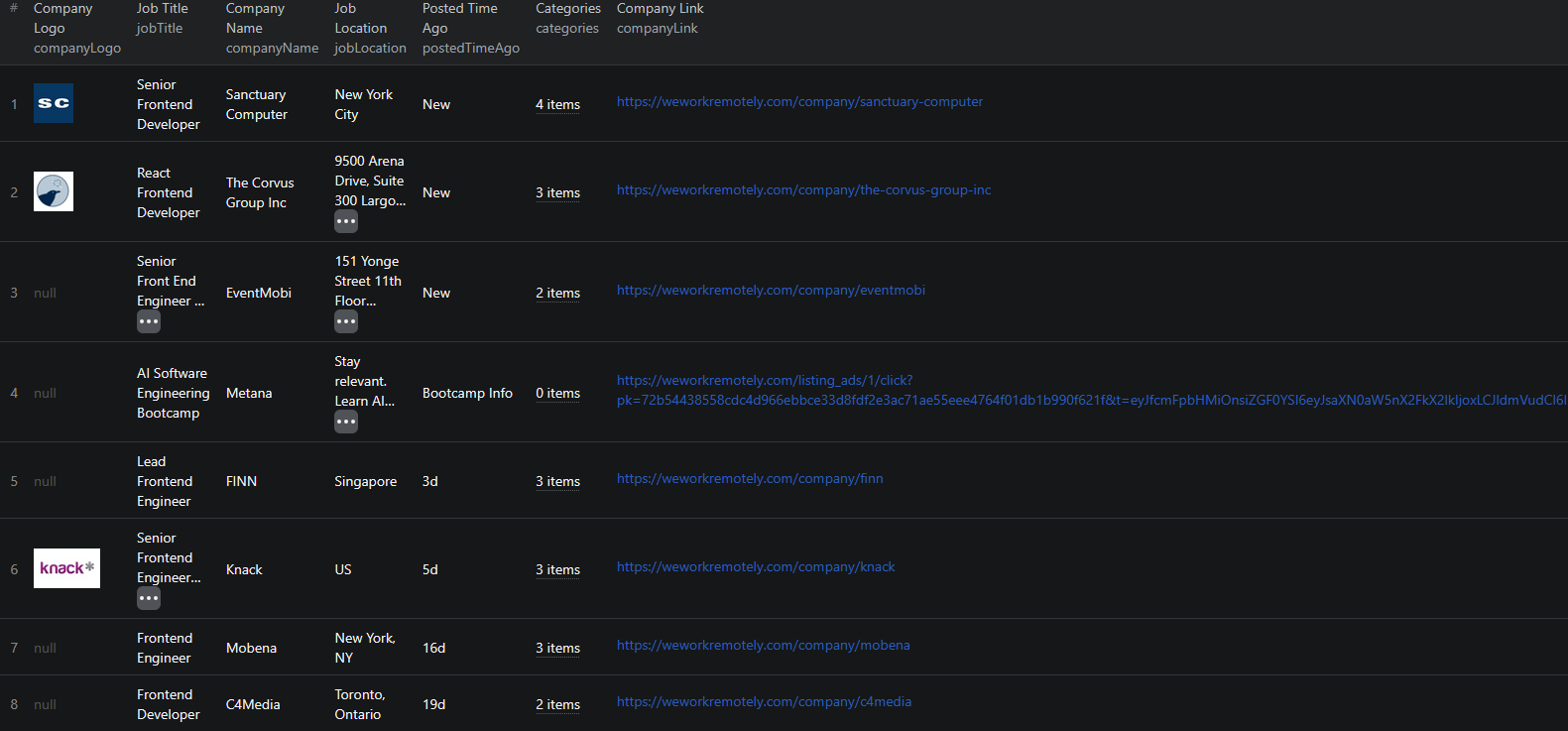
The We Work Remotely Scraper extracts structured data from job search result pages. Here are the key fields you can collect:
| Field | Description | Example |
|---|---|---|
| Job title | The title of the remote position | AI (LLM) Fullstack Engineer |
| Company name | The hiring organization | CloudDevs |
| Company logo | URL of the company's logo image | we-work-remotely.imgix.net/... |
| Job location | Specified location or "Virtual" | San Francisco, Virtual |
| Categories | Tags including employment type, salary, and geographic restrictions | Full-Time, $75,000–$99,999 USD, Anywhere in the World |
| Posted time ago | Relative time since posting | 4d, 1w, 2h |
| Job link | Direct URL to the job listing on We Work Remotely | weworkremotely.com/remote-jobs/... |
| Company link | URL of the company profile on We Work Remotely | weworkremotely.com/company/... |
The categories field is particularly rich — it combines employment type (Full-Time, Contract), salary range where disclosed ($75,000–$99,999 USD), geographic restrictions (Latin America Only, UK Only, Anywhere in the World), and featured status into a single structured array. This lets you filter and segment remote job data without any additional processing.
Common Use Cases for We Work Remotely Data
Remote Work Sales Prospecting
Companies posting on We Work Remotely are explicitly committed to remote hiring. That makes them high-value targets for a specific set of B2B products:
- Remote collaboration tools — video conferencing, async communication, virtual offices
- Global payroll and HR platforms — paying distributed teams across multiple countries
- Remote employee benefits — health insurance, equipment stipends, co-working access
- Security and access management — VPN, zero trust, identity management for distributed teams
- Async-first productivity tools — project management, documentation, and knowledge management platforms
Use We Work Remotely data to build targeted prospect lists of companies actively investing in remote infrastructure right now.
Recruitment and Talent Acquisition
Recruiting firms and talent teams focused on remote placements use We Work Remotely data to stay ahead of the remote job market. Track which categories are seeing the most new postings, which companies are hiring repeatedly (a signal of fast growth), and what salary ranges are being offered for remote roles at different seniority levels.
Monitor how demand for specific roles — AI engineers, product managers, customer success — evolves across the remote-first job market over time.
Remote Work Market Research
We Work Remotely is the largest dataset of remote job postings available anywhere. Researchers and analysts use it to study the remote work economy: how remote hiring volumes shift over time, which geographies are most represented or restricted, how salary ranges for remote roles compare to in-office benchmarks, and which categories are growing or declining in the distributed workforce.
Geographic Restriction Analysis
The categories field reveals whether companies restrict remote positions to specific regions — Latin America Only, Europe Only, UK Only, Canada Only, or Anywhere in the World. This geographic data is valuable for understanding how companies structure their distributed hiring and which markets are most open to global talent versus regional-only hiring.
Company Intelligence
We Work Remotely includes company profile links alongside each listing. Track which companies are consistently active on the platform, how frequently they post, and which categories they hire into. Repeated posting across multiple roles is a strong signal of a company in growth mode.
Job Market Benchmarking
Use salary range categories to benchmark remote compensation across roles, categories, and hiring companies. We Work Remotely's salary tiers ($50,000–$74,999 USD, $75,000–$99,999 USD, $100,000–$149,999 USD, etc.) provide a structured way to compare remote compensation without requiring salary data parsing.
Challenges of Extracting We Work Remotely Data Manually
Before jumping into the tutorial, it is worth understanding why automation is necessary:
- Volume — We Work Remotely lists hundreds of active remote jobs at any time across dozens of categories. Manually reviewing even a subset of categories is time-consuming
- Category breadth — with categories spanning programming, design, DevOps, marketing, customer support, sales, and more, full coverage requires systematic collection across all category pages
- Freshness — new listings appear daily and older ones expire. Any manual snapshot is stale within 24 hours for fast-moving categories
- Category metadata — the rich category tags on each listing (salary range, geographic restrictions, employment type) require careful parsing to extract consistently from raw pages
- Scale — building a useful dataset for trend analysis requires consistent collection over weeks and months, not one-off manual snapshots
Step-by-Step: How to Scrape We Work Remotely Job Listings
Here is how to scrape We Work Remotely job data using the We Work Remotely Scraper on Apify.
Step 1 — Identify Your Target Search URLs
The We Work Remotely Scraper is URL-based — you provide one or more We Work Remotely search or category page URLs, and the scraper extracts all listings from those pages.
To find the right URLs:
- Go to weworkremotely.com and browse or search for the roles you want
- Apply any filters you need — category, job type, region, or salary range
- Copy the resulting search or category page URL
- Provide that URL as input to the scraper
You can provide multiple URLs in a single run to collect across multiple categories or searches simultaneously.
Common We Work Remotely category URLs include pages for programming, design, DevOps and sysadmin, product, marketing, customer support, sales, and more. Each category URL covers all active listings in that category.
Step 2 — Configure the Scraper Input
Head to the We Work Remotely Scraper on Apify and configure your run:
- Enter one or more We Work Remotely search result URLs as your input
- Click Start to begin the extraction
The scraper processes each URL and extracts all job listings from the search results.
Step 3 — Run the Scraper
Once started, the scraper will:
- Load each We Work Remotely search or category page you provided
- Extract all job listings from the results
- Parse structured data including job title, company, categories, salary range, geographic restrictions, and direct links
- Store results in a clean, structured dataset
Runs are fast — We Work Remotely pages load quickly and the scraper processes results efficiently.
Step 4 — Export Structured Results
Once the scraper finishes, export your results in your preferred format:
- JSON — ideal for developers building data pipelines or integrations
- CSV — perfect for analysis in Excel or Google Sheets, or importing into a CRM
- API — access results programmatically via the Apify API for automated workflows
Each record includes the full set of structured fields: job title, company name, logo, location, categories (with employment type, salary, and geographic restrictions), posting date, and direct URLs.
Ready to try it? Run the We Work Remotely Scraper on Apify and get your first dataset in minutes.
Example Output (Real Data Preview)

Here is what the actual output looks like from the We Work Remotely Scraper. Each job listing returns a structured JSON object:
[
{
"companyLogo": "https://we-work-remotely.imgix.net/logos/0081/8410/logo.gif?ixlib=rails-4.0.0&w=50&h=50&dpr=2&fit=fill&auto=compress",
"jobTitle": "AI (LLM) Fullstack Engineer",
"postedTimeAgo": "4d",
"companyName": "CloudDevs",
"jobLocation": "San Francisco",
"categories": [
"Featured",
"Full-Time",
"Latin America Only",
"Europe Only",
"UK Only",
"Canada Only"
],
"jobLink": "https://weworkremotely.com/remote-jobs/clouddevs-ai-llm-fullstack-engineer-3",
"companyLink": "https://weworkremotely.com/company/clouddevs"
},
{
"companyLogo": "https://we-work-remotely.imgix.net/logos/0083/7653/logo.gif?ixlib=rails-4.0.0&w=50&h=50&dpr=2&fit=fill&auto=compress",
"jobTitle": "Software Design Engineer",
"postedTimeAgo": "4d",
"companyName": "Elite Software Automation",
"jobLocation": "Virtual",
"categories": [
"Featured",
"Full-Time",
"$75,000 - $99,999 USD",
"Anywhere in the World"
],
"jobLink": "https://weworkremotely.com/remote-jobs/elite-software-automation-software-design-engineer",
"companyLink": "https://weworkremotely.com/company/elite-software-automation"
}
]
Key things to notice:
- Categories as multi-dimensional tags — the
categoriesarray encodes employment type, salary range, and geographic scope in a single field. The first listing is restricted to Latin America, Europe, UK, and Canada; the second is open anywhere in the world - Salary tiers — where disclosed, salary ranges like
$75,000 - $99,999 USDare included as category tags, giving you structured compensation data without parsing - Featured flag — the
Featuredcategory tag identifies promoted listings, useful for distinguishing organic from boosted postings - Company profile link —
companyLinkgives you a direct path to the company's We Work Remotely profile for further research - Posting recency —
postedTimeAgotells you how fresh each listing is, important for filtering to recently active roles
This structured format is ready to import into any CRM, database, or analytics tool.
Try the We Work Remotely Scraper now — no coding required.
Automating We Work Remotely Data Collection
For ongoing remote hiring intelligence or sales prospecting, you need continuous data collection. The Apify platform supports full automation:
Scheduled Runs
Set up recurring scrapes on any schedule — daily, weekly, or monthly. The scraper runs automatically and stores results in a persistent dataset you can access at any time. Daily runs are ideal for sales prospecting and recruitment monitoring; weekly runs work well for broader market trend research.
API Integration
Use the Apify API to trigger scraper runs programmatically and retrieve results. This lets you integrate We Work Remotely job data into your existing workflows:
- Feed new remote job listings into your CRM or ATS automatically
- Trigger alerts when target companies post new remote roles
- Build dashboards tracking remote hiring trends across categories and geographies
- Connect to tools like Zapier, Make, or custom data pipelines
Remote Hiring Signal Pipelines
Combine scheduled We Work Remotely scraping with company-level aggregation to build remote hiring signal systems. Track which companies are posting the most remote roles, which are expanding into new categories, and which are hiring for geographies that signal global team growth. These signals are powerful for B2B sales teams and investors focused on the remote-first economy.
Node.js Example
For a complete working example showing how to call this scraper from Node.js, see the GitHub repository.
Webhooks
Configure webhooks to get notified when a scraper run completes. This is useful for event-driven architectures where you want to process new remote job data as soon as it is available rather than polling on a schedule.
Using We Work Remotely Data for Remote Market Analysis
We Work Remotely's focused scope — exclusively remote roles — makes it uniquely valuable for studying the distributed work economy.
Remote Hiring Trend Analysis
Track how remote hiring volumes shift over time by category, employment type, and salary tier. Identify which categories are growing fastest in the remote job market and which are contracting. This data provides a real-time view of the remote-first economy that complements general job board data.
Geographic Restriction Mapping
The geographic restriction categories — Anywhere in the World, US Only, Europe Only, Latin America Only, etc. — reveal how companies structure their distributed hiring. Track which companies are opening up to global talent versus restricting to specific regions. This is valuable for policy researchers, remote work advocates, and sales teams targeting specific geographic markets.
Category Demand Monitoring
Monitor which We Work Remotely categories are seeing the most new listings over time. Identify rising categories like AI engineering or product design alongside more established ones. This category-level intelligence helps training companies, recruiters, and toolmakers focus on the highest-demand remote roles.
Company Remote Hiring Profiles
Aggregate We Work Remotely data at the company level to profile each organization's remote hiring behavior. How frequently do they post? Which categories do they hire into? Are they growing their remote team across multiple functions simultaneously? This company-level view is powerful for both sales intelligence and competitive research.
Does We Work Remotely Offer an API?
We Work Remotely does not provide a public API for extracting job listing data:
No Public Data Access
Unlike some job boards that offer RSS feeds or limited APIs, We Work Remotely does not expose its listing data through an official programmatic interface available to the general public.
Manual Export Limitations
You can manually browse We Work Remotely and copy job details, but this only scales to a handful of listings at a time. For any meaningful analysis — tracking trends, building prospect lists, or monitoring hiring activity — manual collection is impractical.
The Practical Alternative
For most teams that need structured We Work Remotely data at scale, a web scraper is the practical solution. The We Work Remotely Scraper extracts the same publicly visible job listings that anyone can see by visiting the site — structured and ready for analysis.
Why Use a Pre-Built We Work Remotely Scraper
Building a custom We Work Remotely scraper is straightforward in theory but has real maintenance overhead in practice:
- Category metadata parsing — the rich category tags encoding salary, geography, and employment type require careful extraction logic to parse consistently
- URL management — tracking multiple category and search URLs and handling their pagination correctly requires systematic implementation
- Maintenance overhead — We Work Remotely updates its frontend periodically, breaking scrapers that rely on specific HTML selectors. Every update requires immediate fixes to keep your data pipeline running
- Infrastructure costs — even simple scraping at scale requires proxy management and request handling to avoid blocks
- Opportunity cost — every hour spent on scraper maintenance is an hour not spent analyzing remote hiring trends or building prospect lists
A maintained, pre-built solution lets you focus on what to do with the data instead of how to collect it.
Try the We Work Remotely Scraper
The We Work Remotely Scraper extracts structured data from We Work Remotely job listings — job titles, companies, categories, salary ranges, geographic restrictions, employment types, and direct links.
What you get:
- Structured JSON or CSV output ready for analysis
- All key job and company data fields in a single export
- URL-based input targeting any We Work Remotely search or category page
- Rich category metadata including salary tiers and geographic restrictions
- Scheduled runs for ongoing remote hiring signal monitoring
- API access for integration into your workflows
- No coding or scraper maintenance required
Start scraping We Work Remotely now — your first run takes less than 5 minutes to set up.
If you are building a remote hiring intelligence pipeline, combine We Work Remotely data with ZipRecruiter for broader US market coverage, or Dice for deep tech hiring signals.
Legal and Ethical Considerations
Web scraping occupies a well-established legal space, but responsible practice matters:
- Public data only — the We Work Remotely Scraper extracts publicly visible job listings that anyone can see by visiting We Work Remotely. No login or authentication is required
- Responsible use — use the data for legitimate business purposes such as recruitment, sales intelligence, and market research
- Respect rate limits — the scraper is designed to make requests at a reasonable pace to avoid overloading We Work Remotely's servers
- Privacy compliance — job listings contain company and role data. Handle any data you collect in compliance with applicable regulations
Frequently Asked Questions
Is scraping We Work Remotely legal?
Scraping publicly available job listings from We Work Remotely is generally legal. The postings are visible to anyone who visits the site without logging in. However, you should always use the data responsibly and avoid overloading We Work Remotely's servers with excessive requests.
Does We Work Remotely offer an API?
We Work Remotely does not offer a public API for extracting job listing data. A scraper is the practical alternative for accessing structured remote job data at scale.
What data can be extracted from We Work Remotely?
You can extract job titles, company names, company logos, job categories, salary ranges (where listed), geographic restrictions, posting dates, and direct links to both the job listing and the company profile on We Work Remotely.
Can I filter We Work Remotely jobs by category or location?
Yes. The scraper accepts We Work Remotely search URLs directly, so you can target any search or category page on the site — filtering by job type, category, region, or salary range before the scraper even runs.
What categories does We Work Remotely cover?
We Work Remotely covers a wide range of remote-friendly categories including programming, design, DevOps and sysadmin, product, marketing, customer support, sales, finance, and more.
Can I export We Work Remotely job listings to CSV?
Yes. The We Work Remotely Scraper supports exporting results as JSON, CSV, or via API. CSV exports can be opened directly in Excel or Google Sheets for analysis and CRM import.
About the Author
This guide was written by Piotr, a software engineer with hands-on experience building and maintaining web scrapers at scale. He develops and maintains a suite of data extraction tools on the Apify platform, helping businesses automate their data collection workflows.
Need help with your scraping project?
Book a free discovery call and let's scope your project together.
Book a Call