Piotr VassevPiotr Vassev

How to Scrape Alibaba Product Listings (Step-by-Step Guide)

How to Scrape Alibaba Product Listings

If you want to scrape Alibaba product listings for supplier discovery, wholesale price monitoring, or sourcing research, this guide covers everything you need. You will learn what data you can extract from Alibaba, how to automate the process, and how to turn raw product listings into actionable sourcing intelligence.

Why Scrape Alibaba Product Data?

Alibaba is the world's largest B2B wholesale marketplace, connecting buyers with manufacturers and suppliers across virtually every product category. With millions of listings from suppliers in over 190 countries, it is the go-to platform for businesses sourcing products at wholesale prices.

That makes Alibaba a high-value data source for anyone involved in procurement, product sourcing, or e-commerce. Unlike consumer marketplaces, Alibaba listings include B2B-specific data like minimum order quantities, bulk pricing tiers, supplier company details, and delivery estimates — the kind of information procurement teams need to make sourcing decisions.

Businesses scrape Alibaba data for several reasons:

  • Supplier discovery — find and compare manufacturers and wholesalers across product categories and regions
  • Price monitoring — track wholesale prices, promotions, and discounts across categories to identify the best deals
  • Product sourcing — identify trending products with competitive pricing and reliable suppliers for your e-commerce store or retail business
  • Competitive analysis — benchmark your product costs against Alibaba alternatives to understand your margin position
  • Market research — analyze product availability, pricing distribution, and supplier density across categories

Manually browsing Alibaba and copying product data into spreadsheets is impractical at scale. A single search query can return thousands of results across many pages. Automation is the only realistic approach.

What Data You Can Extract from Alibaba

The Alibaba Listings Scraper extracts structured data from search result pages. Here are the key fields you can collect:

FieldDescriptionExample
Product titleFull product name and descriptionHot Selling Galaxy S24 Ultra 5G Smartphone...
PriceListed price or price range$119.60
Promotion priceDiscounted price during promotions$59.80
DiscountDiscount percentage50% off
MOQMinimum order quantityMin. order: 1 unit
Supplier nameCompany name of the supplierHefei Iceching Technology Co., Ltd.
CountrySupplier country codeCN
Product URLDirect link to the product pagealibaba.com/product-detail/...
Main imageProduct image URLs.alicdn.com/...
Review scoreAverage product rating4.2
Review countNumber of reviews8
Delivery estimateEstimated delivery timelineDelivery by Mar 21

This is exactly the kind of data sourcing teams need for wholesale procurement — product details, pricing with discounts, MOQs, supplier information, and delivery timelines — all in one structured export.

Common Use Cases for Alibaba Data

Supplier Discovery

Alibaba is the primary platform for finding manufacturers and wholesalers. Scraping product listings lets you compare suppliers side by side — their pricing, MOQs, review scores, and delivery estimates — without manually browsing hundreds of product pages. Build curated supplier shortlists for any product category in minutes instead of days.

Wholesale Price Monitoring

Wholesale prices on Alibaba fluctuate based on demand, promotions, and supplier competition. Scraping product data regularly lets you track pricing trends, detect promotions and flash sales, and identify the optimal time to place orders. This is critical for businesses where margins depend on sourcing costs.

Product Sourcing Research

E-commerce businesses and dropshippers use Alibaba data to discover products worth selling. Scrape listings for specific keywords to find products with strong reviews, competitive pricing, and low MOQs. Compare similar products across multiple suppliers to find the best sourcing option.

Competitive Analysis

If you already sell products, Alibaba data shows you what your competitors can source and at what price. Compare your product costs against Alibaba wholesale prices to understand margin pressure, identify cheaper alternatives, and spot new products entering your market.

Market Intelligence

Analyze Alibaba listings at scale to understand market dynamics — which product categories are growing, where prices are trending, which suppliers dominate specific niches, and how promotional activity changes across seasons. This intelligence informs procurement strategy and product roadmap decisions.

Challenges of Scraping Alibaba Manually

Before jumping into the tutorial, it is worth understanding why scraping Alibaba is harder than it looks:

  • Massive product catalogs — Alibaba has millions of listings. Even a narrow search can return thousands of results across many pages
  • Dynamic content — product pages use JavaScript rendering and dynamic loading, making simple HTTP requests insufficient
  • Anti-bot protections — Alibaba uses various techniques to detect and block automated traffic, including CAPTCHAs and request fingerprinting
  • Complex data structure — each listing contains nested data like pricing tiers, supplier details, and promotion information that requires careful parsing
  • Maintaining scrapers — Alibaba updates its frontend regularly, meaning custom scrapers break and need constant fixing
  • Infrastructure overhead — reliable scraping at scale requires proxy rotation, request management, and distributed infrastructure

Building and maintaining your own Alibaba scraper is a significant engineering investment. For most use cases, using a pre-built, maintained solution is far more practical.

Step-by-Step: How to Scrape Alibaba Product Listings

Here is how to scrape Alibaba product data using the Alibaba Listings Scraper on Apify.

Step 1 — Choose a Product Category or Keyword

Start by deciding what kind of products you want to extract. The Alibaba Listings Scraper supports keyword-based search. For example:

  • Smartphones — search keyword "galaxy smartphones"
  • Industrial equipment — search keyword "industrial valves"
  • Packaging — search keyword "custom packaging boxes"

You can target any product category or keyword combination that Alibaba covers.

Step 2 — Configure the Scraper Input

Head to the Alibaba Listings Scraper on Apify and configure your run:

  1. Enter your search query to target specific products or categories
  2. Set the number of results you want to collect
  3. Review the settings and click Start to begin the extraction

The scraper handles pagination automatically and extracts all matching results.

Step 3 — Run the Scraper

Once started, the scraper will:

  • Search Alibaba with your keywords
  • Extract product data from all matching results
  • Parse structured data including prices, discounts, MOQs, supplier details, and reviews
  • Store results in a clean, structured dataset

Processing time depends on the number of matching products. Most runs complete within a few minutes.

Step 4 — Export Your Results

When the scraper finishes, export your data in the format you need:

  • JSON — ideal for developers building integrations or data pipelines
  • CSV — perfect for spreadsheet analysis in Excel or Google Sheets, or importing into procurement tools
  • API — access results programmatically via the Apify API for automated workflows

Each record includes the full set of structured fields — product title, price, promotion price, discount, MOQ, supplier name, country, reviews, and direct URLs.

Ready to try it? Run the Alibaba Listings Scraper on Apify and get your first dataset in minutes.

Example Output (Real Data Preview)

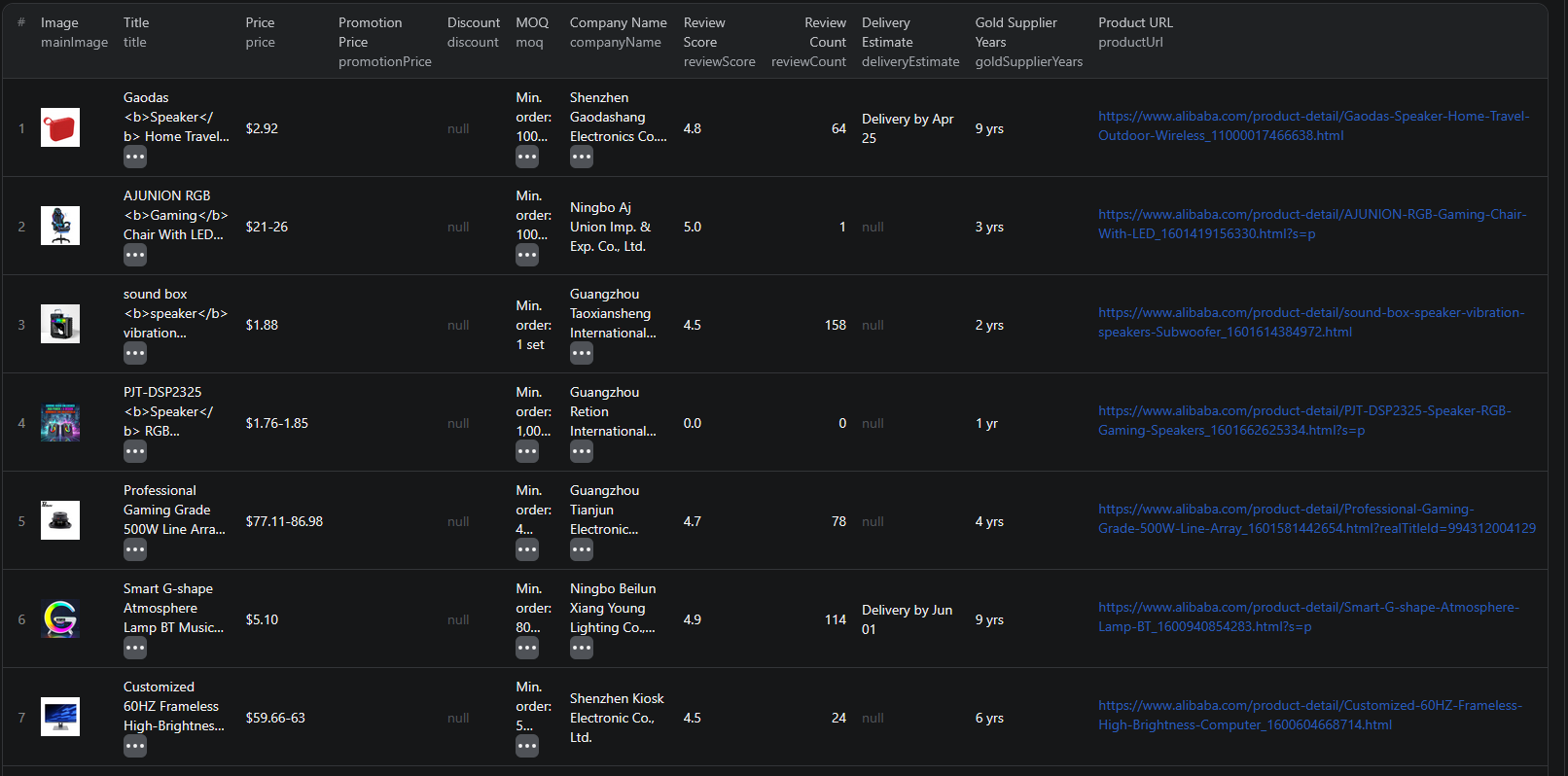
Alibaba scraper results

Here is what the actual output looks like from the Alibaba Listings Scraper. Each product listing returns a structured JSON object:

{
  "title": "Hot Selling Galaxy S24 Ultra 5G Smartphone 6.8inch 16G+512GB With S-Pen Original Android 13 Telephone 4G 5G+WIFI Mobile Phones",
  "price": "$119.60",
  "promotionPrice": "$59.80",
  "discount": "50% off",
  "moq": "Min. order: 1 unit",
  "companyName": "Hefei Iceching Technology Co., Ltd.",
  "countryCode": "CN",
  "productUrl": "https://www.alibaba.com/product-detail/Hot-Selling-Galaxy-S24-Ultra-5G_1601346037142.html",
  "mainImage": "https://s.alicdn.com/@sc04/kf/H1b5534c89e824e47bdd077487445e014I.jpg_300x300.jpg",
  "reviewScore": "4.2",
  "reviewCount": 8,
  "deliveryEstimate": "Delivery by Mar 21"
}

Key things to notice:

  • Product details — full title and direct product URL for quick access to the listing page
  • Pricing intelligence — original price, promotion price, and discount percentage for cost comparison
  • Supplier data — company name and country code for supplier vetting and geographic analysis
  • Order requirements — minimum order quantity for sourcing feasibility assessment
  • Social proof — review score and count for supplier and product quality evaluation
  • Logistics — delivery estimate for supply chain planning

This structured format makes it straightforward to import into any procurement tool, spreadsheet, or analytics platform for sourcing decisions and price comparisons.

Try the Alibaba Listings Scraper now — no coding required.

Automating Supplier Research

For ongoing sourcing intelligence, you do not want to run the scraper manually every time you need fresh data. The Apify platform supports full automation:

Scheduled Runs

Set up recurring scrapes on any schedule — daily, weekly, or monthly. The scraper runs automatically and stores results in a dataset you can access anytime. Daily runs work well for price monitoring, while weekly runs are sufficient for general supplier research.

API Integration

Use the Apify API to trigger scraper runs programmatically and retrieve results. This lets you integrate Alibaba data into your existing sourcing workflows:

  • Feed new product listings directly into your procurement system
  • Trigger alerts when prices drop below a threshold
  • Build dashboards that update with fresh wholesale pricing data
  • Connect to tools like Zapier, Make, or custom data pipelines

Supplier Comparison Pipelines

Combine Alibaba data with data from other e-commerce platforms like AliExpress for retail pricing comparison or Clutch for finding sourcing agencies. Cross-referencing multiple sources gives you a more complete picture of the market.

Node.js Example

For a complete working example showing how to call this scraper from Node.js, see the GitHub repository.

Webhooks

Configure webhooks to get notified when a scraper run completes. This is useful for event-driven architectures where you want to process new product data as soon as it is available.

Using Alibaba Data for Sourcing Intelligence

Alibaba data goes beyond simple product discovery. It is a powerful tool for strategic sourcing decisions.

Supplier Comparison

Compare suppliers across the same product category by analyzing their pricing, MOQs, review scores, and delivery estimates. Identify which suppliers offer the best combination of price, quality, and reliability. This data-driven approach replaces guesswork with structured evaluation.

Pricing Analysis Across Regions

Alibaba suppliers operate from different countries and regions. Scraping product data lets you compare pricing across geographies — for example, comparing smartphone sourcing costs from Chinese suppliers versus Southeast Asian manufacturers. This regional pricing intelligence informs procurement strategy.

Product Trend Identification

Track which products appear most frequently in search results, which have the highest review counts, and which categories show the most promotional activity. These signals indicate market demand and can inform your product selection decisions.

Does Alibaba Provide an API?

Alibaba offers limited API access through its partner and affiliate programs, but it has significant limitations:

Alibaba Open Platform

  • Requires partner approval and business verification
  • Limited to specific use cases approved by Alibaba
  • Does not provide the full depth of listing data available on the website
  • Rate limits restrict the volume of data you can access
  • Access can be revoked if usage does not align with Alibaba's terms

What the API Misses

The official API does not give you the same data you can see on the website — particularly detailed promotion pricing, discount percentages, delivery estimates, and the full supplier company information shown in search results. For comprehensive product research and price monitoring, a scraper provides significantly more data depth.

The Alibaba Listings Scraper gives you a practical alternative — structured product data from any search query, without API approval or access restrictions.

Why Use an Alibaba Scraper Instead of Building One

Building a custom Alibaba scraper sounds straightforward until you start dealing with the reality:

  • Infrastructure complexity — Alibaba requires browser-level rendering, proxy rotation, and sophisticated request management. Setting this up from scratch is a significant engineering project.
  • Anti-bot protection — Alibaba actively detects and blocks scraping attempts. A production-quality scraper needs CAPTCHA handling, fingerprint management, and anti-detection measures that take time to fine-tune.
  • Maintenance cost — Alibaba updates its frontend regularly. Every update can break your scraper, requiring immediate fixes to keep your data pipeline running.
  • Scaling challenges — scraping across multiple product categories and keywords requires distributed infrastructure, queue management, and monitoring. The operational overhead adds up fast.
  • Opportunity cost — every hour spent building and maintaining a scraper is an hour not spent on sourcing decisions, supplier negotiations, or growing your business

Unless you have very specific requirements that no existing tool can meet, using a maintained scraper lets you focus on what to do with the data instead of how to collect it.

Try the Alibaba Listings Scraper

The Alibaba Listings Scraper extracts structured data from Alibaba product listings — product titles, prices, promotion prices, discounts, MOQs, supplier names, country codes, review scores, delivery estimates, and direct URLs.

What you get:

  • Structured JSON or CSV output ready for procurement tools or analysis
  • All key product and supplier data fields in a single export
  • Search-based extraction for any product category or keyword
  • Scheduled runs for ongoing price monitoring and supplier research
  • API access for integration into your sourcing workflows
  • No coding or scraper maintenance required

Start scraping Alibaba now — your first run takes less than 5 minutes to set up.

If you are building a sourcing data pipeline, combine Alibaba data with other e-commerce sources like AliExpress for retail price comparison, LinkedIn jobs for hiring signals from potential partners, or Fiverr for finding e-commerce freelancers and sourcing agents.

Legal and Ethical Considerations

Web scraping occupies a well-established legal space, but responsible practice matters:

  • Public data only — the Alibaba scraper extracts publicly visible product information that anyone can see by visiting Alibaba.com. No login or authentication is required.
  • Respect rate limits — the scraper is designed to make requests at a reasonable pace to avoid overloading Alibaba's servers
  • No misuse — use collected data for legitimate business purposes like sourcing research, price monitoring, and competitive analysis. Do not use the data to create counterfeit listings or mislead buyers.
  • Compliance — if you operate in the EU or California, ensure your data handling complies with GDPR or CCPA. This primarily applies to how you store and process the data, not the collection itself.

Alibaba product listings are public marketplace data — they are designed to be found by buyers worldwide. Scraping this data for sourcing and procurement is aligned with the platform's intended purpose.

Frequently Asked Questions

Is scraping Alibaba legal?

Scraping publicly available product data from Alibaba is generally legal. The listings are visible to anyone who visits the site without logging in. However, you should always use the data responsibly, comply with local privacy regulations, and avoid overloading Alibaba's servers with excessive requests.

Does Alibaba provide an API?

Alibaba offers limited API access through its affiliate and partner programs, but these require approval, have usage restrictions, and do not provide the same depth of data you can get from scraping — particularly detailed pricing, MOQs, discount percentages, and supplier-level information. A web scraper is the practical alternative for extracting structured product data at scale.

What data can be extracted from Alibaba?

You can extract product titles, prices, promotion prices, discount percentages, minimum order quantities, supplier company names, country codes, product URLs, images, review scores, review counts, and delivery estimates. Each listing is returned as a structured JSON object.

How often can product data be updated?

You can schedule scraper runs as often as you need — daily, weekly, or on a custom schedule. For price monitoring, daily or every-other-day runs keep data fresh. For general sourcing research, weekly runs provide a good balance of freshness and efficiency.

Can I export Alibaba product lists?

Yes. The Alibaba Listings Scraper supports exporting results as JSON, CSV, or via API. CSV exports can be opened directly in Excel or Google Sheets for analysis and sourcing comparisons.

How many Alibaba products can I scrape at once?

The scraper can process searches across multiple keywords in a single run. There is no hard limit on the number of listings — the run time scales with the volume of data you request.

About the Author

This guide was written by Piotr, a software engineer with hands-on experience building and maintaining web scrapers at scale. He develops and maintains a suite of data extraction tools on the Apify platform, helping businesses automate their data collection workflows.

Need help with your scraping project?

Book a free discovery call and let's scope your project together.

Book a Call
Piotr Vassev

Piotr Vassev

Founder of FalconScrape. Building production-grade web scraping systems and data automation pipelines for businesses worldwide.

Connect on LinkedIn