How to Scrape Mercado Libre Product Reviews
A product's average rating tells you whether buyers are broadly satisfied. It does not tell you which problems recur, whether feedback is recent, or whether customer photos support the written comments.
Our Mercado Libre Reviews Scraper accepts product URLs from Mexico, Argentina, and Brazil. It returns individual reviews with star ratings, text, dates, helpful votes, customer photos and videos, and the product and marketplace identifiers needed to keep the feedback traceable.
Use it to review a manageable sample before running sentiment analysis. Mercado Libre can group reviews across countries and product variants, and the returned text may already have been translated by the marketplace.

Collect twelve recent reviews
- Open the Actor on Apify and click Try for free.
- Add a catalog or seller-item URL under Product URLs.
- Set Maximum reviews to
12. - Choose Newest first and All ratings.
- Leave Deeper collection off for the first run, then click Start.
We used this input:
{
  "productUrls": [
    "https://www.mercadolibre.com.mx/apple-iphone-16-256-gb-rosa/p/MLM40287790"
  ],
  "maxItems": 12,
  "sort": "dateCreated",
  "rating": "all",
  "deepScan": false,
  "proxyConfiguration": {
    "useApifyProxy": true
  }
}
maxItems is global, not per product. If you add several URLs, they are processed in order and the first product can use the whole limit. Use separate tasks when each product needs the same review allowance.
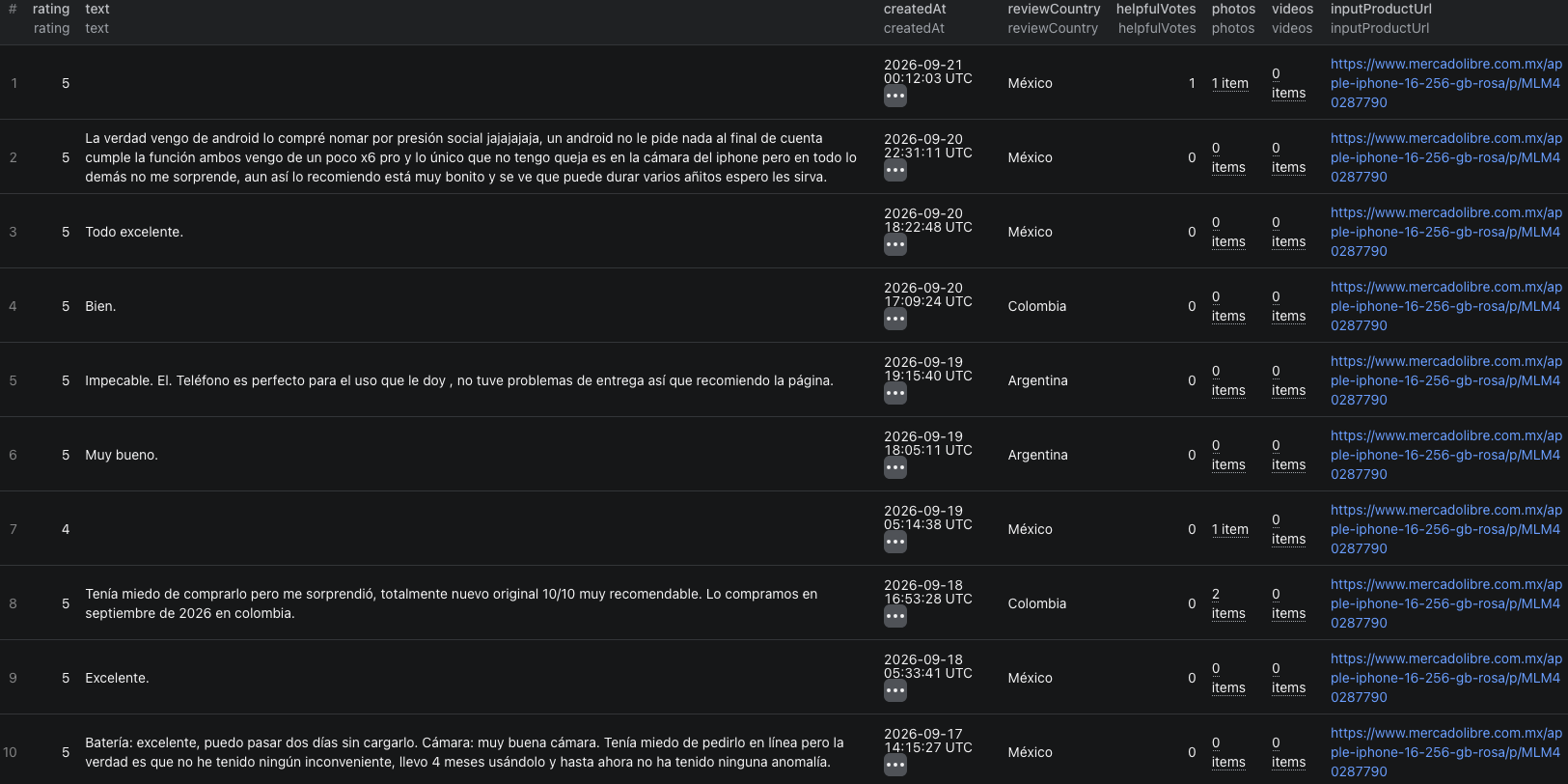
Our example run returned 12 reviews. One abbreviated row was:
{
  "reviewId": "3146101484",
  "rating": 5,
  "text": "",
  "dateText": "Ayer",
  "createdAt": "2026-09-21T00:12:03Z",
  "reviewSite": "MLM",
  "reviewCountry": "México",
  "reviewedCatalogProductId": "MLM40287808",
  "variant": null,
  "helpfulVotes": 1,
  "photos": ["https://http2.mlstatic.com/...jpg"],
  "videos": [],
  "inputProductId": "MLM40287790",
  "marketplace": "MLM",
  "sourceSort": "dateCreated",
  "sourceRating": "all",
  "scrapedAt": "2026-09-22T05:45:06.003Z"
}
An empty text value is valid. Some buyers leave only a rating or attach media without a written comment.
| Field group | How to use it |
|---|---|
reviewId, inputProductId, reviewedCatalogProductId | Deduplicate reviews and keep them attached to the input and reviewed product identities. |
rating, text, createdAt | Find recent low ratings and retain the original returned text beside any topic or sentiment label. |
reviewSite, reviewCountry | Separate feedback by source market instead of assuming every row came from the input country. |
variant | Keep variant context when Mercado Libre supplies it. A null value means the source did not provide one. |
helpfulVotes, photos, videos | Use supporting signals and customer media during manual review. Media remains hosted by the source. |
sourceSort, sourceRating, sourceOffset | Record how each review was collected, especially when comparing several runs. |
The Mercado Libre reviews Node.js example calls the Actor with the same product URL and retrieves the resulting dataset.
Find the problems buyers mention repeatedly
Start with one product and a small newest-first sample. Keep the source fields visible while you classify the feedback:
- Separate rows by
reviewCountryandreviewedCatalogProductId. - Filter ratings from one to three stars, but retain rating-only rows as a separate group.
- Tag specific subjects such as battery, sizing, packaging, compatibility, or delivery.
- Keep the returned text beside every tag. Do not discard it after translation or sentiment scoring.
- Count a subject only after defining a consistent rule for what belongs in it.
The input marketplace and review country can differ because Mercado Libre groups feedback across its catalog. That can be useful for regional research, but it means a Mexican product URL is not automatically a Mexico-only review sample.
Use the Mercado Libre product details guide when you also need price, seller, stock, attributes, and variations. Use the listings guide to discover products before selecting a smaller set for review analysis.
Choose the collection mode deliberately
Use dateCreated when the goal is monitoring new complaints. Use relevance when you want Mercado Libre's most-helpful ordering for an initial qualitative review. Neither order creates a representative survey by itself.
Select a one-to-five-star filter when the question is narrow, such as examining recent one-star feedback. Keep all when you need the surrounding positive and neutral context.
Turn on deepScan only after the first stream is useful. It explores more rating and sort groups, which can discover additional reviews, but output is no longer globally ordered by date. Mercado Libre may expose fewer written comments than the rating total shown on the product page, so deeper collection does not promise a complete history.
For recurring monitoring, save recent reviewId values and provide them through stopAtReviewIds on the next newest-first run. The Actor stops each product when it reaches a known ID. Mercado Libre can reorder feedback, so this is a convenient stopping rule rather than proof that every new review was found.
Pricing
Pricing as of September 22, 2026 is $0.001 per unique saved review, or $1 per 1,000 reviews. Duplicates, retries, empty responses, and run summaries are not charged as review events.
Our 12-review example cost 12 × $0.001 = $0.012 in Actor event charges. Apify platform or proxy usage may be billed separately according to your plan. Set maxItems, use the run's maximum-charge control, and check live pricing before increasing the scope.
Check these cases before scaling up
- A review has no text. Keep rating-only rows separate instead of interpreting an empty string as neutral feedback.
- Reviews come from another country. Use
reviewSiteandreviewCountry; grouped catalog reviews can cross marketplace borders. - Several inputs return the same review. The Actor deduplicates by review ID and retains the first encountered copy.
- The run stops before the advertised total. Ratings and written comments are different totals, and Mercado Libre can limit each review stream. Open the run summary to see the stopping reason.
- Customer media stops loading. The output contains source-hosted URLs, not downloaded files. Retain media only when you are permitted to do so.
- A seller-item URL fails. Use the original article or review URL and retain
isItem=trueon seller-item review URLs. Search URLs, short links, and bare IDs are not supported.
Frequently asked questions
Which Mercado Libre sites are supported?
The Actor accepts catalog and seller-item product URLs from Mexico, Argentina, and Brazil. A product can contain grouped reviews from other Mercado Libre markets.
Does maxItems apply to every product URL?
No. maxItems is the maximum number of unique reviews across the whole run. URLs are processed in order, so an earlier product can use the entire allowance.
Can the Actor collect every review shown by Mercado Libre?
Not always. Mercado Libre exposes fewer written reviews than ratings for some products and can limit individual review streams. Deeper collection explores more groups but does not guarantee a complete history.