Piotr VassevPiotr Vassev

How to Scrape Xianyu (Goofish) Listings and Second-Hand Market Data

How to Scrape Xianyu Listings

If you want to scrape Xianyu listings for price research, resale trend analysis, or second-hand market intelligence, this guide walks you through the complete process. You will learn what data you can extract from China's largest C2C marketplace, how to automate collection at scale, and how to turn raw Xianyu listings into structured, actionable datasets — without needing a Taobao account for most use cases.

Why Scrape Xianyu Data?

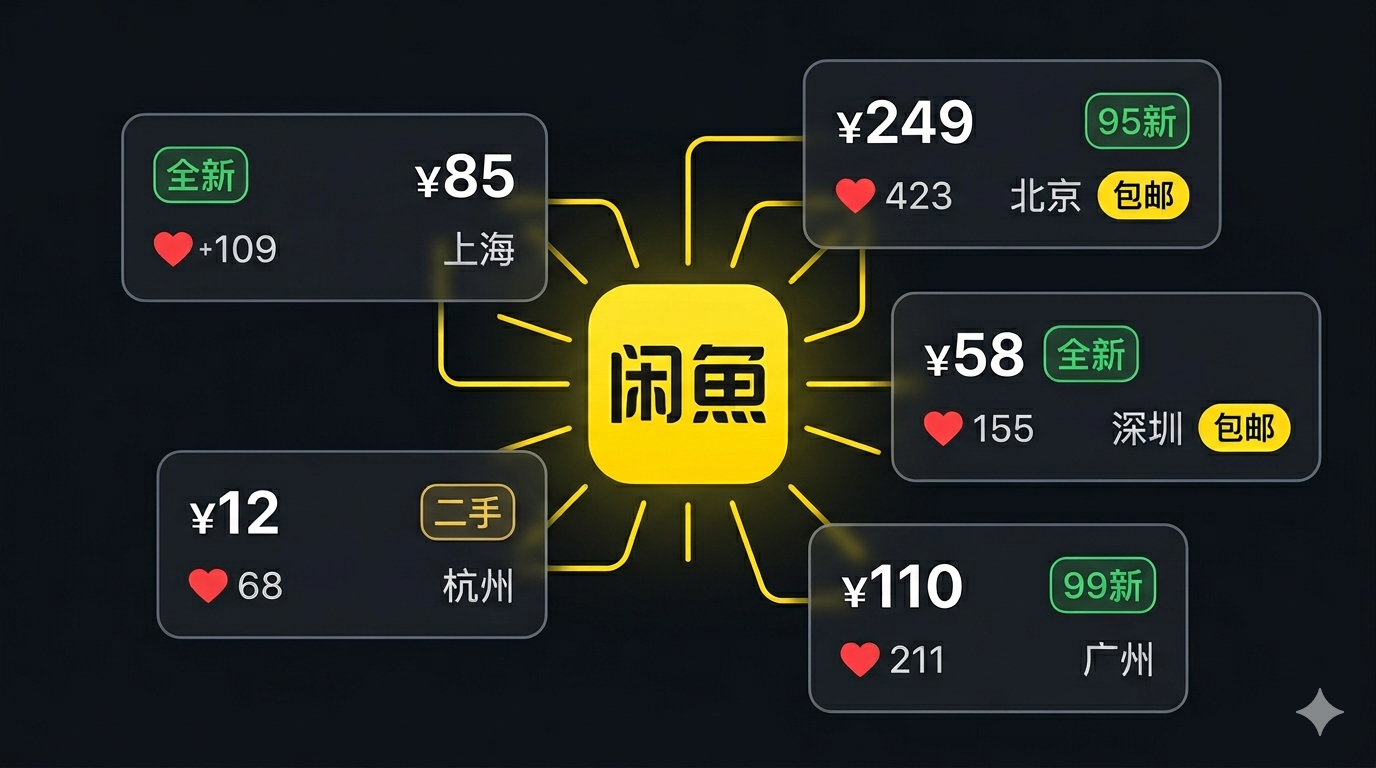
Xianyu (闲鱼), which translates to "idle fish" and operates internationally as Goofish, is Alibaba's peer-to-peer second-hand marketplace. With tens of millions of active listings spanning 30+ categories — electronics, fashion, collectibles, home goods, sports equipment, and more — it is the dominant C2C resale platform in China and one of the largest second-hand marketplaces in the world by transaction volume.

What makes Xianyu uniquely valuable as a data source is its sheer scale and the real-world pricing dynamics it reflects. Unlike curated retail platforms, Xianyu prices emerge from genuine buyer-seller negotiations between private individuals and small resellers. The platform also surfaces emerging product demand in the Chinese consumer market before that demand shows up in mainstream retail or export channels.

Businesses and researchers scrape Xianyu data for several reasons:

  • Price research — understand what specific products fetch on the Chinese second-hand market, expressed in real transaction-level pricing data
  • Resale market analysis — track supply and demand for product categories, identify regional pricing differences, and monitor how quickly certain goods move
  • Trend monitoring — spot which product types are gaining traction among Chinese consumers in the secondhand market before trends reach mainstream coverage
  • Competitive intelligence — track how specific sellers price and position their inventory over time
  • Cross-market arbitrage — compare Xianyu prices with international resale platforms to identify pricing gaps and arbitrage opportunities
  • Brand and product research — understand how branded products retain their value in the Chinese resale market
  • Academic and market research — build datasets for studying China's informal economy, consumer electronics lifecycle, and second-hand market dynamics

Manually browsing Xianyu and copying listing details is completely impractical at scale. The platform's continuously updated home feed surfaces millions of items, and listings appear and disappear rapidly. Automation is the only viable approach for meaningful data collection.

What Data You Can Extract from Xianyu

The Xianyu Listings Scraper extracts structured data in two depth levels — standard listing data and optionally enriched detail data. Here are the key fields available:

Standard Listing Fields

FieldDescriptionExample
Item IDUnique Xianyu listing identifier956904261043
URLDirect link to the listing on Goofishgoofish.com/item?id=956904261043
TitleListing title as written by the seller进口原装Alpha wire 阿尔法电子线2634BK001
PriceListed price in CNY85
CurrencyCurrency codeCNY
CitySeller's city上海 (Shanghai)
ConditionItem condition as listed全新 (Brand new)
SellerSeller's display name黑色羽翼
Main imagePrimary listing image URLimg.alicdn.com/...jpg
ImagesArray of all listing image URLs["img.alicdn.com/...jpg"]
Want countNumber of users who "want" this item4
Free shippingWhether free shipping is offeredtrue
Accepts bargainWhether the seller accepts offerstrue
Category IDXianyu category identifier50025387
Listed atOriginal listing timestamp2026-02-13T10:22:37.938Z
Scraped atTimestamp of data collection2026-03-25T18:12:00.000Z

Additional Fields with Detail Enrichment (fetchDetails: true)

FieldDescriptionExample
DescriptionFull seller-written item description全新未开封,购于官网,因换工作不再需要,低价出售。
ViewsNumber of views on the listing112
Seller ratingSeller's positive rating percentage94%
Seller sold countTotal items sold by the seller131
Seller sinceHow long the seller has been on Xianyu来闲鱼9年 (9 years on Xianyu)
Escrow transactionWhether the listing uses escrow protectiontrue

The two-level design lets you choose between breadth and depth: standard mode is fast and cost-efficient for bulk price surveys, while detail enrichment gives you everything needed for comprehensive seller and listing analysis.

Common Use Cases for Xianyu Data

Chinese Resale Price Research

Xianyu is the ground truth for what consumer goods are worth in China's second-hand market. Unlike official retail pricing, Xianyu reflects real buyer-seller dynamics — what people actually pay for used and surplus goods. For anyone sourcing products from or selling into China, Xianyu pricing data provides a reliable market baseline that complements official retail data.

Use listing price data combined with condition fields to build segment-level pricing models: what does a lightly-used smartphone sell for versus a sealed new unit? How does pricing vary by city? How do bargain-accepted listings compare to firm-price listings?

Consumer Demand Monitoring

The wantCount field — the number of users who have marked an item as "wanted" — is a direct demand signal that most marketplace scrapers don't expose. Tracking want counts across product categories reveals which items are attracting buyer interest even before a transaction occurs.

Combine this with listing volume and price trends to build a multi-dimensional demand picture: high want counts + high prices + low inventory suggests a supply-constrained category where prices may rise further.

Cross-Market Arbitrage Analysis

Xianyu prices frequently diverge from prices on international resale platforms. A used electronics item selling on Xianyu for a fraction of its equivalent price on eBay or Japanese resale platforms may represent a sourcing opportunity — or a pricing signal worth tracking.

Systematically comparing Xianyu prices against other marketplace datasets allows you to identify persistent arbitrage opportunities and track how gaps evolve over time as market information spreads.

Seller Intelligence and Competitive Research

The seller fields — name, rating, sold count, and tenure — let you segment the Xianyu seller base. Identify high-volume sellers who are effectively operating as informal businesses, track their pricing strategies over time, and understand how professional sellers price compared to casual individual sellers.

This is valuable for marketplace operators, brands monitoring their products in the secondhand channel, and businesses considering whether to establish a direct Xianyu presence.

Brand and Product Lifecycle Research

How do your products perform after the initial sale? Scraping Xianyu lets brands track how quickly their products appear in the resale market, what prices they command relative to retail, and how resale value varies across product lines.

The escrow transaction flag and seller rating data also provide signal about how trusted transactions in your product category are — useful context for brands thinking about certified refurbishment or take-back programs in the Chinese market.

China Market Entry Research

For businesses considering entry into the Chinese consumer market, Xianyu data provides an accessible, structured view of what Chinese consumers own, value, and trade. Product categories with high listing volumes and strong demand signals represent established consumer preferences. Category and condition distributions reveal how different product types are positioned in the market.

Challenges of Extracting Xianyu Data Manually

Before jumping into the tutorial, it is worth understanding why scraping Xianyu requires automation:

  • Scale — tens of millions of active listings across 30+ categories makes manual browsing entirely impractical for any meaningful analysis
  • Language barrier — the platform is in Chinese, including category structures, condition labels, and seller descriptions, which adds friction for non-Chinese-speaking teams
  • Session management — keyword search requires managing a Taobao session cookie that expires every 2–3 days, requiring regular refresh
  • API complexity — Xianyu's home feed is powered by Alibaba's in-browser MTOP API, which requires specific request construction and session handling to call reliably
  • Listing volatility — popular items sell quickly and disappear from the platform. Manual collection lags real-time market conditions significantly
  • Geo-diversity — Xianyu operates across hundreds of Chinese cities. Capturing meaningful geographic coverage manually is not feasible

Building and maintaining a custom Xianyu scraper that handles all of this reliably is a significant engineering investment. A pre-built, maintained solution is far more practical for most use cases.

Step-by-Step: How to Scrape Xianyu Listings

Here is how to scrape Xianyu data using the Xianyu / Goofish Listings Scraper on Apify.

Step 1 — Choose Your Mode: Feed or Search

The Xianyu Listings Scraper supports two input modes:

Feed mode (no account required) — scrapes the continuously paginated home feed, collecting up to 20,000+ listings per run across all categories. This is the easiest way to get started and requires no Xianyu or Taobao account.

Search mode (Taobao account required) — lets you target specific keywords and collect results for those searches. This requires a valid Taobao session cookie. One request is created per keyword, and the maxItems limit applies per keyword. See the session setup section below if you need keyword-specific data.

For most broad market research and price benchmarking use cases, feed mode provides more than enough data without the authentication overhead.

Step 2 — Configure the Scraper Input

Head to the Xianyu / Goofish Listings Scraper on Apify and configure your run:

  1. Set mode to feed or search
  2. If using search mode, add your target keywords to the keywords field
  3. Set maxItems to control how many listings to extract (applies to the total in feed mode, per keyword in search mode)
  4. Toggle fetchDetails to true if you need enriched seller data, descriptions, view counts, and all carousel images — note this is slower and charged at a higher rate
  5. If using search mode, paste your session state into the sessionStateBase64 field or store it in the actor's key-value store under the XIANYU_SESSION key
  6. Configure proxy settings — standard datacenter proxies work for feed mode; mainland China residential proxies are recommended for search mode
  7. Click Start to begin the extraction

The scraper handles API calls, pagination, and data parsing automatically.

Step 3 — Run the Scraper

Once started, the scraper will:

  • Call Alibaba's MTOP API to collect listing data in batches of approximately 20 items per API call
  • Navigate through the feed or search results up to your configured maxItems limit
  • Parse all structured listing fields including price, city, condition, seller info, and images
  • Optionally visit each item's detail page if fetchDetails is enabled
  • Store results in a clean, structured dataset

Processing time depends on the number of listings and whether detail enrichment is enabled. Feed mode runs are fast since they use the API directly without heavy DOM parsing. Detail enrichment adds per-item page loads that increase both run time and cost.

Step 4 — Export Your Results

Once the scraper finishes, export your results in your preferred format:

  • JSON — ideal for developers building data pipelines or downstream integrations
  • CSV — perfect for spreadsheet analysis in Excel or Google Sheets
  • API — access results programmatically via the Apify API for automated workflows

Each record includes the full set of structured fields you configured for your run.

Ready to try it? Run the Xianyu / Goofish Listings Scraper on Apify and get your first dataset in minutes.

Example Output (Real Data Preview)

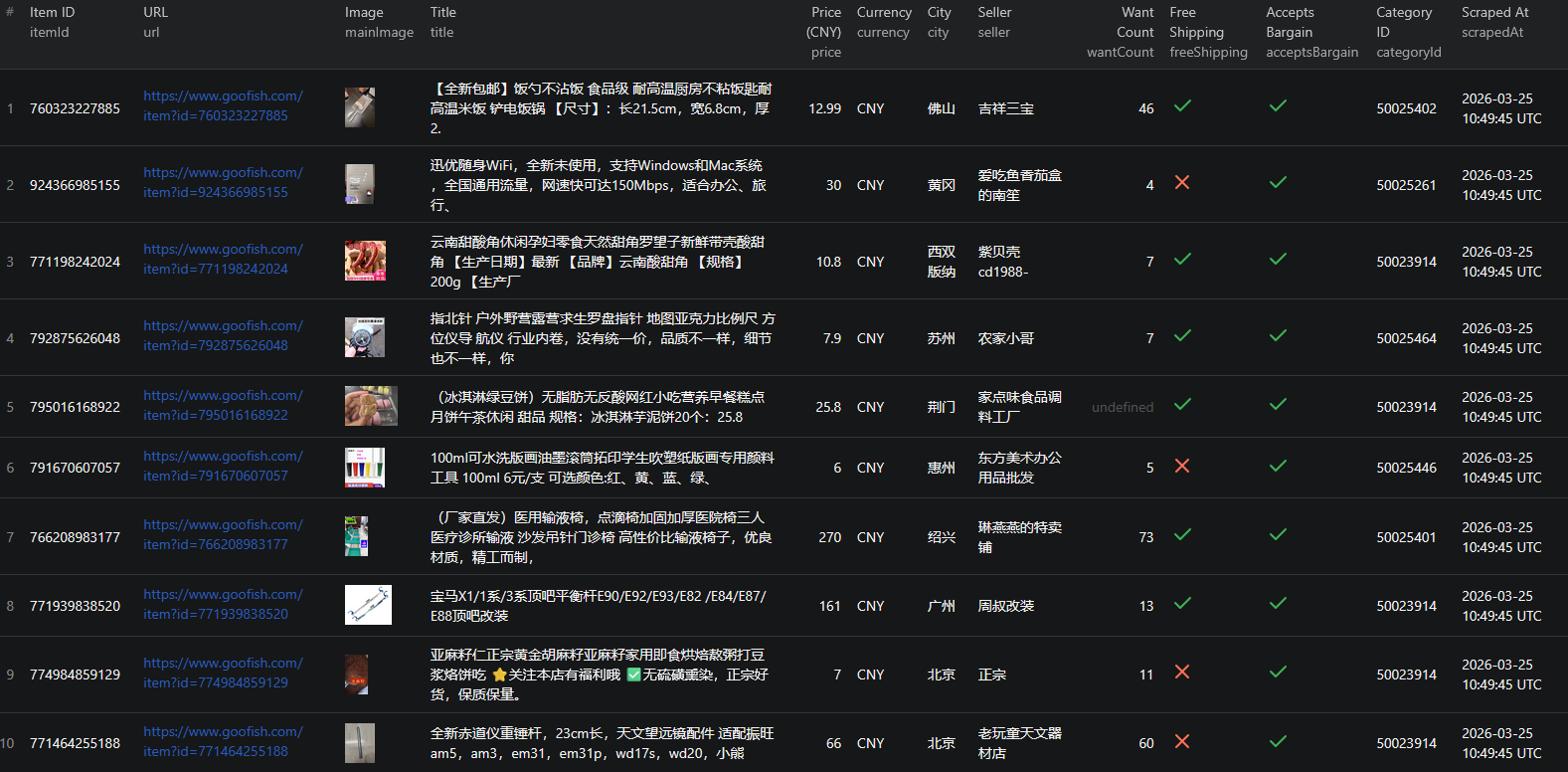
Xianyu scraper results

Here is what the actual output looks like from the Xianyu / Goofish Listings Scraper.

Standard listing output:

{
  "itemId": "956904261043",
  "url": "https://www.goofish.com/item?id=956904261043",
  "title": "进口原装Alpha wire 阿尔法电子线2634BK001",
  "price": 85,
  "currency": "CNY",
  "city": "上海",
  "condition": "全新",
  "seller": "黑色羽翼",
  "sellerAvatar": "http://img.alicdn.com/...",
  "mainImage": "http://img.alicdn.com/...jpg",
  "images": ["http://img.alicdn.com/...jpg"],
  "wantCount": 4,
  "freeShipping": true,
  "acceptsBargain": true,
  "categoryId": "50025387",
  "listedAt": "2026-02-13T10:22:37.938Z",
  "scrapedAt": "2026-03-25T18:12:00.000Z"
}

With detail enrichment (fetchDetails: true):

{
  "itemId": "956904261043",
  "url": "https://www.goofish.com/item?id=956904261043",
  "title": "进口原装Alpha wire 阿尔法电子线2634BK001",
  "price": 85,
  "currency": "CNY",
  "city": "上海",
  "condition": "全新",
  "seller": "黑色羽翼",
  "sellerAvatar": "http://img.alicdn.com/...",
  "mainImage": "http://img.alicdn.com/...jpg",
  "images": ["http://img.alicdn.com/...jpg"],
  "wantCount": 4,
  "freeShipping": true,
  "acceptsBargain": true,
  "categoryId": "50025387",
  "listedAt": "2026-02-13T10:22:37.938Z",
  "scrapedAt": "2026-03-25T18:12:00.000Z",
  "description": "全新未开封,购于官网,因换工作不再需要,低价出售。",
  "views": 112,
  "sellerRating": "94%",
  "sellerSoldCount": 131,
  "sellerSince": "来闲鱼9年",
  "escrowTransaction": true
}

Key things to notice:

  • Price in CNY — prices are returned as numbers in Chinese Yuan, ready for currency conversion or direct comparison across listings
  • City-level location — every listing includes the seller's city, enabling geographic segmentation across China's 300+ prefecture-level cities without additional parsing
  • Condition field — the condition label (e.g. 全新 / brand new, 九成新 / like new) is returned exactly as the seller entered it, giving you both the raw signal and the ability to normalize across condition tiers
  • Want count — a demand signal unique to Xianyu that indicates how many users have expressed interest in an item, even before a sale occurs
  • Bargain and shipping flags — boolean flags for acceptsBargain and freeShipping enable instant filtering without parsing price text or description fields
  • Timestamps — both the original listing date and the scrape timestamp are included, enabling you to calculate listing age and identify freshly posted inventory

This structured format imports cleanly into any spreadsheet, database, or analytics platform without additional transformation.

Try the Xianyu / Goofish Listings Scraper now — no coding required.

Setting Up Search Mode (Taobao Session)

If you need keyword-targeted results rather than broad home-feed data, search mode requires an authenticated Taobao or Xianyu session. Here is how to generate one:

  1. Open a Playwright browser and navigate to https://www.goofish.com/
  2. When the QR code popup appears, scan it using the Xianyu mobile app
  3. After successful login, export the session state by running: Buffer.from(JSON.stringify(await context.storageState())).toString('base64')
  4. Paste the resulting Base64 string into the sessionStateBase64 input field, or store it under the XIANYU_SESSION key in the actor's default key-value store

Sessions remain valid for approximately 2–3 days before requiring a refresh. For ongoing search mode usage, build a refresh workflow into your pipeline.

Note that Taobao registration requires a Chinese phone number, which limits search mode to users who already have a Taobao or Xianyu account.

Automating Xianyu Market Monitoring

For ongoing price tracking, trend research, or demand monitoring, you do not want to run the scraper manually every time. The Apify platform supports full automation:

Scheduled Runs

Set up recurring scrapes on any schedule — daily, weekly, or monthly. The scraper runs automatically and stores results in a persistent dataset you can access at any time. Daily runs are ideal for fast-moving categories like electronics or collectibles where prices shift quickly. Weekly runs are sufficient for broader market research and trend analysis.

API Integration

Use the Apify API to trigger scraper runs programmatically and retrieve results. This lets you integrate Xianyu data into your existing workflows:

  • Feed listing data into pricing dashboards or analytics tools automatically
  • Trigger alerts when specific product categories drop below a target price threshold
  • Build trend reports that update on a schedule with fresh Xianyu data
  • Connect to tools like Zapier, Make, or custom data pipelines

Price Tracking Pipelines

Combine scheduled scraping with historical data storage to build price tracking systems. Monitor how prices shift over time for specific product categories, identify seasonal patterns, and track listing volume as a leading indicator of supply and demand shifts.

Node.js Example

For a complete working example showing how to call this scraper from Node.js, see the GitHub repository.

Webhooks

Configure webhooks to get notified when a scraper run completes. This is useful for event-driven workflows where you want to process new listing data as soon as it is available rather than polling on a schedule.

Does Xianyu Have an Official API?

No. Xianyu does not offer a public API for accessing its marketplace data. There is no official way to programmatically query product listings, pricing, or seller information.

Your practical options for bulk data extraction are:

  • Manual browsing — works for a handful of listings but completely unscalable for any meaningful analysis
  • Custom scraper — requires development time, ongoing maintenance, MTOP API reverse engineering, session management, and proxy infrastructure
  • Pre-built scraper — a maintained solution like the Xianyu / Goofish Listings Scraper that handles all technical complexity out of the box

For most teams, the pre-built scraper is the most practical path. It eliminates the engineering and maintenance burden while delivering reliable, structured output.

Why Use a Pre-Built Xianyu Scraper Instead of Building One

Building a custom Xianyu scraper sounds straightforward until you encounter the real challenges:

  • MTOP API reverse engineering — Xianyu's home feed is powered by Alibaba's internal MTOP API, not a standard web page. Reverse-engineering this API requires significant time and breaks periodically as Alibaba updates the protocol
  • Session management — search mode requires maintaining a live Taobao session that expires every few days. Building reliable session refresh automation adds meaningful complexity to any custom solution
  • Proxy requirements — search mode requires mainland China residential proxies for reliable access, which adds infrastructure cost and management overhead beyond standard datacenter proxies
  • Chinese language handling — category structures, condition labels, and attribute fields are in Chinese. Correct parsing and normalization requires familiarity with the platform's conventions
  • Anti-bot protection — Alibaba has sophisticated bot detection. Reliable scraping at scale requires careful request timing, fingerprint management, and proxy rotation
  • Maintenance burden — Alibaba updates Xianyu's API and frontend regularly. Every update is a potential breakage that requires immediate intervention to keep your pipeline running
  • Opportunity cost — every hour spent building and maintaining a scraper is an hour not spent analyzing prices, identifying trends, or making sourcing decisions

Unless you have highly specific requirements that no existing tool can meet, a pre-built, maintained scraper lets you focus on using the data rather than collecting it.

Try the Xianyu / Goofish Listings Scraper

The Xianyu / Goofish Listings Scraper extracts structured product data from China's largest C2C second-hand marketplace — titles, prices, cities, conditions, seller info, images, want counts, shipping and bargain flags, and timestamps.

What you get:

  • Structured JSON or CSV output ready for analysis
  • Home-feed mode with no account required — up to 20,000+ listings per run
  • Keyword search mode for targeted collection (Taobao session required)
  • Optional detail enrichment for descriptions, view counts, seller ratings, and full image sets
  • Want count demand signals unique to Xianyu
  • City-level geographic data on every listing
  • Scheduled runs for ongoing price monitoring and trend tracking
  • API access for integration into your data workflows
  • No coding or scraper maintenance required

Start scraping Xianyu now — your first run takes less than 5 minutes to set up.

If you are building a broader resale market intelligence pipeline, combine Xianyu data with other secondhand marketplace sources like Mercari for Japanese market insights or Depop for Western secondhand fashion data.

Legal and Ethical Considerations

Web scraping occupies a well-established legal space, but responsible practice matters:

  • Public data only — the Xianyu scraper's feed mode extracts publicly visible listing information that anyone can see by visiting Goofish without logging in
  • Respect rate limits — the scraper is designed to make requests at a reasonable pace to avoid overloading Xianyu's servers
  • Responsible use — use collected data for legitimate business purposes like price research, market analysis, and trend monitoring
  • Privacy compliance — if you operate in jurisdictions with data protection laws, ensure your data handling complies with applicable regulations. This applies to how you store and process data, not to the collection of publicly visible listing information
  • Session security — if using search mode, handle your Taobao session state securely and do not share it publicly

Frequently Asked Questions

Is scraping Xianyu legal?

Scraping publicly available data from Xianyu's home feed is generally legal. Listings in the home feed are visible to anyone who visits the site without logging in. You should always use the data responsibly, comply with applicable regulations, and avoid overloading Xianyu's servers with excessive requests.

Does Xianyu have an official API?

Xianyu does not offer a public API for accessing its marketplace data. There is no official way to programmatically query product listings, pricing, or seller information. A web scraper is the practical alternative for extracting structured resale data at scale.

What data can be extracted from Xianyu?

You can extract listing IDs, URLs, titles, prices (in CNY), cities, conditions, seller names, images, want counts, free-shipping and bargain-accepted flags, category IDs, and timestamps. With detail enrichment enabled, you also get descriptions, view counts, seller ratings, sold counts, seller tenure, and escrow status.

Do I need a Taobao or Xianyu account to use the scraper?

No account is required for home-feed mode, which can collect 20,000+ listings per run. Keyword search mode requires an authenticated Taobao session (Chinese phone number registration). See the session setup section for how to generate a session state.

What is the difference between feed mode and search mode?

Feed mode scrapes Xianyu's continuously paginated home feed without any login, up to your configured item limit. Search mode lets you target specific keywords but requires a valid Taobao session cookie. Use feed mode for broad market discovery and search mode for targeted keyword research.

Can I export Xianyu data to CSV or JSON?

Yes. The Xianyu / Goofish Listings Scraper exports data in both JSON and CSV formats. You can also access results via the Apify API for automated workflows and data pipeline integrations.

About the Author

This guide was written by Piotr, a software engineer with hands-on experience building and maintaining web scrapers at scale. He develops and maintains a suite of data extraction tools on the Apify platform, helping businesses automate their data collection workflows.

Need help with your scraping project?

Book a free discovery call and let's scope your project together.

Book a Call
Piotr Vassev

Piotr Vassev

Founder of FalconScrape. Building production-grade web scraping systems and data automation pipelines for businesses worldwide.

Connect on LinkedIn