Piotr VassevPiotr Vassev

How to Scrape Etsy Listings (Step-by-Step Guide)

How to Scrape Etsy Listings

If you want to scrape Etsy listings for price benchmarking, competitor tracking, or product research, this guide walks you through the process. You will learn how to extract listing titles, prices, and images from any Etsy search or category page, how Etsy's price localization affects your data, and how to control pagination so you get exactly the coverage you want.

Why Scrape Etsy Data?

Etsy is the largest marketplace for handmade, vintage, and custom goods, with millions of active sellers and a catalog that looks nothing like Amazon's. Products are one-off, personalized, or made to order; pricing is set by individual makers rather than by algorithms; and entire product categories exist there that no mass retailer carries.

That makes Etsy unusually informative for a specific question: what will people pay for something that does not have a standard price? A custom embroidered hoodie or a personalized print has no MSRP and no reference SKU. The only way to know what the market bears is to look at what thousands of independent sellers are charging — which is exactly what a category sweep gives you.

Businesses and researchers scrape Etsy data for a range of purposes:

  • Price benchmarking for makers — find out what comparable handmade items sell for before setting your own prices
  • Niche and category research — measure how crowded a product niche is and where the price bands sit
  • Competitor tracking — monitor what specific shops list and how their prices move
  • Product discovery and trend spotting — surface which product concepts are proliferating in a category
  • Print-on-demand and dropshipping research — identify designs and formats that sellers are converging on
  • Catalog seeding — gather product names and images to bootstrap your own listing research

A single Etsy category runs to hundreds of pages, and prices shift constantly as sellers experiment. Automation is the practical way to see the whole picture rather than the first two screens of results.

What Data You Can Extract from Etsy

This scraper is deliberately narrow: it captures the listing grid at high speed and low cost. Each listing returns six fields.

FieldDescriptionExample
NameFull listing title as written by the sellerCustom Embroidered Initial Heart Hoodie On Sleeve, Personalized Initials Embroidery Sweatshirts
PriceNumeric price234.12
CurrencyCurrency the price is expressed inPLN
BrandShop name — populated inconsistently, frequently null (see below)EmbroiderWise / null
ImageFull-size listing image URLi.etsystatic.com/.../il_fullxfull...jpg
URLDirect link to the listingetsy.com/listing/1690872862/...

Be clear about what this is and is not. It is a breadth tool — the fastest and cheapest way to capture what is listed and at what price across a large slice of Etsy. It does not return reviews, favorites, sales counts, shipping costs, processing times, tags, or variant-level options. If your research depends on those, this scraper alone will not answer it, and it is better to know that before you run it than after.

What it does exceptionally well is volume: at $1.00 per 1,000 listings, sweeping an entire category for price distribution costs less than a coffee.

Common Use Cases for Etsy Data

Price Benchmarking in a Niche

This is the strongest use of the dataset. Sweep a category or search term, take the price distribution, and you know the market. For a maker deciding what to charge for a personalized print, the median and interquartile range of 2,000 comparable listings is a far better answer than intuition — and the six fields returned are exactly the fields that question needs.

Competitor Shop Monitoring

Etsy shop pages are just URLs, so pointing the scraper at a competitor's shop and scheduling it daily gives you their full catalog and pricing over time — what they add, what they reprice, what they retire.

This is also the reliable way to work at shop level. Because you chose the shop URL, you already know whose listings you are looking at — you do not need the brand field to be populated, which matters given how often it is not.

Trend and Design Discovery

Etsy listing titles are keyword-dense by necessity, because that is how sellers get found. That makes the name field a surprisingly rich text corpus: tokenize titles across a category and the phrases that spike are the trends sellers are chasing.

Print-on-Demand Research

For POD sellers, the useful question is which product formats and design concepts are proliferating and at what price. A category sweep answers both at once, and the image URLs let you review visual direction at a glance.

Three Things to Understand Before You Run It

These are the behaviors that surprise people. All three change how you should use the output, so they are worth reading before your first run rather than after.

1. Prices Are Localized to the Request Origin

Etsy displays prices in the visitor's local currency, and it does the same for a scraper. That means the currency field may come back as PLN, EUR, GBP, or USD depending on where the request originated — not on any setting you choose.

The practical implications:

  • Always read currency before using price. Never assume USD
  • Do not aggregate across currencies without converting. A median computed over mixed currencies is meaningless
  • For consistent reporting, apply an exchange rate at ingest and store both the original and the normalized value

This is genuinely fine for most analysis — relative comparison within a single run is unaffected, since every listing in that run is quoted the same way. It only bites when you merge runs from different times or origins without checking.

2. You Control Pagination Explicitly

The scraper takes a list of URLs and scrapes exactly those. It does not walk pagination for you. Etsy exposes pages through a simple ?page=N parameter, so the pattern is to generate the page URLs yourself:

https://www.etsy.com/c/clothing
https://www.etsy.com/c/clothing?page=2
https://www.etsy.com/c/clothing?page=3
...

This is more work than automatic pagination, but it buys you exact control over scope and cost — you know precisely how many pages you are paying for before you start. Generating 50 page URLs in a loop is three lines of code, and the Node.js example linked further down shows exactly that.

3. The brand Field Is Unreliable

brand is meant to carry the Etsy shop name, and sometimes it does. Frequently it comes back null for every listing on a page — it depends on the layout variant Etsy serves, not on anything you control.

Plan around it rather than depending on it:

  • Do not build shop-level aggregation on brand. Any "listings per shop" or niche-concentration metric will be wrong whenever the field is empty, and it will fail silently
  • Scrape shop URLs directly instead. If you care about a specific seller, use their shop page as the input — then the shop identity comes from your input, not from a field that may be missing
  • Recover the shop from url if you need it. The listing URL is always present, and fetching a listing page will give you the shop, though that is a second request the scraper does not make

Every other field — name, price, currency, image, url — is populated reliably. brand is the one to treat as optional.

Step-by-Step: How to Scrape Etsy Listings

Here is how to scrape Etsy data using the Etsy Listings Scraper on Apify.

Step 1 — Build Your URLs on Etsy

Everything starts in the Etsy UI you already use. Any listing-grid page works:

  • Search results — run a search and copy the URL, e.g. https://www.etsy.com/search?q=embroidered+hoodie
  • Category pages — browse into a category, e.g. https://www.etsy.com/c/clothing
  • Shop pages — a specific seller's storefront, for competitor monitoring
  • Filtered pages — any filter you apply on Etsy (price range, shipping, item type) is carried in the URL and respected

Then decide your depth and append ?page=2, ?page=3, and so on — or &page=N if the URL already has a query string.

Step 2 — Configure the Scraper Input

Head to the Etsy Listings Scraper on Apify and paste your URLs into searchUrls. That is the only input.

{
  "searchUrls": [
    "https://www.etsy.com/c/clothing",
    "https://www.etsy.com/c/clothing?page=2",
    "https://www.etsy.com/c/clothing?page=3",
    "https://www.etsy.com/c/clothing?page=4"
  ]
}

For a search-term sweep with filters applied:

{
  "searchUrls": [
    "https://www.etsy.com/search?q=embroidered+hoodie",
    "https://www.etsy.com/search?q=embroidered+hoodie&page=2",
    "https://www.etsy.com/search?q=embroidered+hoodie&page=3"
  ]
}

Step 3 — Run the Scraper

Once started, the scraper fetches each URL you supplied, parses the listing grid, and emits one record per listing with name, price, currency, shop, image, and URL. Because there is no crawling beyond the URLs you provide, run time and cost are both predictable from the outset — pages in, listings out.

Step 4 — Export Your Results

When the run finishes, export your data in the format you need:

  • CSV / Excel — ideal here, since six clean columns drop straight into a pivot table for price distribution
  • JSON — for developers feeding a pricing model or research pipeline
  • XML / HTML / RSS — useful for feeds and reporting workflows
  • API — pull results programmatically via the Apify API for scheduled runs

Ready to try it? Run the Etsy Listings Scraper on Apify and get your first dataset in minutes.

Example Output (Real Data Preview)

Etsy scraper results

Each listing is returned as a flat object:

[
  {
    "name": "Custom Embroidered Initial Heart Hoodie On Sleeve, Personalized Initials Embroidery Sweatshirts, Matching Couples Outfit, Anniversary Gifts",
    "image": "https://i.etsystatic.com/50940255/r/il/99d775/5928213553/il_fullxfull.5928213553_smpk.jpg",
    "url": "https://www.etsy.com/listing/1690872862/custom-embroidered-initial-heart-hoodie",
    "brand": "EmbroiderWise",
    "price": 234.12,
    "currency": "PLN"
  },
  {
    "name": "T8 Mcrae x Lando Norris Football Jersey, Tate Concert Clothes, T8 Mcrae Jersey, Tate Mcrae Tshirt, T8 Shirt, T8 Hoodie",
    "image": "https://i.etsystatic.com/49536090/r/il/f0331f/6568324853/il_fullxfull.6568324853_tmux.jpg",
    "url": "https://www.etsy.com/listing/1832170132/t8-mcrae-x-lando-norris-football-jersey",
    "brand": "Inspira8",
    "price": 337.75,
    "currency": "PLN"
  }
]

Key things to notice:

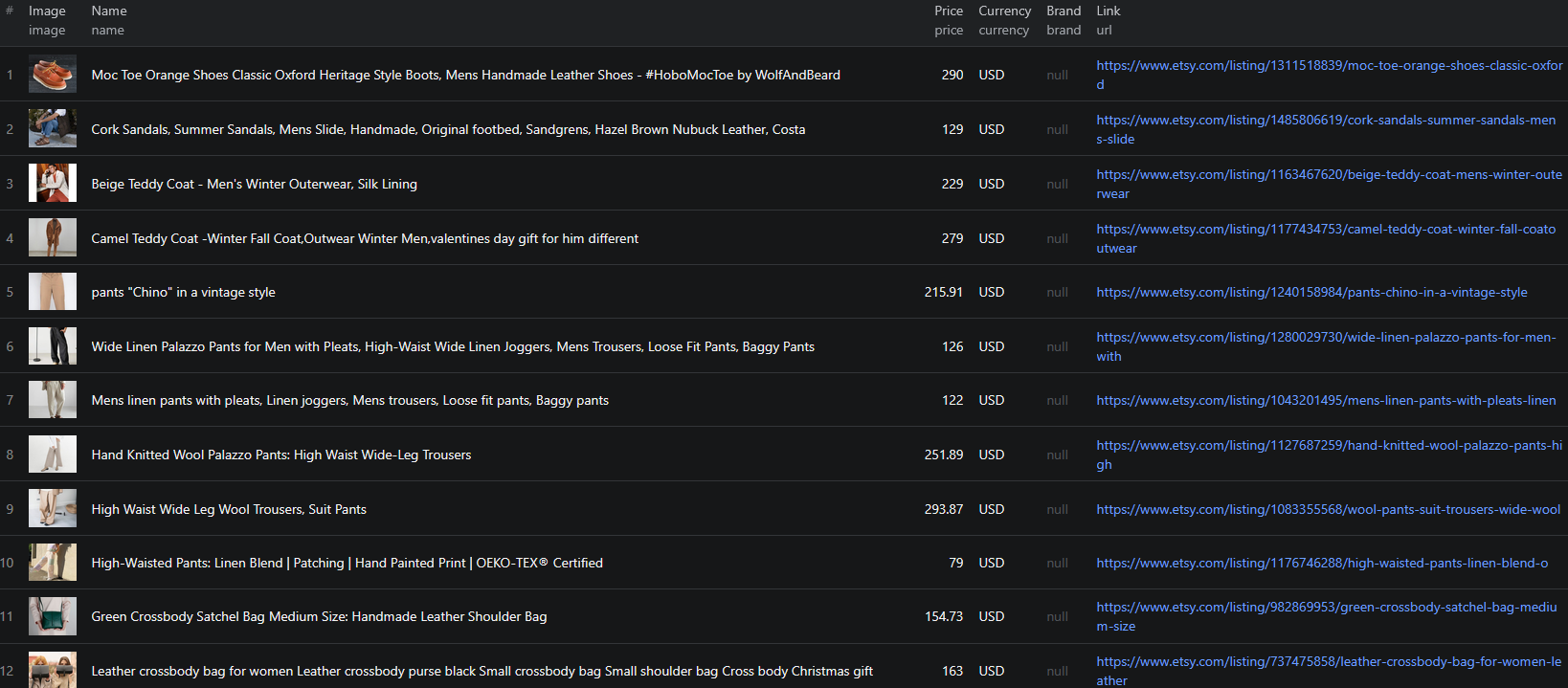
  • currency here is PLN, but the screenshot above shows USD — same scraper, same fields, different request origin. That is Etsy's localization in action across two runs, and it is exactly why you read the field rather than assuming
  • price is already numeric — no currency symbols or thousands separators to strip before analysis
  • brand is populated in this sample but null throughout the screenshot — treat it as optional, and never build a shop-level metric that silently breaks when it is missing
  • name is keyword-stuffed by design — sellers pack titles with search terms, which makes this field a useful text corpus rather than a clean product name
  • image is the full-size assetil_fullxfull rather than a thumbnail, so it is usable for visual review

Try the Etsy Listings Scraper now — no coding required.

Automating Etsy Data Collection

Scheduled Runs

For competitor shop monitoring, a daily run over a handful of shop-page URLs is cheap and gives you a complete repricing history. For category-level price benchmarking, weekly is plenty — handmade pricing does not move hourly, and a weekly series is enough to see trend.

API Integration

Use the Apify API to trigger runs programmatically and retrieve results:

  • Feed category price distributions into a pricing tool for your own listings
  • Alert when a tracked competitor changes prices
  • Sync category sweeps into a spreadsheet or warehouse for trend reporting
  • Connect to Zapier, Make, Google Sheets, or Slack for no-code workflows

Node.js Example

Because you supply the page URLs yourself, generating them in code is the natural way to use this scraper at any real depth. For a complete working example — including a loop that builds 50 paginated URLs and a currency-aware grouping of the results — see the GitHub repository.

Webhooks

Configure webhooks to fire when a run completes, so downstream processing starts as soon as new listings land.

Using Etsy Data for Business Intelligence

Price Distribution, Not Price Average

For handmade goods the average is close to useless — a category contains $8 stickers and $800 commissions. What you want is the distribution: median, quartiles, and the shape of the tail. Six clean fields over a few thousand listings gives you exactly that, and it is the single most actionable output of this scraper.

Title Keyword Mining

Tokenize the name field across a category and count phrase frequency. Because Etsy sellers optimize titles for Etsy's own search, the resulting term frequencies are effectively a proxy for what sellers believe buyers search for. That is useful for writing your own listings.

Visual Trend Review

The image URLs are full-size. Pulling a few hundred into a contact sheet is a fast way to see where a category's design direction is heading — something no numeric field captures.

Does Etsy Provide an API?

Etsy offers the Open API v3, but it is a poor fit for market research.

What's Available

  • The API requires registration, an application key, and approval before use
  • Rate limits are strict, which makes broad catalog sweeps impractical
  • The endpoints are built around managing your own shop — listings, inventory, orders, shipping profiles — rather than exploring the wider marketplace
  • General cross-seller catalog search is not the use case v3 is designed to serve

What the API Misses

The pattern is the familiar one: a marketplace API exists to help sellers operate on the platform, not to help analysts observe it. If your question is "what are 3,000 other shops charging for something like mine," a shop-scoped API cannot answer it, no matter how well documented.

That information is fully public — every price is rendered on a category page for any visitor. The Etsy Listings Scraper reads those pages and returns the grid as structured rows.

Pricing — Pay Only for Results

The Etsy Listings Scraper uses Apify's Pay-Per-Event pricing model with a single, flat event.

EventWhen it's chargedPrice per eventPer 1,000 listings
productEach listing written to the dataset$0.001$1.00

Quick cost estimates:

  • A 2,000-listing category sweep for price benchmarking → $2.00
  • A daily competitor shop monitor at 200 listings → $0.20/day, about $6/month
  • A 10,000-listing niche saturation study → $10.00

At $1.00 per 1,000 records this is one of the cheapest marketplace scrapers available anywhere, which is precisely what makes the breadth use cases work. Sweeping an entire category to get a real price distribution is a rounding error in cost, and that is the right way to use it.

New Apify accounts include free monthly usage credits, so you can validate the output before spending anything.

Try the Etsy Listings Scraper

The Etsy Listings Scraper extracts listing grids from any Etsy search, category, or shop page — product name, numeric price, currency, shop name, full-size image, and listing URL.

What you get:

  • Six clean fields per listing, ready for a pivot table with no cleanup
  • Works on any Etsy listing-grid URL — search, category, shop, or filtered results
  • Explicit page control, so run scope and cost are predictable before you start
  • Numeric prices with an explicit currency code on every row
  • Pay-Per-Event pricing at $1.00 / 1,000 listings — among the cheapest available
  • Scheduled runs, webhooks, and API access
  • No coding, no proxy management, no scraper maintenance

If you need reviews, favorites, sales counts, or variant data, this is not the tool — it is built for breadth and price capture at volume, and it is very good at that.

Start scraping Etsy now — your first run takes less than 5 minutes to set up.

If you are building a marketplace research pipeline, combine Etsy with eBay sold listings for realized resale prices, Amazon storefronts for the mass-market comparison, or work through the e-commerce scraping guide for the broader pipeline picture.

Legal and Ethical Considerations

Web scraping occupies a well-established legal space, but responsible practice matters:

  • Public data only — the scraper extracts publicly visible listing information that anyone can see by browsing Etsy. No login or authentication is required
  • Shop names are business identifiers — Etsy shops are commercial sellers, and shop names are public trading names rather than personal data. The scraper does not collect buyer information
  • Respect creators' work — Etsy sellers are independent makers, and their listing images are their own product photography. Use images for research and review, not for republishing or for building competing listings
  • Respect rate limits — the scraper paces its requests rather than overloading Etsy's servers
  • No misuse — use the data for legitimate purposes like price research and competitive analysis. Do not use it to copy listings or undercut individual makers through automated repricing
  • Compliance — if you operate in a regulated jurisdiction, ensure your storage and processing practices comply with local requirements

Etsy listings are public commerce data, published so buyers and search engines can find them. Using them for price research is consistent with that purpose; copying a maker's work is not.

Frequently Asked Questions

Is scraping Etsy legal?

Scraping publicly available data from Etsy is generally legal. Listing titles, prices, shop names, and images are visible to anyone browsing Etsy without an account. You should use the data responsibly, comply with applicable regulations, and avoid overloading Etsy's servers with excessive requests.

What data does the Etsy Listings Scraper return?

Each listing returns six fields: the product name, the main image URL, the listing URL, the shop name (returned as brand, though it is frequently null), the numeric price, and the currency code. It is a fast, cheap breadth tool for capturing prices and product names at scale — it does not return reviews, favorites, sales counts, shipping, tags, or variant data.

Why are prices returned in a currency I did not expect?

Etsy localizes prices to the visitor's region, so the currency depends on where the request originates rather than on a setting in the scraper. The currency field always tells you which currency a given price is in, so check it before comparing or aggregating prices, and normalize with an exchange rate if you are mixing regions.

Does the scraper paginate automatically?

No. You supply the exact page URLs you want scraped, which means pagination is under your control. Etsy exposes page numbers as a simple ?page=N query parameter, so you can generate a list of page URLs programmatically and pass them all in a single run.

Can I scrape a specific Etsy shop?

Yes. An Etsy shop page is just another listing-grid URL — paste it into searchUrls like any search or category page, adding ?page=N variants for shops with large catalogs.

Does Etsy have a public API?

Etsy offers the Open API v3, but it requires registration and approval, enforces strict rate limits, and its endpoints are oriented around managing your own shop rather than researching the wider marketplace. For broad catalog and price research across other sellers, scraping the public site is the practical route.

How much does the Etsy Listings Scraper cost?

The actor uses Apify's Pay-Per-Event pricing at $0.001 per product — $1.00 per 1,000 listings. That makes it one of the cheapest ways to capture marketplace pricing at volume, and you only pay for listings that actually land in your dataset.

About the Author

This guide was written by Piotr, a software engineer with hands-on experience building and maintaining web scrapers at scale. He develops and maintains a suite of data extraction tools on the Apify platform, helping businesses automate their data collection workflows.

Need help with your scraping project?

Book a free discovery call and let's scope your project together.

Book a Call
Piotr Vassev

Piotr Vassev

Founder of FalconScrape. Building production-grade web scraping systems and data automation pipelines for businesses worldwide.

Connect on LinkedIn