How to Scrape Mercado Libre Questions and Seller Answers
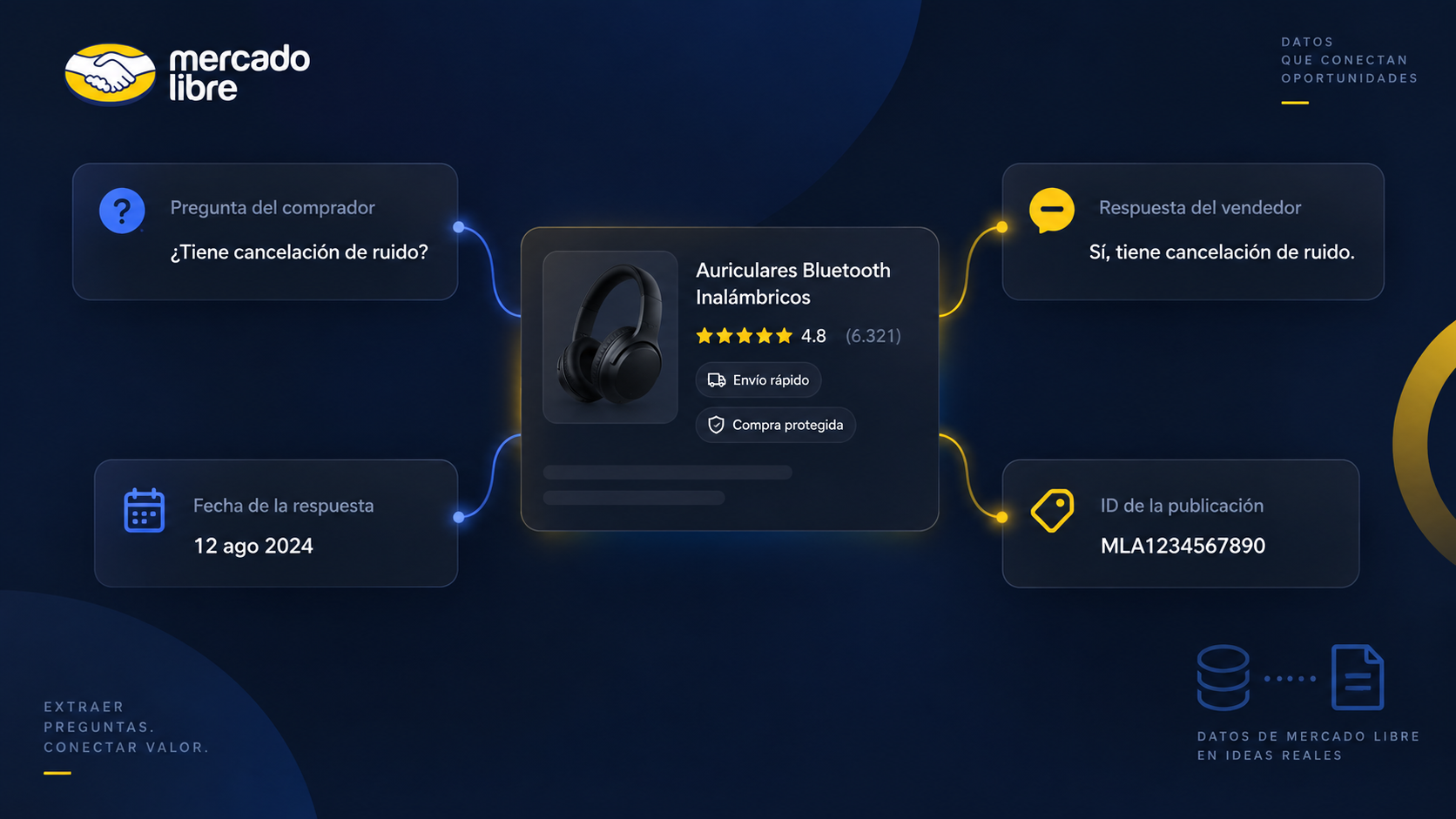
Product questions show what buyers still need to know before ordering. A repeated question about network support, dimensions, delivery, or included accessories often points to information that should be easier to find on the listing.
Our Mercado Libre Questions Scraper exports public questions and seller answers from Mercado Libre listings in Mexico, Argentina, and Brazil. Each row includes the listing ID, question, answer, answer date, marketplace, and source URL.
Questions belong to a seller listing, not to the catalog product as a whole. Keep that distinction when comparing offers or turning the export into an FAQ.
Collect ten questions from one listing
- Open the Actor on Apify and click Try for free.
- Add a public seller-listing URL or item ID.
- Set Maximum questions per item to
10. - Keep the residential proxy group enabled.
- Click Start.
We used this input:
{
  "items": [
    "https://articulo.mercadolibre.com.mx/MLM-2574560561"
  ],
  "maxQuestionsPerItem": 10,
  "proxyConfiguration": {
    "useApifyProxy": true,
    "apifyProxyGroups": ["RESIDENTIAL"]
  }
}
maxQuestionsPerItem applies separately to each listing. The Actor returns the newest public questions first.
Our example run returned ten rows. One abbreviated result was:
{
  "itemId": "MLM2574560561",
  "marketplace": "MLM",
  "position": 2,
  "questionId": "13662120448",
  "question": "Acepta la compañía bait?",
  "answer": "Este teléfono es compatible con redes móviles 4G/LTE...",
  "answered": true,
  "answerDate": "2026-09-20",
  "answerTranslated": false,
  "inputUrl": "https://articulo.mercadolibre.com.mx/MLM-2574560561",
  "scrapedAt": "2026-09-22T11:11:45.084Z"
}
The Actor returns the source text. Preserve it beside any translated or classified version so a reviewer can check the original meaning.
| Field group | How to use it |
|---|---|
itemId, marketplace, itemUrl | Keep every question attached to the correct seller listing and country site. |
questionId, position | Deduplicate rows and retain their returned newest-first order. |
question, answer | Classify the buyer's concern and review the seller's public response together. |
answered, answerDate | Separate answered and unanswered questions and measure response recency where a date is available. |
answerTranslated | Record whether Mercado Libre marked the answer as translated before adding your own translation. |
inputUrl, scrapedAt | Trace the row back to the requested listing and the collection time. |
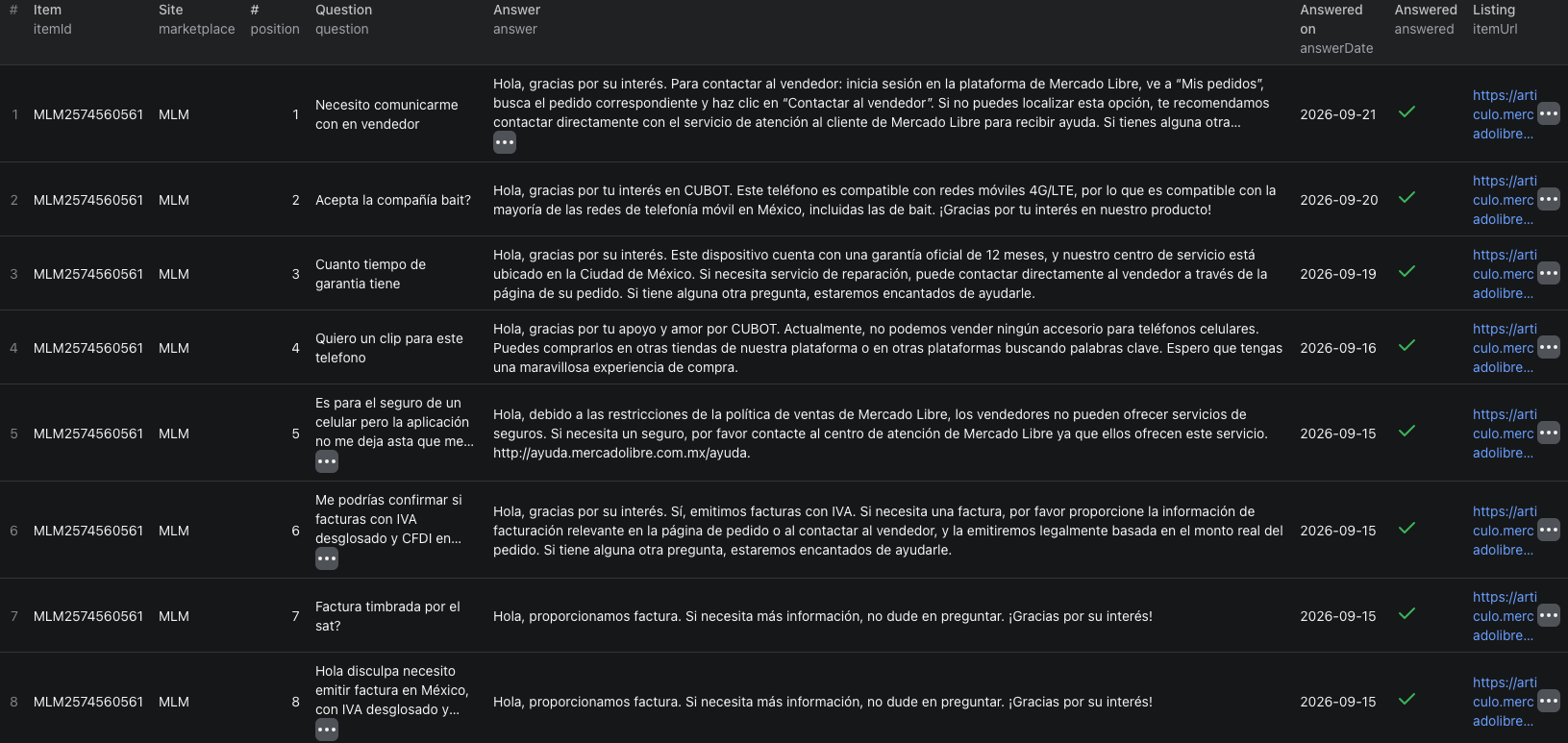
The Mercado Libre questions Node.js example runs the same ten-question export with apify-client and retrieves the resulting dataset.
Turn buyer questions into a useful FAQ
Start with one listing and a small recent sample. Then:
- Tag each question with one clear subject, such as compatibility, sizing, contents, warranty, or delivery.
- Keep the answer beside the question. A buyer concern and the seller's resolution are one unit of evidence.
- Count repeated subjects only after defining a consistent tagging rule.
- Review high-frequency questions against the current title, images, description, and specifications.
- Rewrite your own FAQ in direct language, without copying seller text as a product guarantee.
For example, several questions about carrier compatibility can justify a clearer compatibility section. They do not prove that every answer applies to every variant, country, or future version of the offer.
Use the Mercado Libre listings guide to discover relevant offers. Add the product details guide when you need current price, attributes, seller, stock, and variations. The reviews guide covers post-purchase feedback, which answers a different question from pre-purchase Q&A.
Use seller-item URLs, not generic catalog pages
The Actor accepts public seller-listing URLs containing articulo or produto, plus bare IDs such as MLM2574560561.
A catalog page can also work when its URL identifies the seller item through #wid= or a pdp_filters=item_id: parameter. A plain catalog URL does not point to one seller's Q&A, so the Actor returns an explanatory status row instead of guessing which offer you meant.
This matters when several sellers share a catalog product. Their prices, fulfilment terms, variants, and answers can differ. Treat each listing as its own source, then compare common question themes across listings only when that is the intended analysis.
Pricing
Pricing as of September 22, 2026 is $0.001 per returned question, plus an Actor start event of $0.00005 per GB of allocated memory, with a minimum of one event.
Our example used one start event and returned ten questions. Its Actor event charges were $0.00005 + (10 × $0.001) = $0.01005. Apify platform or proxy usage may be billed separately according to your plan.
Set a small per-listing limit first and check live pricing before increasing the number of listings or questions.
Check these cases before scaling up
- A catalog URL returns no questions. Use a seller-item URL, a URL with a seller item parameter, or the bare item ID.
- A listing has no public questions. Keep the returned status row as an explanation. Do not interpret it as proof that buyers have no concerns.
- Almost every row is answered. Public Mercado Libre Q&A commonly emphasizes answered questions. Do not use the sample to calculate a general seller response rate.
- A question has no asker or question date. Those fields are not part of the public output. Do not infer them from position or answer date.
- The same product has different answers. Confirm the seller listing, marketplace, variant, and collection date before comparing text.
- Translated text changes a technical term. Preserve the source text and have ambiguous compatibility or specification claims reviewed.
Frequently asked questions
Which Mercado Libre markets are supported?
The Actor accepts seller-listing URLs and item IDs from Mexico, Argentina, and Brazil. Catalog URLs must identify a specific seller item through a wid or item_id parameter.
Does maxQuestionsPerItem apply to the whole run?
No. It limits the newest questions returned for each valid seller listing.
Can I use the questions as product-level demand data?
Not by themselves. Questions belong to a specific seller listing, so interpret them as a sample of concerns raised on that offer rather than every question about the catalog product.