Piotr VassevPiotr Vassev

How to Scrape Yiwugo Product Listings and Supplier Contacts (Step-by-Step Guide)

How to Scrape Yiwugo Product Listings

If you want to scrape Yiwugo product listings, supplier contacts, and physical booth coordinates, this guide covers everything you need. You will learn what data you can extract from the online storefront of Yiwu Small-Commodity City — the world's largest wholesale market — and how to turn raw listings into actionable B2B sourcing intelligence.

Why Scrape Yiwugo Product Data?

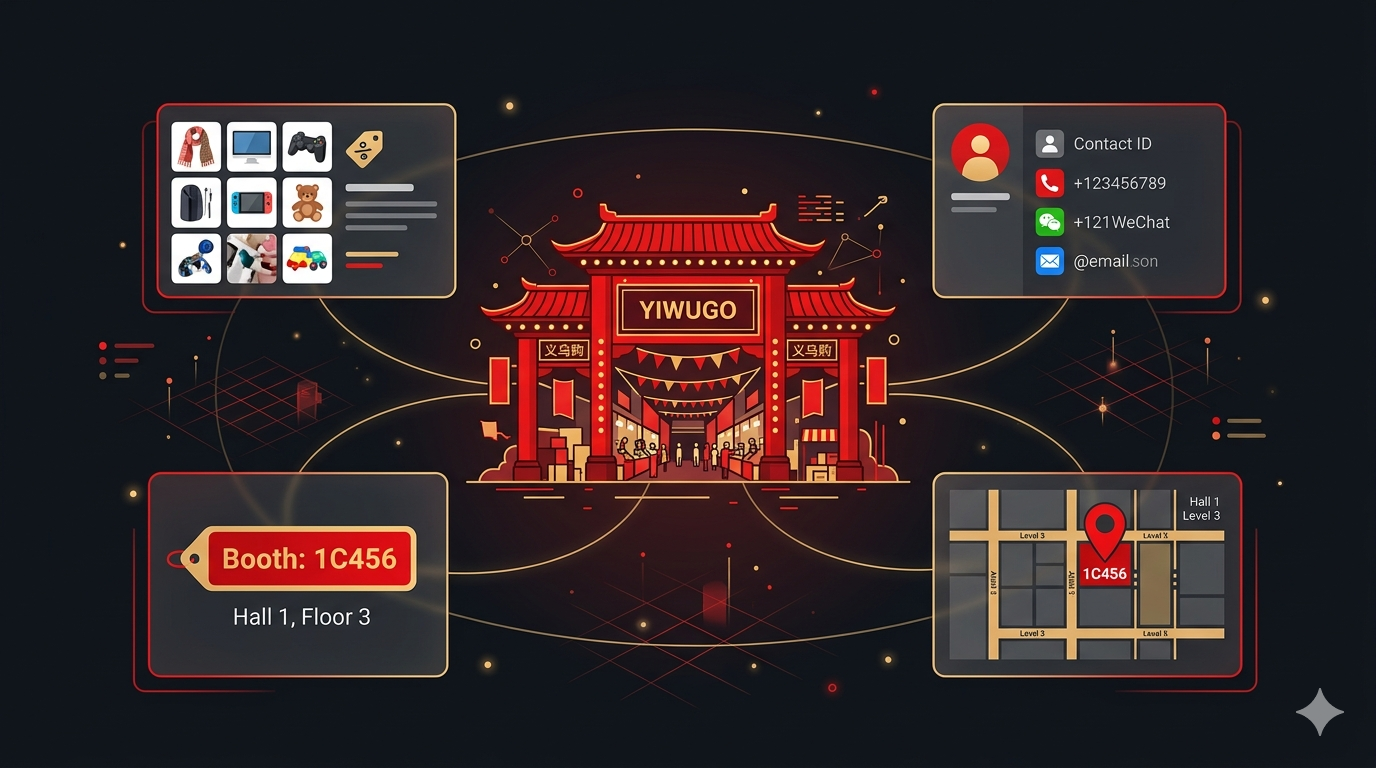
Yiwugo.com is the official online storefront of Yiwu Small-Commodity City, the largest wholesale market in the world. The physical market in Yiwu, Zhejiang spans several million square meters and houses tens of thousands of suppliers selling everything from phone accessories and toys to Christmas ornaments and tools. Yiwugo is the digital index of those physical booths.

Unlike Alibaba.com (export-facing) or 1688.com (general domestic-China B2B), Yiwugo is uniquely tied to the physical Yiwu market — every listing maps back to a real booth in a real building. This makes it one of the highest-signal data sources for sourcing agents, importers, and trading companies that actually travel to Yiwu.

Businesses scrape Yiwugo data for several reasons:

  • Direct supplier contacts — mobile numbers, WeChat IDs, emails, and factory addresses for outreach. This is the data that sourcing agents pay for
  • Physical booth coordinates — booth ID, market code, door, and street inside the Yiwu trade-city building so you can walk straight to the supplier
  • Wholesale price intelligence — discover the true wholesale floor for any small-commodity category before negotiating with exporters
  • Trip planning before flying to Yiwu — pre-build a route through the market based on the suppliers most relevant to your category
  • Product trend research — track which products are gaining traction inside Yiwu before they reach Western marketplaces
  • Competitive sourcing intelligence — understand which factories your competitors might be sourcing from

Manually browsing Yiwugo and copy-pasting product data is impractical at any meaningful scale, especially because the most valuable fields (mobile, WeChat, booth coordinates) only appear on detail pages behind a CSRF-protected request. Automation is the only realistic approach.

What Data You Can Extract from Yiwugo

The Yiwugo Listings Scraper extracts structured data from both search results and full product detail pages. Here are the key fields you can collect:

FieldDescriptionExample
Product IDYiwugo's unique product identifier970407473
TitleFull Chinese product title适用苹果17pro手机壳磁吸16promax防摔...
Sell priceHeadline price in CNY¥2.75
Unit price / total pricePer-unit and bundle pricing3.13 / 3.13
Metric / MOQUnit of sale and minimum order quantity个 (piece), 1+
Sale number / deal quantityLifetime sales and recent deal count3,719,415 sold, 64 recent deals
PropertiesFull attribute matrix (color, size, material)颜色: 马卡龙磁吸-粉色, ...
ImagesAll product image URLsywgimg.yiwugo.com/...
Shop name / shop IDRegistered shop and its Yiwugo ID云想百货 (775063)
Shop credit / integrity scoreYiwugo's seller reputation signalsCredit 2, integrity 7,774
Years in businessHow long the shop has operated on Yiwugo3 years
Contacter / mobileDirect contact person and phone number多多, 15669663507
WeChat / emailDirect messaging and email contact15669663507, Lucy@gotoyiwu.com
Factory addressRegistered factory address浙江省金华市义乌市江东街道
Market info / market codeWhich Yiwu market building the shop sits in国际商贸城 (code 14)
Booth ID / booth ownerPhysical booth identifier and registered owner761113 (许海明)
Product URLDirect link to the product detail pageyiwugo.com/product/970407473.html

This is exactly the kind of structured B2B data sourcing teams need — full supplier contact info, physical booth coordinates, pricing, and reputation signals — all in a single export.

Common Use Cases for Yiwugo Data

Sourcing-Trip Planning

Anyone who actually goes to Yiwu knows the trade-city is too large to walk randomly. Scrape Yiwugo for your target category, filter by booth coordinates, and pre-build a walking route through the market. This is the highest-leverage use case for the data — turning a multi-day exploratory trip into a focused 1-day sweep of pre-qualified suppliers.

Supplier Outreach at Scale

Each listing returns a contacter name, mobile, WeChat, and email. Build outbound lists for any category and reach out before flying to Yiwu — or skip the trip entirely and negotiate remotely. Sourcing agents who do this for a living already pay handsomely for this exact data; the scraper gives you the same dataset on demand.

Wholesale Price Discovery

Yiwugo prices are typically the closest you can get to the factory-direct cost for small-commodity goods without negotiating with a manufacturer in person. Scraping listings lets you discover the true wholesale floor for any category and benchmark every other price (Alibaba.com, AliExpress, Amazon) against it.

Cross-Platform Arbitrage Research

Combine Yiwugo data with data from Alibaba, AliExpress, and 1688 on the same SKUs to spot pricing gaps. Margin opportunities are easiest to spot when you can see domestic Yiwu, 1688, export Alibaba, and retail prices side by side.

Trend Spotting in Small-Commodity Categories

Yiwu is the spawning ground for trends in small-commodity goods — accessories, gadgets, seasonal items, party supplies. Tracking sale counts and new listings on Yiwugo is an early indicator of what will hit Amazon, TikTok Shop, or your dropshipping niche next.

Challenges of Scraping Yiwugo Manually

Before jumping into the tutorial, it is worth understanding why scraping Yiwugo is harder than scraping most other marketplaces:

  • Vue SSR frontend — the site renders much of its content through Vue server-side rendering, which breaks selector-based scrapers that expect static HTML
  • CSRF handshake on detail pages — supplier contacts and booth coordinates are only returned after a CSRF token handshake. Naïve HTTP scrapers get blocked or receive scrubbed records
  • Chinese-only content — titles, attributes, and most shop info are in Chinese. Search results for English keywords work but tend to be narrower
  • Contact-data gating — supplier mobile, WeChat, and booth coordinates are returned in a separate detail endpoint with different billing economics, so you need a scraper that handles two depth modes
  • Maintenance burden — like any major marketplace, Yiwugo updates its frontend periodically, breaking custom scrapers that are not actively maintained

Building and maintaining your own Yiwugo scraper is a non-trivial engineering project, especially because the most valuable data is gated behind the CSRF handshake. For most use cases, a pre-built, maintained solution is far more practical.

Step-by-Step: How to Scrape Yiwugo Product Listings

Here is how to scrape Yiwugo product data using the Yiwugo Listings Scraper on Apify.

Step 1 — Choose Your Keywords or Product IDs

The scraper supports two input modes:

  • Keyword search — paginate any Yiwugo search query. Chinese keywords (e.g. 手机壳) work best, but English (phone case) is fully supported
  • Direct product lookup — if you already know which products you want, pass their Yiwugo product IDs (e.g. 970407473) to skip the search step entirely

You can mix and match — many users start with broad keyword searches to discover products, then re-scrape specific product IDs later in detail mode to pull supplier contacts and booth coordinates.

Step 2 — Configure the Scraper Input

Head to the Yiwugo Listings Scraper on Apify and configure your run:

  1. Enter your search keywords (Chinese preferred) or specific product IDs
  2. Set maxItems to cap the total rows returned across all keywords and product IDs (Yiwugo's API caps any single keyword at ~5,000 items)
  3. Toggle includeDetails:
    • Off (listing-only mode) — fast, cheap, returns core listing fields per product. Best for price tracking and broad market surveys
    • On (detail mode) — fetches full supplier contact info (mobile, WeChat, email, factory address) and booth coordinates (market code, door, booth ID). Best for outreach lists and trip planning
  4. Leave the proxy configuration on its default — Yiwugo does not require a proxy in validation, so Apify Proxy is opt-in only for scale

Example input:

{
  "keywords": ["phone case", "手机壳"],
  "maxItems": 200,
  "includeDetails": true,
  "proxyConfiguration": {
    "useApifyProxy": false
  }
}

Step 3 — Run the Scraper

Once started, the scraper will:

  • Search Yiwugo with your keywords against the plain JSON API
  • Walk pagination automatically up to maxItems
  • Handle the Vue SSR frontend and CSRF handshake automatically
  • Follow each search hit to its detail page if includeDetails: true
  • Extract structured data including supplier contacts, booth coordinates, and properties
  • Store everything in a clean, typed dataset

Processing time depends on the volume of data requested. Most runs complete in a few minutes — the underlying crawler is Cheerio-based (no browser), which keeps it fast and cheap.

Step 4 — Export Your Results

When the scraper finishes, export your data in the format you need:

  • JSON — ideal for developers building integrations or sourcing pipelines
  • CSV — perfect for spreadsheet analysis or importing into outreach tools
  • API — access results programmatically via the Apify API for automated workflows

Ready to try it? Run the Yiwugo Listings Scraper on Apify and get your first dataset in minutes.

Example Output (Real Data Preview)

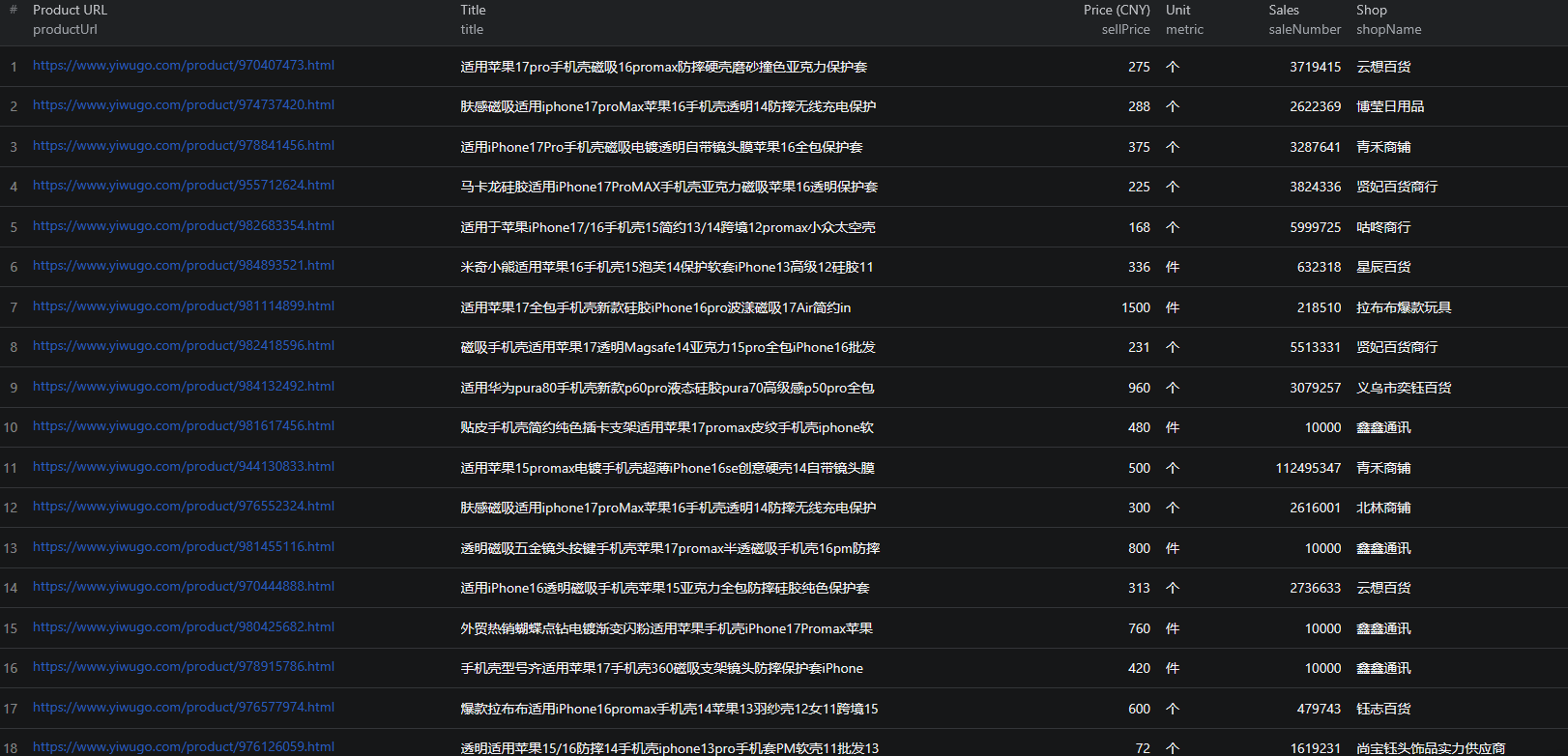
Yiwugo scraper results

Here is what the actual output looks like with includeDetails: true. Each product returns a structured JSON object:

{
  "id": 970407473,
  "productUrl": "https://www.yiwugo.com/product/970407473.html",
  "title": "适用苹果17pro手机壳磁吸16promax防摔硬壳磨砂撞色亚克力保护套",
  "sellPrice": 275,
  "unitprice": "3.13",
  "totalprice": "3.13",
  "metric": "个",
  "defaultfreight": "5.00",
  "saleNumber": 3719415,
  "dealQuantitys": "64",
  "propertyList": [
    {
      "pvalue": "颜色",
      "cvalueList": ["马卡龙磁吸-粉色", "马卡龙磁吸-黑色"]
    }
  ],
  "shopId": 775063,
  "shopName": "云想百货",
  "years": 3,
  "shopCredit": 2,
  "shopIntegrityFraction": 7774,
  "contacter": "多多",
  "mobile": "15669663507",
  "safeMobile": "13335913818",
  "weixin": "15669663507",
  "email": "Lucy@gotoyiwu.com",
  "factoryAddress": "浙江省金华市义乌市江东街道",
  "marketCode": 14,
  "boothId": 761113,
  "boothOwners": "许海明"
}

Key things to notice:

  • Direct supplier contacts — mobile, safeMobile, WeChat (weixin), and email surfaced as first-class fields, not buried in unstructured text
  • Physical booth coordinatesmarketCode, boothId, and boothOwners map each shop to a real location inside the Yiwu trade-city building
  • Reputation signalsyears, shopCredit, and shopIntegrityFraction give you a quick read on supplier reliability
  • Demand signalssaleNumber (lifetime) and dealQuantitys (recent) show actual traction for each product
  • Attribute matrix — color variants, size, and other category-specific attributes as structured key-value pairs

When includeDetails: false, you get a lighter row per product with the core fields (id, title, images, sellPrice, metric, saleNumber, shopId, shopName, contacter, mobile) — useful for shallow market surveys before committing to a full detail run.

Try the Yiwugo Listings Scraper now — no coding required.

Automating Sourcing Research

For ongoing sourcing intelligence, you do not want to run the scraper manually every time you need fresh data. The Apify platform supports full automation:

Scheduled Runs

Set up recurring scrapes on any schedule — daily, weekly, or monthly. The scraper runs automatically and stores results in a dataset you can access anytime. Daily runs work well for tracking volatile categories or spotting new product launches; weekly runs are sufficient for general supplier research.

API Integration

Use the Apify API to trigger scraper runs programmatically and retrieve results. This lets you integrate Yiwugo data into your existing sourcing workflows:

  • Feed new products into your product research pipeline
  • Trigger alerts when a tracked product's price drops below a threshold
  • Build dashboards that update with fresh wholesale pricing data
  • Connect to tools like Zapier, Make, or custom data pipelines

Cross-Platform Comparison Pipelines

Pair Yiwugo data with 1688 on the same keyword set to compare physical-booth suppliers vs general domestic-China factory pricing. Add Alibaba for the export-side markup and AliExpress for retail comparison. The four together give you the full margin stack from Yiwu booth to Western consumer.

Node.js Example

For a complete working example showing how to call this scraper from Node.js, see the GitHub repository.

Webhooks

Configure webhooks to get notified when a scraper run completes. This is useful for event-driven architectures where you want to process new product data as soon as it is available.

Using Yiwugo Data for Sourcing Intelligence

Yiwugo data goes far beyond simple product discovery. It is one of the highest-signal datasets in small-commodity sourcing.

Mapping the Yiwu Market Before You Fly

Yiwu Small-Commodity City is divided into multiple districts and floors, each focused on different product categories. Combine marketCode, boothId, and category data to map exactly where the suppliers in your category cluster. A few hours of pre-trip analysis can save you days of confused walking around the market.

Outreach List Building

Filter listings by category, shop reputation (shopCredit, shopIntegrityFraction), and tenure (years), then export the mobile, weixin, and email fields directly into your CRM. This gives you a pre-qualified outbound list of suppliers far cheaper than buying sourcing leads from a broker.

Supplier Reliability Filtering

Combine years, shopCredit, shopIntegrityFraction, and saleNumber to filter for established, high-trust suppliers. New listings with no track record are easy to spot and exclude before you even pick up a sample.

Category-Level Market Mapping

Scrape every product for a keyword (e.g. 手机壳) and analyze the booth/market-code distribution. Most Yiwugo categories are tightly geographically clustered inside the trade-city — knowing the cluster makes booth visits and direct outreach far more efficient.

Does Yiwugo Provide an API?

Yiwugo does not offer a public API for product listings or supplier contacts:

What's Available

  • The Yiwugo site is powered by an internal JSON API used by its Vue SSR frontend, but it is not publicly documented or supported
  • Detail endpoints require a CSRF token handshake, which is not something an external integration can rely on long-term
  • There is no official partner program for bulk product or supplier data access

What an Official API Would Miss

Even if Yiwugo did publish a public API, the most valuable data — supplier mobile, WeChat, email, factory address, and physical booth coordinates — is exactly the kind of data marketplaces tend to gate or scrub. The public site exposes these fields to logged-out visitors; an official API almost certainly would not.

The Yiwugo Listings Scraper gives you a practical alternative — structured product data and full supplier contacts from any search query or product ID, without API approval or access restrictions.

Why Use a Yiwugo Scraper Instead of Building One

Building a custom Yiwugo scraper sounds straightforward until you start dealing with the reality:

  • CSRF handshake — detail-page data is gated behind a CSRF token request that has to be acquired and rotated correctly. Naïve scrapers get scrubbed records or HTTP 403s
  • Vue SSR parsing — the frontend rehydrates from a JSON island, but the structure is undocumented and changes occasionally. You need to track API changes, not just HTML changes
  • Chinese-language parsing — extracting properties and booth metadata correctly requires understanding the page structure in Chinese
  • Two-tier billing logic — the listing API and the detail API have different economics and should be billed separately. Building this yourself means writing your own event-based metering
  • Frontend churn — Yiwugo updates its frontend periodically. Every update can break selectors or shift JSON shapes, requiring immediate fixes
  • Opportunity cost — every hour spent fixing your scraper is an hour not spent on sourcing decisions, supplier negotiations, or growing your business

Unless you have very specific requirements that no existing tool can meet, using a maintained scraper lets you focus on what to do with the data instead of how to collect it.

Try the Yiwugo Listings Scraper

The Yiwugo Listings Scraper extracts structured data from Yiwugo product listings — product IDs, Chinese titles, prices, MOQs, sale counts, property matrices, images, full supplier contact information, and physical booth coordinates inside the Yiwu trade-city.

What you get:

  • Structured JSON or CSV output ready for outreach tools or analysis
  • Direct supplier contacts as first-class data — mobile, WeChat, email, factory address
  • Physical booth coordinates (market code, booth ID, owner) — walk straight to the supplier on a sourcing trip
  • Pay-Per-Event pricing: $1.00 / 1,000 listing-only rows, $5.00 / 1,000 detail rows — you only pay for results
  • Plain JSON API + Cheerio crawler — no browser, no proxy required by default
  • Scheduled runs and API access for ongoing sourcing intelligence
  • No coding, no CSRF handling, no scraper maintenance

Start scraping Yiwugo now — your first run takes less than 5 minutes to set up.

If you are building a sourcing data pipeline, combine Yiwugo data with other e-commerce sources like 1688 for general domestic-China wholesale, Alibaba for the export-side markup, or DHgate for an alternative China-to-Western wholesale channel.

Legal and Ethical Considerations

Web scraping occupies a well-established legal space, but responsible practice matters:

  • Public data only — the Yiwugo scraper extracts publicly visible product and shop information that anyone can see by visiting Yiwugo.com. No login or authentication is required
  • Respect rate limits — the scraper is designed to make requests at a reasonable pace and rotate sessions to avoid overloading Yiwugo's servers
  • Handle supplier contacts responsibly — mobile numbers, WeChat IDs, and emails are personal data in many jurisdictions. Use them for legitimate B2B outreach only and ensure your handling complies with GDPR, CCPA, or local equivalents
  • No misuse — use collected data for legitimate business purposes like sourcing research, supplier outreach, and trip planning. Do not use the data for spam, harassment, or to create counterfeit listings

Yiwugo product listings are public marketplace data — they are designed to be found by buyers and sourcing agents. Scraping this data for sourcing and procurement is aligned with the platform's intended purpose.

Frequently Asked Questions

What is Yiwugo and how is it different from 1688 or Alibaba?

Yiwugo is the official online storefront of Yiwu Small-Commodity City — a sprawling physical wholesale market in Yiwu, Zhejiang Province, often called the largest wholesale market in the world. Unlike Alibaba.com (export-facing) or 1688.com (general domestic-China B2B), Yiwugo is specifically the digital index of the suppliers that have a physical booth inside the Yiwu trade-city buildings. That's why every listing comes with a booth ID, market door number, and street — you can walk straight to the supplier on a sourcing trip.

Is scraping Yiwugo legal?

Scraping publicly available product data from Yiwugo is generally legal. Listings are visible to anyone who visits the site without logging in. Use the data responsibly, comply with local privacy regulations like GDPR/CCPA when handling supplier contacts, and avoid overloading Yiwugo's servers with excessive requests.

Does Yiwugo provide an API?

Yiwugo does not offer a public API for product listings or supplier contacts. The site is powered by a Vue SSR frontend behind a CSRF handshake, which is why most off-the-shelf scrapers fail on it. A purpose-built scraper that handles the handshake is the practical alternative.

Can I search in English on Yiwugo?

Yes, the scraper accepts both Chinese and English keywords. Chinese terms (e.g. 手机壳) generally return richer results because Yiwugo is built for Chinese buyers and sourcing agents, but English (e.g. phone case) is fully supported and returns relevant listings for most common categories.

What are booth coordinates and why do they matter?

Every Yiwugo supplier maintains a physical booth inside the Yiwu trade-city buildings — a multi-district complex spanning several million square meters. The scraper returns the booth ID, market code, door number, and street for each shop. If you fly to Yiwu on a sourcing trip, you can walk straight to the booth instead of trying to navigate the world's largest wholesale market blind.

How is pricing structured for the Yiwugo Listings Scraper?

Pricing is pay-per-event. You only pay for products you successfully receive: $1 per 1,000 products in listing-only mode (default), or $5 per 1,000 products when includeDetails is on and full supplier contacts and booth coordinates are returned. There are no platform compute or proxy charges on top.

About the Author

This guide was written by Piotr, a software engineer with hands-on experience building and maintaining web scrapers at scale. He develops and maintains a suite of data extraction tools on the Apify platform, helping businesses automate their data collection workflows.

Need help with your scraping project?

Book a free discovery call and let's scope your project together.

Book a Call
Piotr Vassev

Piotr Vassev

Founder of FalconScrape. Building production-grade web scraping systems and data automation pipelines for businesses worldwide.

Connect on LinkedIn