How to Find the Factory Source of an AliExpress Product
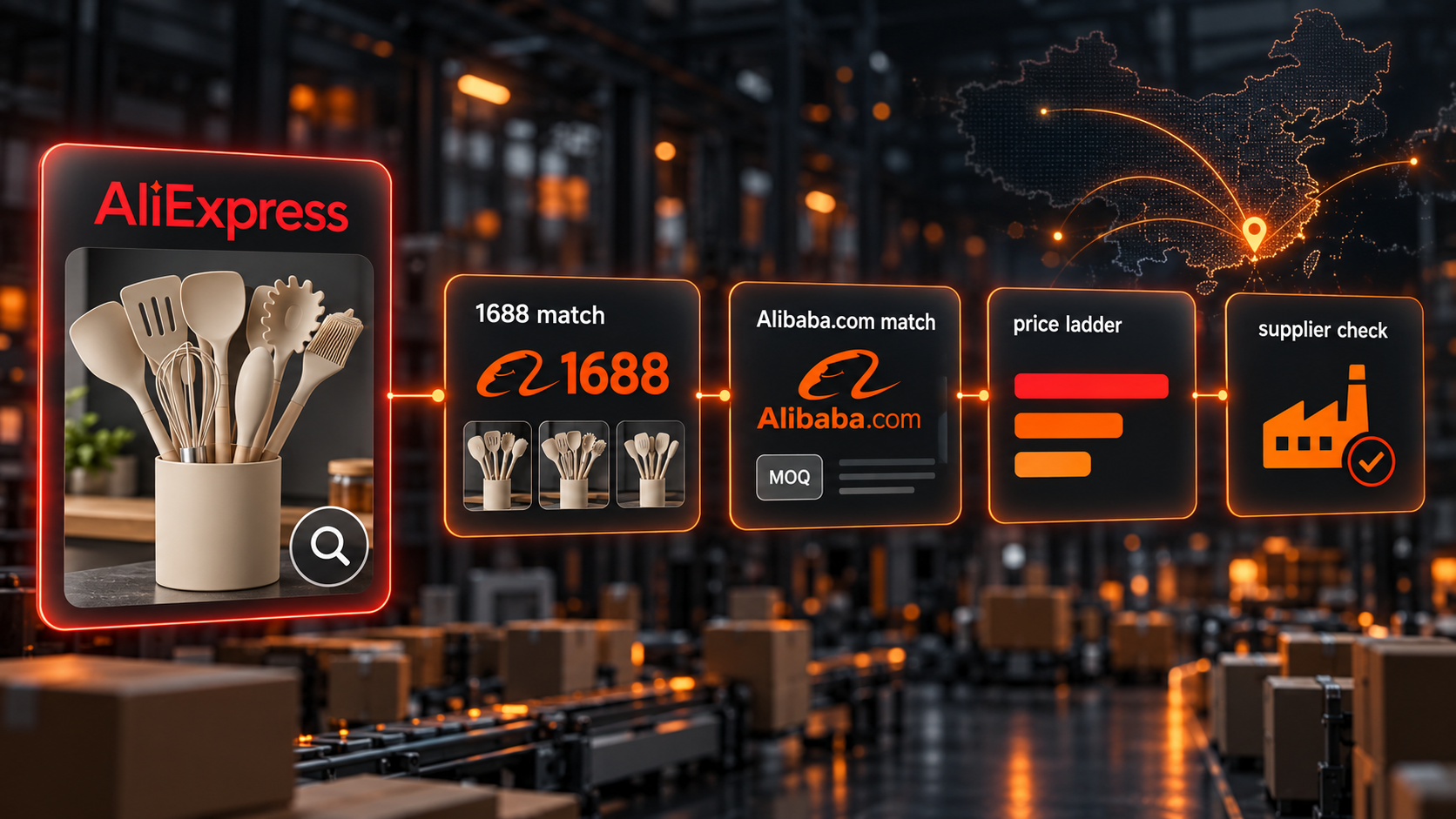
Most generic products on AliExpress are also listed on 1688, China's domestic wholesale marketplace, and on Alibaba.com, its export counterpart. To find them, take the AliExpress product's main photo, run a reverse image search on both sites, and line the wholesale prices up against the retail price. Then check the minimum order quantity (MOQ) and whether the match really is the same product.
This guide walks through that workflow with one real product, a 13-piece silicone utensil set, and shows what the numbers looked like in October 2026. Each step uses one of our Apify Actors (an Actor is a tool you run on Apify), but you can do any step by hand on the marketplace's own site. The two limits to keep in mind from the start: image search finds products that look the same, not the factory that makes them, and wholesale prices leave out freight, duties and agent fees.
What you need
- One AliExpress product URL. Generic, unbranded goods work best. Branded electronics mostly return look-alikes (more on that below).
- An Apify account to run the Actors. The free plan's monthly credit covers a test like this one.
- About $0.06 per product in Actor fees for all four steps, as of October 28, 2026. The steps and prices are listed in the cost table near the end.
No 1688 or Alibaba account is needed to search. Buying is a separate step: Alibaba.com sells to overseas buyers directly, while most 1688 sellers only ship inside China, so overseas buyers usually go through a sourcing agent.
Our example product
We started from a 13-piece silicone cooking utensil set with stainless steel handles sold by Cozyest Store on AliExpress. It's a typical generic product: no brand, sold by many stores, made in many places. Everything below comes from one run of our Actors on October 28, 2026.
Step 1: Get the retail price and main photo
Open the AliExpress Product Details Scraper, paste the product URL under AliExpress product URLs, set Ship-to country to the market you sell in, and click Start. Or switch the input to JSON:
{
  "productUrls": [
    { "url": "https://www.aliexpress.com/item/3256813280686223.html" }
  ],
  "shipTo": "US",
  "currency": "USD",
  "maxItems": 1
}
Set maxItems to the number of products you paste so nothing extra is collected. From the result, you need three things:
- The price of the variant you would actually sell.
price.minis the cheapest variant, which can be a different size or pack. Checkskus[], where each variant has its ownattributesandprice. IgnoreoriginalPrice: our product showed a struck-through "original" price of $83.93 next to the real price of $10.75. - Shipping.
shipping[]has the fee and delivery window to your ship-to country. Ours shipped free from a US warehouse in 3 to 8 days, which matters in Step 4. - The main photo.
images[0]is the image you'll search with.
Our row came back with all three colours (grey, white, black) at $10.75, and a store rating of 4.8. The AliExpress product details guide covers the other fields.
Step 2: Reverse image search on 1688 and Alibaba.com
Pass the images[0] URL to both image search Actors. AliExpress photo URLs work as they are. Both take the same two fields:
{
  "imageUrls": [
    "https://ae-pic-a1.aliexpress-media.com/kf/S0cf162854be24c0584432ab156707dcan.jpg"
  ],
  "maxResultsPerImage": 20
}
Run it in the 1688 Image Search Scraper (prices in CNY) and the Alibaba Image Search Scraper (prices in USD, with MOQ). Max matches per image applies to each photo, not the whole run. Twenty is enough to build a price ladder, and it keeps each photo to a single image-search charge.
Here's a short walkthrough of the 1688 step:
What our searches returned:
- 1688: 20 offers. Seven of them used the identical product photo, at ¥54 to ¥56, although two of those titles named 11- and 12-piece sets. The rest were similar sets with wooden handles, other colours or other piece counts, plus a few listings under ¥2, such as a pair of food tongs. Nineteen of the 20 sellers were in Yangjiang, Guangdong.
- Alibaba.com: 20 listings, and 14 of them used the identical photo. They came from 13 different companies, with names ranging from a factory to e-commerce and trading firms. Most of the rest showed the same set from another angle. Prices for the same-photo listings ran from $4.00 (MOQ 3,000 pieces) to $13.98, with most between about $7.50 and $12.
Don't rely on the similarity score alone. The 1688 rows include a similarityScore. In our run, the seven listings with the exact AliExpress photo scored 0.034, and the highest score, 1.255, went to a pair of steel food tongs. Look at each row's imageUrl and title first. 1688 titles are in Chinese: 不锈钢管柄硅胶厨具13件套 means "stainless steel tube handle silicone kitchen utensils, 13-piece set", which is a close description of our product.
Every row carries queryImage, so when you search several products at once you can join the matches back to the right AliExpress listing. Rows with a status of image_error or no_matches contain no offer and are not charged as image searches. The guides to searching 1688 by image and searching Alibaba by image cover the remaining fields.
Step 3 (optional): Check MOQ and price tiers on 1688
1688 image search returns a price but no minimum order. Pick the two or three offers you'd consider and pass their offerId values to the 1688 Listings Scraper:
{
  "offerIds": ["652917641658", "709722958524", "835952706890"],
  "maxItems": 3
}
All three came back with an MOQ of 2 and a price range of ¥43.50 to ¥54 or ¥56. The attributes on the first offer showed why the range exists: the same listing sells 13-piece, 12-piece and 9-piece versions in three colours. Before you quote ¥43.50, confirm which version and quantity that price is for. The same attributes also said the seller accepts custom logo printing and supplies cross-border sellers, and the logistics field listed a unit weight of 1.4 kg, which you'll need for a freight quote. Two of the three offers came from the same company, a reminder that several listings can lead to one seller.
Step 4: Build the price ladder
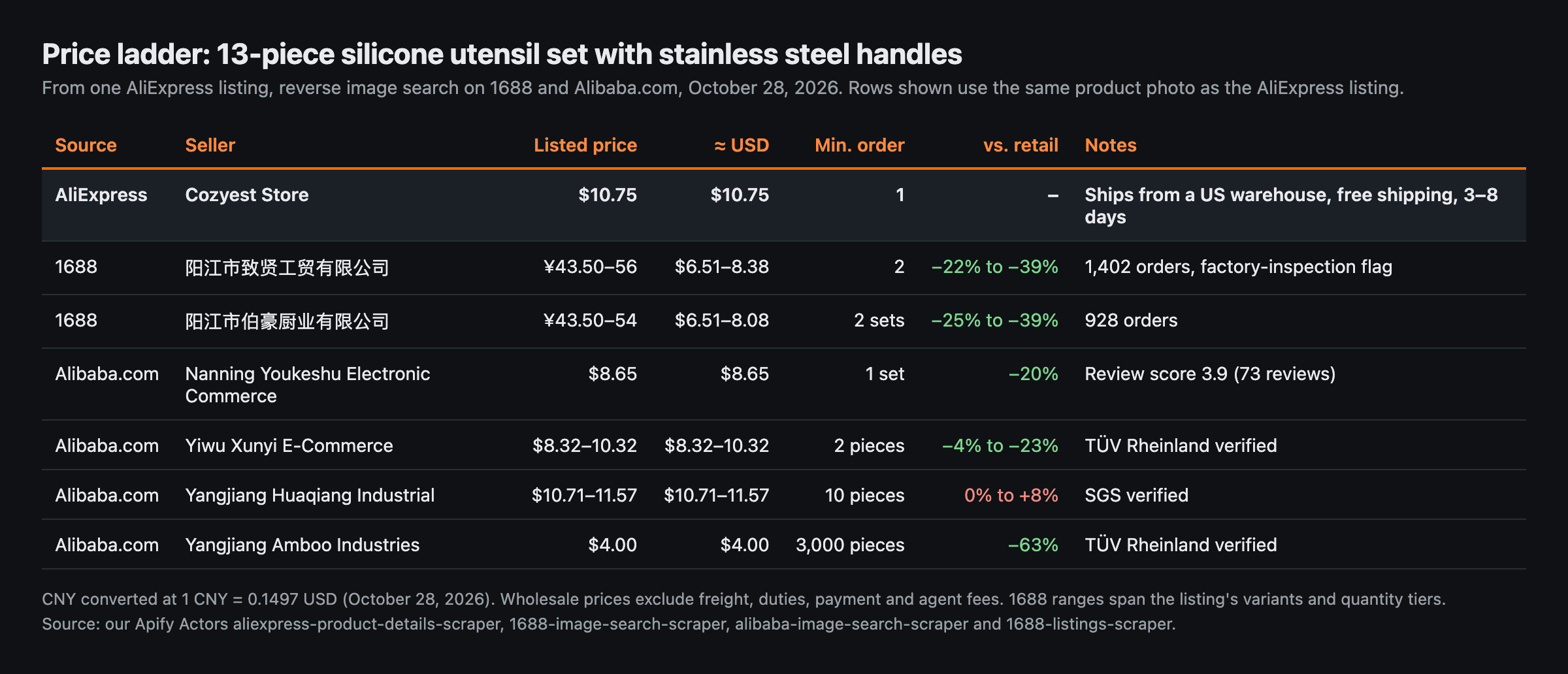
Put the retail price next to the wholesale offers that show the same product, convert CNY at a dated rate, and compare at the quantity you'd really order. Here is ours:
| Source | Seller | Price | Min. order | vs. retail |
|---|---|---|---|---|
| AliExpress | Cozyest Store | $10.75, free US shipping | 1 | – |
| 1688 | 阳江市致贤工贸有限公司 | ¥43.50–56 (≈ $6.51–8.38) | 2 | −22% to −39% |
| 1688 | 阳江市伯豪厨业有限公司 | ¥43.50–54 (≈ $6.51–8.08) | 2 sets | −25% to −39% |
| Alibaba.com | Nanning Youkeshu Electronic Commerce | $8.65 | 1 set | −20% |
| Alibaba.com | Yiwu Xunyi E-Commerce | $8.32–10.32 | 2 pieces | −4% to −23% |
| Alibaba.com | Yangjiang Huaqiang Industrial | $10.71–11.57 | 10 pieces | 0% to +8% |
| Alibaba.com | Yangjiang Amboo Industries | $4.00 | 3,000 pieces | −63% |
CNY converted at 1 CNY = 0.1497 USD on October 28, 2026. Both 1688 sellers are in Yangjiang. All rows use the same product photo as the AliExpress listing.
What this ladder says. For small orders, the wholesale prices were only 20% to 39% below a retail price that already included free delivery from a US warehouse. A 1.4 kg parcel from China, plus duties and agent fees, would take a large share of that gap. The one big difference was the $4.00 offer, and it needs an order of 3,000 sets. So for this product, buying a few units at the source wouldn't beat AliExpress. The source becomes interesting when you can order in volume, want your own logo on it, or want to compare several factories for quality.
Your product may look very different. That is the point of building the ladder before contacting anyone.
How good is the match?
How reliable the results are depends on the kind of product:
- Generic goods match well. Kitchen tools, storage shelves and consumables are made by many factories and sold under many store names. In our example, most Alibaba.com results showed the same set.
- Branded electronics mostly return look-alikes. In an earlier test with branded noise-cancelling earbuds, the closest 1688 matches were generic earbuds, and the brand's own 1688 listing ranked fourth and was more expensive than on AliExpress. If every match looks like a clone rather than the product, report "no reliable source" rather than picking the cheapest one.
- A shared photo is not proof of a factory. Fourteen Alibaba.com listings from 13 companies reused the same photo. Some sellers make the product, others resell it. Check each supplier's business type, factory badges (the 1688 rows have
factoryInspectionandsuperFactoryflags) and, on Alibaba.com, the third-party verification inverifiedBy. Our guide to Alibaba supplier verification reports shows how to review those. - Collage or text-heavy photos match worse. If a search returns nothing useful, try another image from the product's
imageslist or a variant photo.
Before you contact a supplier
The data gets you a shortlist. These are the questions it can't answer:
- Is it the same variant? Confirm the piece count, materials, colour and packaging. Our 1688 listing sold 9-, 12- and 13-piece versions under one price range.
- What is the real MOQ and price at your quantity? Price ranges usually fall as quantity rises, so the low end often applies only to larger orders.
- Can you get a sample? Order one before a bulk order, and ask about sample fees and lead time.
- What documents does your market need? For a product that touches food, ask which test reports the supplier can provide for your target market.
- What will it cost landed? None of these listings include international freight, import duties, payment fees or agent fees. Get a freight quote using the listed weight and your quantity.
- How will you buy on 1688? Most 1688 sellers ship within China and expect a Chinese payment method, so overseas buyers usually go through a sourcing agent or forwarder. Alibaba.com rows are the ones you can order from directly.
What our example run cost
Pricing as of October 28, 2026. Each Actor also charges $0.00005 per start.
| Step | Actor | Price | Our run |
|---|---|---|---|
| 1 | AliExpress Product Details Scraper | $0.008 per product | $0.008 |
| 2 | 1688 Image Search Scraper | $0.02 per photo with matches (up to 60), $0.01 per extra page of 60 | $0.02 |
| 2 | Alibaba Image Search Scraper | $0.02 per photo with matches (up to 100), $0.01 per extra set of 100 | $0.02 |
| 3 | 1688 Listings Scraper | $0.004 per offer ID | $0.012 (3 offers) |
That's $0.06 in event fees plus four start events, about $0.0602 in total. Ten products with the same settings would come to about $0.60. Check live pricing on each Actor's page before a large batch.
Automate it for many products
Once the manual run makes sense, you can repeat it without copying URLs between Actors. Our open-source apify-cross-border-sourcing skill in the apify-skills repository runs these four steps from an AI coding agent such as Claude Code, Codex or Cursor and returns one price ladder per product. Install it with npx skills add piotrv1001/apify-skills. You'll need the Apify CLI logged in to your account. The skill works out the cost before it runs.
You can also call the Actors from your own code through the Apify API and schedule runs, for example to recheck wholesale prices every month for the products you sell.
Frequently asked questions
Can I find the AliExpress supplier's factory without paying for anything?
Yes, for a handful of products. 1688 and Alibaba.com both have image search on their own sites. Download the AliExpress product photo, upload it, and compare the results by hand. The Actors in this guide help when you check many products and want the prices, MOQs and supplier details in one spreadsheet.
Is a listing with the same photo the factory that makes the product?
Not necessarily. In our example, 14 of the first 20 Alibaba.com results used the exact AliExpress photo, from 13 different companies, including e-commerce and trading firms. Treat a matching photo as proof that the product exists at wholesale, then check the business type, factory badges and samples before deciding who actually makes it.
Should I sort 1688 image search results by similarity score?
Sort it from lowest to highest: it works like a distance, so lower means closer. Use it as a hint, not a verdict. In our October 2026 run, 1688 listings showing the identical photo scored 0.034, while a pair of food tongs scored 1.255. Look at the photo and the title, and use the listing order and order counts as additional signals.
Does this work for branded electronics?
Usually not. In our test with branded noise-cancelling earbuds, 1688 returned generic earbuds as the closest matches, and the brand's own listing ranked fourth and cost more than on AliExpress. The workflow works best for generic, unbranded goods.
What does one product cost to check?
Our example run cost about $0.06 in Actor events as of October 28, 2026: $0.008 for the AliExpress product, $0.02 each for the 1688 and Alibaba.com image searches, $0.012 for three 1688 offer details, and four $0.00005 start events.